If you’ve never found yourself rooting for a cytochrome P450 enzyme before, buckle up: the molecular saga behind anticancer compounds like cephalotaxinone and homoerythratine is juicier than a soap opera set in a petri dish. So why all the hype about these mouthful-of-consonant alkaloids? For starters, homoharringtonine (a close cousin) is already elbowing its way onto the leukemia drug scene. But here’s the plot twist—a major production bottleneck has these potential cancer fighters in an existential crisis, and it's not just because they're extracted from endangered yew trees doing their best Greta Thunberg impression.
Let’s face it: if you had to choose between clear-cutting rare plants for a 20-milligram pile of medicine or teaching a plant how to whip up these molecules from scratch, wouldn’t you go for the eco-friendly option? Well, scientists just did exactly that, and the story only gets better.
The “CSI: Plant Edition” Approach
Picture an all-star squad of researchers poking through the genetic junk drawers of Cephalotaxus species (the source of these chemically-cool alkaloids), armed with chemistry sets, mass spectrometers, and some serious multi-omics swagger. Mission: find the missing enzymes to finally crack the recipe for these anticancer compounds.
Turns out, the true heroes were two enzymes—CfCYP2 and CfCYP3—both members of the cytochrome P450 family (“the Beyoncé of enzyme families,” as no biochemist has ever said, but probably should). These two do something practically unheard of: they pull off divergent oxidation on different branches of the same molecular family tree. It’s like finding out your identical twin has been moonlighting as a crime-solving detective while you’ve been quietly working the night shift at the public library.
Plants as Pharmaceutical Startups
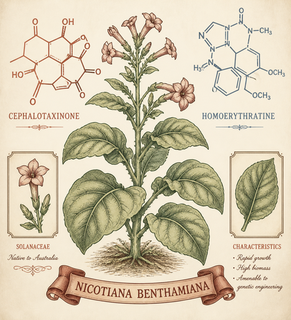
Here comes the synthetic biology magic trick: the researchers loaded the finished biosynthetic blueprint into Nicotiana benthamiana—basically, the plant world’s version of an indie garage band, famous for being flexible, easygoing, and genetically hackable.
Suddenly, you’ve got everyday plants stepping up to synthesize cephalotaxinone and homoerythratine, skipping the part where endangered trees get the short end of the stick (or, technically, root). One day, the “farm to pharma” pipeline could let us grow these complex medicines, rain or shine, in a controlled, eco-friendly setup instead of a wild forest chase.
What’s the Real-World Impact? Plant-Powered Hope
Sure, this all sounds cool—if you’re the kind of person who has a favorite coenzyme (NADPH, am I right?). But let’s talk big picture:
- Solving the supply bottleneck for life-saving drugs.
- Protecting biodiversity by unshackling medicine from rare plants.
- Sharpening our enzyme toolkits so future researchers can remix nature’s blueprints and bioengineer new therapies.
It’s a win for patients, a win for conservation, and, frankly, a win for plant enzymes that have long been typecast as background characters in the leafy sitcom of life.
Bringing the Science Home (and Maybe Into a Houseplant?)
Here’s where it gets quirky: who’s to say the future of cancer medicine won’t come from a window box of genetically remixed tobacco? We’re on the verge of being able to custom-order complex natural compounds from friendly plant hosts, just like one-click shopping, but for your immune system (“Alexa, brew me up 10 mg of alkaloid, stat!”).
Still, don’t go pouring Miracle-Gro on your ficus and expecting chemo drugs to sprout by Thursday. This research is at the proof-of-concept stage, but given how fast synthetic biology is moving, you might want to keep an eye on your basil anyway.
Further Reading and References
-
Tian, R., Lin, F., Guo, N., et al. Complete biosynthesis of the anticancer cephalotaxinone and homoerythratine. Cell. 2026. https://doi.org/10.1016/j.cell.2026.06.007
-
Maresh, J. J., et al. (2023). "Plant Alkaloid Biosynthesis: Pathways, Enzyme Discovery and Synthetic Biology Approaches." Nature Reviews Molecular Cell Biology, 24(1), 18-34. https://doi.org/10.1038/s41580-022-00499-1
-
Olivares, A. M., et al. (2022). "Synthetic Biology for the Sustainable Production of Plant Natural Products." Annual Review of Chemical and Biomolecular Engineering, 13, 163-186. PMC9379312
-
Akdemir, Z. H., et al. (2021). "Cytochrome P450 Enzymes in Natural Product Biosynthesis: Structure, Mechanism, and Engineering." Chemical Reviews, 121(2), 362-432. https://doi.org/10.1021/acs.chemrev.0c00456
-
White, J. S., et al. (2024). "The Next Generation of Plant-Based Pharmaceuticals." Trends in Pharmacological Sciences, 45(3), 220-233. https://doi.org/10.1016/j.tips.2023.12.006
Disclaimer: The image accompanying this article is for illustrative purposes only and does not depict actual experimental results, data, or biological mechanisms.