1999: pathologists finally agree on a name for tiny precancerous pancreatic duct lesions, PanINs. 2021-2025: single-cell and spatial transcriptomics start letting scientists map tumors like suspicious little cities. 2026: Zhuo and colleagues report the rude plot twist: pancreatic cancer may become invasive by hijacking a wound-healing program that normally helps skin close a cut.
That is annoying, biologically elegant, and very pancreatic cancer.
The standard story has been that pancreatic ductal adenocarcinoma, or PDAC, becomes deadly as mutations pile up, cells go rogue, and the tumor microenvironment turns into a fibrotic bunker with terrible customer service. True enough. But this new Cancer Cell paper argues that one important step may be less “cells forget who they are” and more “cells remember a repair program at exactly the wrong time” (Zhuo et al., 2026).
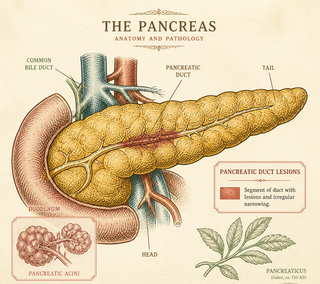
The Weird Part: Lots of People Have the Seeds
PanINs are microscopic precancerous duct lesions. They are common, often quiet, and mostly not the beginning of an action movie. Reviews estimate they can be surprisingly abundant in normal adult pancreas tissue, while PDAC itself remains much rarer (Mannucci and Goel, 2025). That mismatch has always been the eyebrow-raiser.
If PanINs are everywhere, why is invasive pancreatic cancer not everywhere too?
The usual answer is “more mutations.” Again, not wrong. KRAS mutations often show up early; loss of tumor suppressors such as TP53, CDKN2A, and SMAD4 helps remove the brakes. But Zhuo’s team asked a sharper question: what does a PanIN cell actually do when it crosses the line from duct-bound nuisance to invasive menace?
Their answer: it turns on a conserved epithelial program called MP10.
Not EMT, But “Emergency Paving Crew”
Cancer biology loves epithelial-to-mesenchymal transition, or EMT, because it gives tumor cells a cinematic makeover: tidy epithelial cell becomes wandering, invasive troublemaker. Fine. But the MP10 program is not quite that script.
MP10 looks more like re-epithelialization, the process skin cells use at the edge of a wound. When you scrape your knee, nearby epithelial cells migrate, grip, rebuild surface coverage, and generally act like a road crew trying to reopen traffic before anyone from management arrives. They use adhesion machinery, integrins, hemidesmosome components, and metabolic changes to move and repair.
In a wound, this is heroic. In pancreatic ducts, it may be a felony.
Using high-resolution spatial transcriptomics, Zhuo and colleagues found MP10 in invasive cancer cells across human PDAC samples and during PanIN-to-PDAC progression in mice. Rare PanIN cells could switch on MP10 spontaneously, but they also activated tumor suppressor genes, like a cell pressing the accelerator and the brake while sweating through the steering wheel. When those tumor suppressor brakes were lost, the MP10-positive cells invaded surrounding pancreatic tissue.
The driver sitting near the dashboard was FOSL1, a transcription factor in the AP-1 family. Translation: FOSL1 helps flip gene-expression switches. In this setting, it appears to help turn a wound-repair routine into a cancer invasion routine. Biology, apparently, is less “good program versus bad program” and more “same program, terrible venue.”
The Neighborhood Joins the Crime
PDAC is not just cancer cells. It is cancer cells plus dense stroma, immune suppression, fibroblasts, nerves, vessels, collagen, and vibes best described as “abandoned mall after midnight.” Spatial studies have already shown that pancreatic tumors contain distinct cancer and stromal neighborhoods that can shape treatment resistance and immune escape (Steele et al., 2022).
This paper adds a neat, uncomfortable loop. MP10-expressing cancer cells push nearby cancer-associated fibroblasts into a wound-like CTHRC1-high myCAF state. Those fibroblasts then feed back onto the cancer cells through EGFR activation, reinforcing MP10. In other words, the cancer cells start pretending there is a wound, then recruit the local construction crew, then the construction crew keeps handing them permits.
That matters because PDAC has been brutally difficult to treat. Most patients still present late, surgery helps only a minority, and systemic therapies have improved outcomes but not nearly enough (O’Reilly et al., 2021). The tumor’s dense, immunosuppressive microenvironment also makes many therapies bounce off like Nerf darts against concrete.
Why This Could Matter
If MP10 marks the cells that are actually making the leap into invasion, it could help researchers find the dangerous PanINs hiding among the boring ones. That is the dream: not “panic because microscopic lesions exist,” but “identify which lesions are preparing to break curfew.”
Therapeutically, the work points toward several possible pressure points: FOSL1, the MP10 state itself, the CTHRC1-high fibroblast response, or the EGFR feedback loop. None of that means a new treatment is ready. Mice are not people, spatial maps are not clinical trials, and cancer has a long history of reading our grant proposals and choosing violence.
Still, the conceptual shift is useful. Instead of viewing invasion only as cancer becoming more alien, this study suggests PDAC may exploit an ancient, normal repair program. The pancreas is not inventing evil from scratch. It is misusing a tool your body already owns.
That is both sobering and oddly clarifying. Sometimes cancer is not a mad scientist. Sometimes it is a handyman with stolen keys.
References
-
Zhuo M, Li Y, Zhang Y, et al. A conserved re-epithelialization program underlies malignancy in pancreatic ductal adenocarcinoma. Cancer Cell. 2026. doi:10.1016/j.ccell.2026.03.021
-
O’Reilly EM, et al. Pancreatic Cancer: A Review. JAMA. 2021;326(9):851-862. PMCID: PMC9363152. doi:10.1001/jama.2021.13027
-
Steele NG, Carpenter ES, Kemp SB, et al. Spatially restricted drivers and transitional cell populations cooperate with the microenvironment in untreated and chemo-resistant pancreatic cancer. Nature Genetics. 2022;54:1390-1405. doi:10.1038/s41588-022-01157-1
-
Mannucci A, Goel A. Advances in pancreatic cancer early diagnosis, prevention, and treatment: The past, the present, and the future. CA: A Cancer Journal for Clinicians. 2025. PMCID: PMC12788368. doi:10.3322/caac.70035
-
Liu Q, et al. Pancreatic cancer: molecular pathogenesis and emerging therapeutic strategies. Signal Transduction and Targeted Therapy. 2025. doi:10.1038/s41392-025-02499-y
Disclaimer: The image accompanying this article is for illustrative purposes only and does not depict actual experimental results, data, or biological mechanisms.