Training immune cells is a bit like running a gym where half the members are elite athletes and the rest are wandering around holding the dumbbells upside down. In cancer immunity, the elite athletes are type 1 conventional dendritic cells, or cDC1s. They are very good at picking up tumor debris, showing suspicious tumor bits to CD8 T cells, and saying, roughly, "Please remove this nonsense from the premises."
The problem? cDC1s are often rare inside tumors. That is inconvenient, in the same way a fire department with one firefighter and a very inspirational calendar is inconvenient.
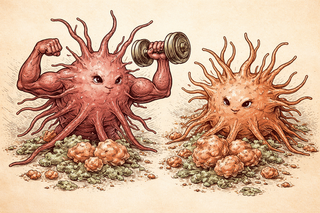
A new Nature Cancer study asks a practical question: if the best immune trainers are scarce, can we recruit the more common cells nearby and teach them the same workout? Castro-Dopico and colleagues tested a strategy that links dead tumor cell material to Fc-gamma receptors, a family of immune receptors that many antigen-presenting cells already carry. In mouse cancer models, that link helped immune cells process dead tumor debris, activate CD8 T cells, and improve tumor control, especially alongside chemotherapy or radiotherapy (Castro-Dopico et al., 2026).
The Corpse Clue
Tumors are messy neighborhoods. Cells die because tumors outgrow their blood supply, because treatment damages them, or because biology enjoys making everything a group project. When cancer cells die, they expose internal scaffolding, including F-actin. Think of F-actin as part of the cell's structural rebar. Usually it stays inside. When it shows up outside, something has gone sideways.
cDC1s have a receptor called DNGR-1, also known as CLEC9A, that recognizes F-actin on dead cells. That helps them collect dead-cell antigens and cross-present them on MHC class I, the display system CD8 T cells use to inspect targets. Cross-presentation is basically immune PowerPoint, except the audience can kill the presenter’s subject matter.
That matters because CD8 T cells do not attack tumors just because tumor proteins exist somewhere in the biological soup. They need those proteins processed and displayed correctly. Antigen presence alone is not enough, which is a nice reminder that cancer biology is where simple explanations go to have a long, uncomfortable meeting.
The New Trick: Bring More Cells Into the Training Room
The researchers built reagents that bridge F-actin from dead tumor cells to Fc-gamma receptors on antigen-presenting cells. One was an Fc-DNGR-1 fusion protein. Another approach used anti-F-actin binding reagents. The basic idea: grab the dead tumor cell clue with one end, engage Fc-gamma receptors with the other, and make nearby immune cells handle the debris in a more useful way.
Why Fc-gamma receptors? Because they are found on several tumor-associated antigen-presenting cells, including cDC2s and monocyte-derived cells. These cells are often much more abundant than cDC1s. They may not naturally be the varsity squad for cross-presenting dead tumor material, but they are standing right there in the tumor microenvironment, wearing the uniform, asking if anyone needs help.
In lab experiments, Fc-DNGR-1 boosted uptake of necrotic cell debris and helped non-cDC1 cells cross-present antigen. In some settings, those cells reached cDC1-like performance. That is the part where my inner skeptic raises an eyebrow, because cells in dishes are famously cooperative compared with cells in actual bodies. But the authors did not stop there.
Mice, Tumors, and the Usual Translation Caveat
In mouse tumor models, Fc-DNGR-1 accumulated near necrotic tumor regions, where Fc-gamma receptor-positive antigen-presenting cells were nearby. When combined with doxorubicin chemotherapy or localized radiation, the treatment improved tumor control. The logic is tidy: chemotherapy and radiotherapy create more dead tumor material; the bridging reagent helps immune cells use that material as training data.
Before anyone prints "cancer solved" on a mug, no. This is preclinical work. Mouse tumors are not human tumors wearing tiny lab coats. Human Fc-gamma receptor biology is complicated, tumors vary wildly, and any therapy that pokes immune activation needs careful safety testing. Also worth noting: several authors have patent and company ties related to this therapeutic concept, which does not invalidate the data, but does mean readers should keep their hype filters plugged in.
Still, the finding is intriguing because it attacks a real bottleneck. Many immunotherapies depend on T cells, but T cells need competent antigen presentation. If a tumor is full of dead cancer-cell evidence and the immune system fails to process it, that is not a lack of clues. That is a detective walking past a crime scene because the paperwork was filed in the wrong drawer.
Why This Could Matter
If this approach translates, it could help turn existing cancer treatments into better immune primers. Chemotherapy and radiation already kill tumor cells. The dream is to make the aftermath more immunologically useful, not just a cleanup operation.
It might also broaden the immune response by helping T cells recognize more tumor antigens. That could matter because tumors evolve. They drop targets, change their molecular outfits, and generally behave like villains who read the script. A broader immune response may make escape harder.
For now, the honest takeaway is this: the study offers a clever way to recruit abundant antigen-presenting cells into a job usually dominated by rare specialists. It is not a therapy yet. It is a persuasive biological argument with mouse data behind it, which is better than a press-release miracle and still several steps short of a clinic-ready answer.
References
-
Castro-Dopico T, Piot C, Buck MD, et al. Coupling dead cell recognition to Fcγ receptors augments anticancer immunity. Nature Cancer. 2026. DOI: 10.1038/s43018-026-01168-5
-
Luri-Rey C, Teijeira Á, Wculek SK, et al. Cross-priming in cancer immunology and immunotherapy. Nature Reviews Cancer. 2025;25:249-273. DOI: 10.1038/s41568-024-00785-5
-
Heras-Murillo I, Adán-Barrientos I, Galán M, et al. Dendritic cells as orchestrators of anticancer immunity and immunotherapy. Nature Reviews Clinical Oncology. 2024;21:257-277. DOI: 10.1038/s41571-024-00859-1
-
Galvez-Cancino F, Simpson AP, Costoya C, et al. Fcγ receptors and immunomodulatory antibodies in cancer. Nature Reviews Cancer. 2024;24:51-71. DOI: 10.1038/s41568-023-00637-8
-
Henry CM, Castellanos CA, Reis e Sousa C. DNGR-1-mediated cross-presentation of dead cell-associated antigens. Seminars in Immunology. 2023;66:101726. DOI: 10.1016/j.smim.2023.101726
-
Lim KHJ, Schulz O, Lobon I, et al. Cross-presentation of dead cell-associated antigens shapes the neoantigenic landscape of tumor immunity. Nature Immunology. 2026;27:72-81. PMCID: PMC12764433. DOI: 10.1038/s41590-025-02354-w
Disclaimer: The image accompanying this article is for illustrative purposes only and does not depict actual experimental results, data, or biological mechanisms.