Scientists got one big thing wrong about DNA repair: we treated it like the helpful cook who always saves dinner, when sometimes it grabs the wrong pot, burns the sauce, and sets off the smoke alarm.
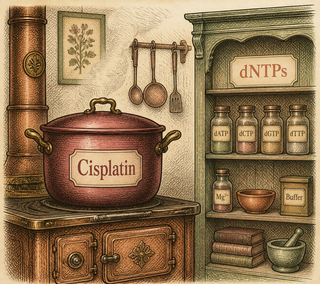
That is the kitchen-table version of a new Cell paper on cisplatin, one of oncology's old workhorse drugs. Cisplatin is very good at ruining cancer's dinner plans. It sticks bulky platinum lumps onto DNA, which is a bit like dropping pebbles into a recipe card. Cells trying to read or copy the recipe stall, panic, and often die. That is useful when the cell is a tumor cell. Less charming when the cell is a neuron you were hoping to keep.
The study by Nathan and colleagues asks a surprisingly practical question: why does a drug built to attack dividing cancer cells also injure neurons, which mostly are not dividing at all? The answer, according to their experiments, is not simply "DNA damage bad." Biology rarely serves anything that tidy. It is more like a potluck where every dish has three hidden ingredients and one aunt refuses to label the casserole.
The Repair Crew Ate the Ingredients
Cells have a repair system called nucleotide excision repair, or NER. Think of NER as a kitchen crew that spots a ruined section of recipe card, cuts out the spoiled strip, and patches in a clean replacement. This is especially handy for bulky DNA damage, including the kind cisplatin makes. In dividing cells, that repair job can be protective.
In neurons, Nathan and colleagues found a plot twist with oven mitts on: NER helps remove cisplatin damage, but it can also push neurons toward death. The problem is supply.
To patch DNA, cells need building blocks called deoxynucleoside triphosphates, or dNTPs. These are the flour, eggs, and butter of DNA repair. Neurons, being long-lived and not especially into cell division, keep relatively small dNTP pantries. When cisplatin damage appears, transcription-coupled NER rushes in first to fix lesions blocking active genes. That burns through the pantry. Then global-genome NER tries to keep repairing damage elsewhere, but the shelves are bare. Half-finished repair can leave dangerous DNA breaks, including double-strand breaks. That is not a burnt cookie. That is the oven door coming off.
Cisplatin Works, But the Side Dish Can Be Rough
Cisplatin and other platinum drugs treat cancers including testicular, ovarian, lung, bladder, head and neck, and others. They have earned their place in the oncology cookbook. But platinum chemotherapy can cause chemotherapy-induced peripheral neuropathy, or CIPN: numbness, tingling, burning pain, balance trouble, and hands or feet that feel like they have been personally insulted by electricity.
Reviews of CIPN describe it as common, sometimes long-lasting, and frustratingly hard to prevent. Current management is still thin soup. ASCO guidelines have found no strong medication option for prevention, and duloxetine remains the best-supported drug for established painful CIPN. That leaves clinicians doing a lot of dose balancing: enough chemotherapy to fight the cancer, not so much nerve injury that the treatment becomes unbearable.
This is why the new paper matters. It moves the story from "cisplatin damages nerves" to a more specific recipe failure: cisplatin damage plus active DNA repair plus low dNTP ingredients equals neuronal danger.
A Pantry Refill, Not a Magic Muffin
Here is the hopeful part, served carefully because nobody should sprint to the supplement aisle wearing a lab coat. In the study, adding deoxynucleosides, the raw ingredients cells can use to rebuild dNTP pools, protected neurons from cisplatin-induced death. Genetic boosting of dNTP synthesis did something similar. In animal models, deoxynucleoside supplementation reduced cisplatin-induced neuropathic pain.
That is a clever idea: do not necessarily block the repair crew, because repair has jobs to do. Instead, restock the pantry so the crew can finish the patch instead of leaving the DNA equivalent of a half-assembled lasagna sliding off the counter.
Still, this is not a proven treatment for patients yet. The next questions are the hard ones. Could nucleoside supplementation protect nerves without protecting tumors? What dose, timing, and mixture would work? Would it interfere with cisplatin's cancer-killing bite? Cancer therapy is already a high-stakes dinner service, and nobody wants to accidentally feed the wrong guest.
Why This Is Such a Neat Mess
The neat part is that the finding connects several loose threads: cisplatin DNA adducts, NER, neuronal vulnerability, and the stubborn reality of CIPN. Earlier work already pointed toward DNA repair and platinum adducts in sensory neurons. Newer reviews have emphasized that CIPN is not one single bad recipe but a whole cookbook of mitochondrial stress, ion channel changes, inflammation, axon injury, and DNA damage.
This paper adds a specific mechanism with a practical handle. Neurons may not die because they ignore DNA damage. They may die because they try to fix it without enough ingredients. That is both elegant and mildly tragic, like a baker who knows exactly how to rescue the cake but has one teaspoon of flour and a deadline.
If these results hold up and translate safely, the real-world impact could be big: fewer patients forced to choose between cancer control and long-term nerve pain, fewer dose reductions, better survivorship, and maybe a new way to protect post-mitotic tissues from chemotherapy damage.
For now, the takeaway is simple enough to fit on a recipe card: cisplatin dents DNA, neurons call in repair, the repair burns through scarce DNA building blocks, and the rescue attempt can become part of the injury. Sometimes the fix needs fixing.
References
-
Nathan WJ, Chen C, Sakr R, et al. DNA repair drives cisplatin-induced neuronal death. Cell. 2026. DOI: 10.1016/j.cell.2026.05.025
-
Acklin S, Xia F. The role of nucleotide excision repair in cisplatin-induced peripheral neuropathy: mechanism, prevention, and treatment. International Journal of Molecular Sciences. 2021;22(4):1975. DOI: 10.3390/ijms22041975. PMCID: PMC7921932
-
Staff NP, Grisold A, Grisold W, Windebank AJ. Chemotherapy-induced peripheral neuropathy: mechanisms and treatment. Neurotherapeutics. 2017;14:332-347. DOI: 10.1007/s13311-017-0527-3
-
Chen X, Gan Y, Au NPB, Ma CHE. Current understanding of the molecular mechanisms of chemotherapy-induced peripheral neuropathy. Frontiers in Molecular Neuroscience. 2024;17:1345811. DOI: 10.3389/fnmol.2024.1345811
-
Loprinzi CL, Lacchetti C, Bleeker J, et al. Prevention and management of chemotherapy-induced peripheral neuropathy in survivors of adult cancers: ASCO guideline update. Journal of Clinical Oncology. 2020;38(28):3325-3348. DOI: 10.1200/JCO.20.01399
Disclaimer: The image accompanying this article is for illustrative purposes only and does not depict actual experimental results, data, or biological mechanisms.