Every cell in your body, if we are honest about it, attends a kind of lifelong school - learning when to grow, when to rest, and most poignantly, when to die gracefully so that the larger organism may continue. Apoptosis was the valedictorian of that school for decades, the tidy, well-behaved death we all studied in textbooks. But there is a newer student in the back of the classroom, one with a chemistry-set obsession and a flair for drama, and its name is ferroptosis. A new Review in Nature Reviews Clinical Oncology by Kang, Liu, Wang, Kroemer, and Tang takes the long view on this peculiar pupil, and asks the question every guidance counselor eventually must: can we actually make something of it?
A Death by Rust
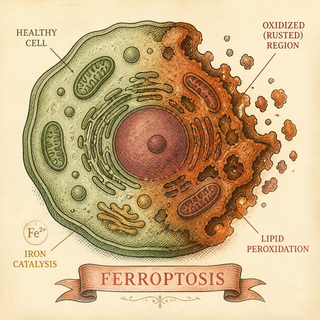
Ferroptosis is, at its heart, a story about iron and fat and the slow violence of oxidation. When a cell's antioxidant defenses falter - particularly a guardian enzyme called GPX4 - iron-fueled chemistry runs amok, and the membranes that hold the cell together begin to peroxidize, which is the elegant scientific word for "go rancid like olive oil left open on the counter." The cell, quite literally, rusts itself to death. There is something almost philosophical in this: a body undone not by a clean executioner's blade but by the gradual corruption of the very fats meant to keep it intact.
Naturally, oncologists got curious. Cancer cells are immortal little freeloaders that have spent their careers learning to dodge the ordinary mechanisms of death. So a death pathway they haven't fully figured out how to evade? That sounds like the chink in the armor we have been hunting for since roughly forever.
The Student Who Switches Sides
Here is where the report earns its existential melancholy. Ferroptosis, it turns out, refuses to pick a team. Depending on the cellular context and the stage of the tumor's life story, it can suppress cancer or, with the same shrug of indifference, help it along. Early on, ferroptosis may police would-be tumor cells out of existence. Later, in the sketchy back-alley economy of the tumor microenvironment, the dying cells can release signals that recruit the wrong crowd and actually grease the wheels of metastasis. It is the biological equivalent of the honor student who tutors freshmen by day and runs a counterfeiting ring by night. We wanted a hero; we got a complicated character study.
This duality is precisely why turning ferroptosis into a drug has proven so stubbornly difficult, and the Review is admirably unflinching about the gap between the laboratory and the clinic.
Why Graduation Keeps Getting Postponed
Despite a tidal wave of preclinical papers - and ferroptosis has been one of the hottest topics in cell biology since Brent Stockwell's lab coined the term back in 2012 - almost none of it has crossed into actual patient care. The authors lay out the reasons with a clarity that borders on tough love. The would-be ferroptosis-inducing drugs are pharmacologically clumsy, with poor stability and the kind of bioavailability that makes a chemist weep. Tumors are maddeningly heterogeneous, so a vulnerability in one cell may be absent in its neighbor. The immune system and the microenvironment impose their own constraints. And the mouse models we lean on capture only a cartoon version of the human disease.
The opportunities, though, are real, and this is where the piece stops scolding and starts dreaming. Newer, more drug-like ferroptosis inducers are emerging. Biomarkers might let us select the patients whose tumors are genuinely susceptible rather than spraying the therapy at everyone and hoping. And ferroptosis appears to play unexpectedly well with others - radiotherapy, certain targeted agents, and especially immunotherapy, where dying tumor cells can sometimes wake up a sluggish immune response.
The Long Lesson
What I find quietly moving about this Review is its refusal to oversell. Cancer biology has a bad habit of promising miracles every Tuesday, and ferroptosis has had more than its share of breathless hype. Instead, the authors offer a translational roadmap - a syllabus, really - for turning a fascinating piece of cell biology into something that helps a person sitting in an infusion chair. As Camus might have noted, one must imagine the ferroptosis researcher happy, patiently rolling the boulder of clinical translation up the hill, fully aware of how the slope behaves.
Whether this particular student graduates remains beautifully, frustratingly unwritten.
Disclaimer: The image accompanying this article is for illustrative purposes only and does not depict actual experimental results, data, or biological mechanisms.
References
- Kang, R., Liu, J., Wang, J., Kroemer, G., & Tang, D. (2026). Translating ferroptosis into oncology: challenges, opportunities and future directions. Nature Reviews Clinical Oncology. DOI: 10.1038/s41571-026-01128-z - PMID: 41735603
- Jiang, X., Stockwell, B. R., & Conrad, M. (2021). Ferroptosis: mechanisms, biology and role in disease. Nature Reviews Molecular Cell Biology, 22, 266-282. DOI: 10.1038/s41580-020-00324-8 - PMCID: PMC8142022
- Lei, G., Zhuang, L., & Gan, B. (2022). Targeting ferroptosis as a vulnerability in cancer. Nature Reviews Cancer, 22, 381-396. DOI: 10.1038/s41568-022-00459-0 - PMCID: PMC9514498
- Stockwell, B. R. (2022). Ferroptosis turns 10: Emerging mechanisms, physiological functions, and therapeutic applications. Cell, 185, 2401-2421. DOI: 10.1016/j.cell.2022.06.003 - PMCID: PMC9258806