Good immunotherapy is a little like making risotto: everyone talks about the rice, but the whole thing lives or dies by heat, timing, patience, and whether somebody wandered away to check their phone.
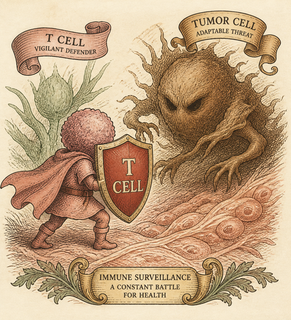
That is the useful irritation at the heart of Zhang and colleagues' new review on immune checkpoint blockade in melanoma. The headline story is familiar: drugs that block CTLA-4, PD-1, PD-L1, and newer checkpoints can wake up T cells and help them attack melanoma. Lovely. Nobel Prize energy. Tiny bodyguards finally reading the security memo.
But the less tidy story is where the action is. Some patients respond dramatically. Some do not respond at all. Some respond, then relapse, because cancer cells are not so much villains twirling mustaches as interns with terrible ethics and excellent adaptability. The review argues that the next era of melanoma treatment will not be "more checkpoint blockade for everyone." It will be smarter combinations, better timing, and personalization that treats each tumor like the weird little ecosystem it is Zhang et al., 2026.
The Immune System Has Brakes For A Reason
Your immune system is supposed to be aggressive, but not unhinged. T cells need signals that say "attack" and signals that say "maybe do not vaporize the pancreas today." Immune checkpoints are part of that restraint system.
Melanoma can exploit those checkpoints. PD-L1 on tumor or nearby cells can bind PD-1 on T cells and send a sleepy little "stand down" message. CTLA-4 can limit early T-cell activation. LAG-3, TIM-3, TIGIT, VISTA, and other molecules join the cast like an overstuffed prestige drama where every character has a secret.
Checkpoint inhibitors block some of these off-switches. Ipilimumab targets CTLA-4. Nivolumab and pembrolizumab target PD-1. Relatlimab targets LAG-3. In plain English: these drugs do not poison melanoma directly. They argue with the immune system's bureaucratic paperwork so T cells can get back into the building.
The Big Win, And The Raised Eyebrow
The win is real. Ten-year CheckMate 067 results showed durable survival gains with nivolumab plus ipilimumab in advanced melanoma, a disease that used to behave like a door slamming shut Wolchok et al., 2024. RELATIVITY-047 added another checkpoint target, showing that nivolumab plus relatlimab improved progression-free survival versus nivolumab alone in untreated advanced melanoma Tawbi et al., 2022.
Now for the eyebrow: if taking off one brake helps, why not remove every brake and let the immune system floor it?
Because bodies are not video games. Combination immunotherapy can bring more immune-related side effects: colitis, hepatitis, endocrinopathies, skin problems, and other reminders that "activate immunity" is not a casual weekend hobby. The immune system is less like a golden retriever and more like a chainsaw with opinions.
Timing May Be The Sneaky Trick
One of the most interesting shifts is neoadjuvant therapy, giving immunotherapy before surgery. That may sound backward at first. Why treat before removing the tumor?
Because the tumor can act like a training camp for immune cells. While it is still present, T cells can learn what to recognize. The NADINA phase 3 trial found that neoadjuvant nivolumab plus ipilimumab improved event-free survival compared with surgery followed by adjuvant nivolumab in resectable stage III melanoma Blank et al., 2024. Translation: sometimes you do not just want to evict the tumor. You want the immune system to inspect the crime scene first.
That does not mean every patient should get the same pre-surgery cocktail. It means timing belongs in the treatment conversation, not as garnish but as a main ingredient.
The Tumor Neighborhood Is Sketchier Than We Hoped
Zhang and colleagues also emphasize the tumor microenvironment, which is science-speak for "the neighborhood around the tumor, including immune cells, blood vessels, fibroblasts, cytokines, and assorted molecular nonsense." In melanoma, that neighborhood can decide whether T cells stroll in confidently or get locked outside with a clipboard.
Resistance can come from tumor mutations, poor antigen presentation, T-cell exhaustion, suppressive macrophages, regulatory T cells, gut microbiome effects, and alternate checkpoints stepping in after PD-1 blockade. Reviews on resistance keep arriving because melanoma is annoyingly good at not reading our treatment plans Jalil et al., 2024.
This is why biomarkers matter. PD-L1 expression, tumor mutational burden, interferon-gamma signatures, circulating tumor DNA, immune-cell patterns, and microbiome signals may help guide therapy. None is perfect. Biology rarely hands us a clean dashboard light. It prefers jazz.
What This Could Mean For Patients
If this field keeps moving, melanoma care could become less like picking from a short menu and more like matching the meal to the kitchen, ingredients, allergies, and whether the stove is currently on fire.
The practical dream is simple: give intense combination therapy to patients who need it, spare others avoidable toxicity, use surgery at the smartest moment, and identify resistance early enough to switch strategies before the tumor starts redecorating. That is not just elegant science. That is fewer wasted months, fewer brutal side effects, and more patients getting back to ordinary life, which remains the best clinical endpoint no spreadsheet can fully capture.
The contrarian lesson is this: checkpoint blockade did not "solve" melanoma. It exposed melanoma as solvable in some people, under some immune conditions, with the right pressure at the right time. That is messier than a miracle. It is also more useful.
References
-
Zhang Q, Yuan C, Zhu L, Zheng S, Xu Y, Che X, et al. Insight of immune checkpoint blockades in melanoma: mechanism and clinical translation. Molecular Cancer. 2026. DOI: 10.1186/s12943-026-02694-7
-
Wolchok JD, Chiarion-Sileni V, Gonzalez R, et al. Final, 10-Year Outcomes with Nivolumab plus Ipilimumab in Advanced Melanoma. New England Journal of Medicine. 2024. DOI: 10.1056/NEJMoa2407417
-
Blank CU, Lucas MW, Scolyer RA, et al. Neoadjuvant Nivolumab and Ipilimumab in Resectable Stage III Melanoma. New England Journal of Medicine. 2024;391:1696-1708. DOI: 10.1056/NEJMoa2402604
-
Tawbi HA, Schadendorf D, Lipson EJ, et al. Relatlimab and Nivolumab versus Nivolumab in Untreated Advanced Melanoma. New England Journal of Medicine. 2022;386:24-34. DOI: 10.1056/NEJMoa2109970
-
Jalil A, Donate MM, Mattei J. Exploring resistance to immune checkpoint inhibitors and targeted therapies in melanoma. Cancer Drug Resistance. 2024;7:42. DOI: 10.20517/cdr.2024.54
Disclaimer: The image accompanying this article is for illustrative purposes only and does not depict actual experimental results, data, or biological mechanisms.