Non-small cell lung cancer, or NSCLC, is the common, broad category that includes most lung cancers. It is not one tidy disease. It is more like a badly planned hospital wing added onto an older building by contractors who communicate mostly through smoke signals.
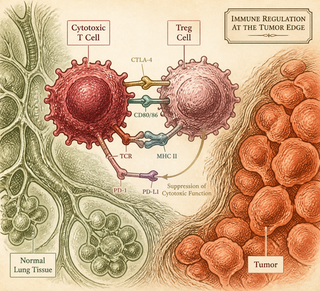
The immune system tries to patrol this structure. Cytotoxic T cells can recognize and kill cancer cells. Other immune cells bring signals, reinforcements, and sometimes chaos. The tumor microenvironment - the tumor plus its surrounding blood vessels, immune cells, fibroblasts, chemical signals, and assorted biological scaffolding - becomes a sketchy neighborhood with excellent zoning loopholes.
Tregs matter here because they suppress immune attack. That is lovely if you are preventing autoimmune mayhem. It is less lovely if a tumor is using them as velvet ropes to keep killer T cells out of the executive lounge. Reviews in cancer immunology have repeatedly pointed to Tregs as major players in tumor immune escape and immunotherapy resistance (Kumagai et al., 2024; Oliveira and Wu, 2023).
A Blood Test With a Microscope's Soul
In the new study, Liu and colleagues used single-cell RNA sequencing and spatial transcriptomics to look for Treg states in NSCLC with unusual precision (Liu et al., 2026; PMCID: PMC13230995). Single-cell RNA sequencing asks, cell by cell, "Which genes are you using right now?" It is less like reading a building blueprint and more like walking room to room, checking which lights are on, which machines are humming, and which intern left the centrifuge running.
The group built a system called regional overlap-expression rate, or rOER. Mercifully, we need not embroider that acronym onto a lab coat. The idea is practical: instead of trusting one marker gene, they used marker gene panels to decide whether a T cell subtype was truly specific to a disease, tissue, or time point.
Their standout finding was a circulating Treg subtype/state they call Treg fci, defined mainly by the gene marker trio FOXP3, CTLA4, and IL2RA. These are familiar Treg-associated genes, but the combination, context, and validation made the subtype behave like a recognizable biological tenant, not merely three names on a mailbox.
The Cell That Showed Up Before Surgery
Here is the part that makes a pathologist sit up slightly, which in our profession counts as a cartwheel.
Treg fci appeared enriched in blood before surgery and in NSCLC tissue. After tumor removal, it decreased or disappeared. That suggests the tumor may help maintain or attract this Treg state, rather than the cell simply wandering through town with no destination.
Spatial analysis added a handsome bit of geography. Treg fci was found near the interface between tumor and normal lung tissue, plus smaller specialized micro-niches. That border zone matters. Tumors invade at edges. Immune cells negotiate there. It is the construction fence where the illicit renovation meets the old masonry.
This fits a broader lesson from T cell biology: location changes meaning. A T cell in blood, lymph node, tumor core, or invasive edge may carry the same broad job title but behave differently because the local tissue gives different orders (Schenkel and Pauken, 2023).
ETS1, the Foreman With a Clipboard
The study also highlights ETS1, a transcription factor. Transcription factors are proteins that help decide which genes get turned on. If DNA is the building code, transcription factors are the people with stamps, clipboards, and suspiciously strong opinions about load-bearing walls.
ETS1 was upregulated in Treg fci. The authors tested it using knockdown, knockout, and inhibitor experiments, including human peripheral blood cells and mouse models. Their results suggest ETS1 helps shape the Treg fci program and may aid movement from circulation into tumor tissue through cancer-cell-derived attraction signals. The study also links ETS1 with metabolic and mitochondrial changes, which is a polite way of saying the cell's power plant and fuel budget may be part of the story.
That is not trivial. Immune cells do not merely decide what they are. They must afford it metabolically. Even tiny bodyguards need lunch.
Why This Could Matter
If these results hold up in larger, independent cohorts, Treg fci could become useful in two ways.
First, it might be a blood-based marker of tumor-immune activity in NSCLC. Blood is easier to sample than lung tissue, and patients generally prefer needles to repeat biopsies, a preference I regard as anatomically sound.
Second, ETS1 and the Treg fci program might offer therapeutic angles. Not "tomorrow morning, new cure, please form a line." More like: here is a better map of a suppressive immune circuit that may help tumors resist attack. In oncology, a better map is not a small thing. Many treatments fail because we attacked the visible wall while the wiring quietly rerouted itself behind the plaster.
The caution is straightforward. This is sophisticated biology, not a ready-made clinical test. Single-cell methods are expensive, computationally demanding, and prone to interpretive exuberance if handled without discipline. The authors know this and built their rOER framework partly to address reproducibility and specificity. Still, the finding needs broader validation across stages, treatments, populations, and real-world clinical workflows.
For now, Treg fci gives us a sharper view of how lung tumors may recruit immune restraint from the bloodstream and position it at the tumor's working edge. Cancer, as ever, is not just a lump of bad cells. It is a renovation project with forged permits, compromised inspectors, and a remarkable talent for hiding the exits.
References
-
Liu X, Liu Y, Duan W, et al. Single-cell identifies and validates human circulating Treg subtype/state Treg fci in non-small cell lung cancer. Signal Transduction and Targeted Therapy. 2026;11:211. DOI: 10.1038/s41392-026-02677-6. PMCID: PMC13230995.
-
Kumagai S, Itahashi K, Nishikawa H. Regulatory T cell-mediated immunosuppression orchestrated by cancer: towards an immuno-genomic paradigm for precision medicine. Nature Reviews Clinical Oncology. 2024;21:337-353. DOI: 10.1038/s41571-024-00870-6.
-
Schenkel JM, Pauken KE. Localization, tissue biology and T cell state: implications for cancer immunotherapy. Nature Reviews Immunology. 2023;23:807-823. DOI: 10.1038/s41577-023-00884-8.
-
Oliveira G, Wu CJ. Dynamics and specificities of T cells in cancer immunotherapy. Nature Reviews Cancer. 2023;23:295-316. DOI: 10.1038/s41568-023-00560-y.
-
Luo Y, Xu C, Wang B, et al. Single-cell transcriptomic analysis reveals disparate effector differentiation pathways in human Treg compartment. Nature Communications. 2021;12:3913. DOI: 10.1038/s41467-021-24213-6.
Disclaimer: The image accompanying this article is for illustrative purposes only and does not depict actual experimental results, data, or biological mechanisms.