Pancreatic ductal adenocarcinoma, or PDAC, is one of cancer biology's grimmest little habitats. It is hard to catch early, hard to treat once found, and still carries an overall five-year survival of about 13% in recent U.S. estimates. In wildlife-documentary terms, this is not a lush meadow. It is a drought-struck plain where very few things go right for the creature trying to survive.
The new paper from Milcarek and colleagues adds a strange and rather elegant twist to that story: some pancreatic tumors appear to profit from damaged mitochondria, the tiny energy-producing structures inside cells, by letting those mitochondria leak double-stranded RNA, or dsRNA [1]. dsRNA is the sort of molecular object your cells usually treat like a home invasion. Viruses often make it, so the immune system evolved several alarms for it.
Two of those alarms are TLR3 and RIG-I. TLR3 sits in internal cellular compartments and recognizes dsRNA brought into the endosomal system. RIG-I patrols the cytoplasm looking for suspicious RNA species. Under normal circumstances, this is useful. Your cells see dsRNA, panic in an organized way, and start broadcasting inflammatory signals to contain a threat [2,3]. Sensible behavior, honestly.
But cancer is a master of taking sensible biology and turning it into a deeply annoying loophole.
The tumor learns a nasty party trick
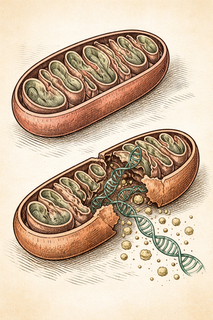
In this study, the trouble begins with low levels of Mic60, a protein that helps maintain mitochondrial structure. When Mic60 drops, the mitochondria become structurally defective, and dsRNA escapes from them [1]. That escape activates TLR3 and RIG-I, which then switch on NF-kB signaling and the production of inflammatory factors such as TNF-alpha. Instead of killing the tumor, that inflammatory program appears to help PDAC cells proliferate.
That is the plot twist. The cell pulls the fire alarm, but the tumor uses the chaos to open a new checkout lane.
This is particularly interesting because "viral mimicry" in cancer can cut both ways. In some settings, endogenous dsRNA wakes up antitumor immunity and makes tumors more vulnerable to treatment. A 2023 PDAC study found that higher METTL3 increased endogenous dsRNA signaling through RIG-I-like receptors and actually suppressed pancreatic tumor progression [4]. Another 2024 study showed that satellite dsRNA can push pancreatic cancer cells toward a more invasive, mesenchymal state by rewiring RNA splicing [5]. So dsRNA is not one simple villain or hero. It is more like a raccoon with access to the electrical panel. Context matters, and context in cancer matters a lot.
Milcarek and colleagues also report something therapeutically useful: blocking this mitochondrial dsRNA signaling caused rapid cell death and slowed tumor growth in Mic60-low PDAC models, without obvious toxicity in mice [1]. That last part is the bit that makes researchers sit up straighter on their lab stools.
Why this matters in the real world
Pancreatic cancer has a dense, hostile tumor microenvironment and a long history of shrugging at therapies that work better elsewhere [6]. Inflammation is part of that story, but inflammation in PDAC is not a clean, noble immune crusade. It often behaves more like a sketchy neighborhood watch that somehow ends up helping the burglars.
So this paper matters for two reasons.
First, it identifies a subset of tumors with a possible weakness. If a patient's PDAC is "Mic60-low," that tumor may rely on this dsRNA-TLR3-RIG-I inflammatory circuit to keep growing. That opens the door to biomarker-guided treatment instead of the usual one-size-fits-nobody chaos.
Second, it reminds us that mitochondria are not just batteries with good branding. They are signaling hubs, emergency beacons, and occasionally tiny saboteurs. Earlier work from the same research orbit had already linked poor mitochondrial "fitness" and low Mic60 signatures to aggressive pancreatic cancer and worse outcomes [7]. This new paper gives that story sharper teeth by showing a mechanism: broken mitochondria release a viral-looking signal, and the tumor turns that signal into fertilizer.
There is, of course, a large step between "worked in preclinical models" and "helps actual patients." Pancreatic cancer has buried many beautiful ideas in the sand. We do not yet know how broadly this applies across PDAC, how best to target the pathway, or whether blocking it will pair well with chemotherapy or immunotherapy. The body is also fond of reusing its own alarm systems for multiple jobs, which means drugging them can get messy fast.
Still, this is one of those studies that makes the landscape look a little less random. The researchers did not just say pancreatic tumors are inflamed. They traced one source of the commotion back to damaged mitochondria and showed that the racket may be targetable.
And out on the cellular savannah, that counts as a meaningful sighting.
References
-
Milcarek AT, Ye M, Esposito C, et al. Mitochondrial double-stranded RNA fuels pancreatic cancer growth via RIG-I/TLR3 inflammation. Proc Natl Acad Sci U S A. 2026;123(18):e2528281123. DOI: 10.1073/pnas.2528281123. PubMed: https://pubmed.ncbi.nlm.nih.gov/42048448/
-
Orlacchio A, Mazzone P. The Role of Toll-like Receptors (TLRs) Mediated Inflammation in Pancreatic Cancer Pathophysiology. Int J Mol Sci. 2021;22(23):12743. DOI: 10.3390/ijms222312743. PMCID: PMC8657588
-
Jiang Y, Zhang H, Wang J, et al. Exploiting RIG-I-like receptor pathway for cancer immunotherapy. J Hematol Oncol. 2023;16(1):8. DOI: 10.1186/s13045-023-01405-9
-
Zhu L, Li B, Li R, et al. METTL3 suppresses pancreatic ductal adenocarcinoma progression through activating endogenous dsRNA-induced anti-tumor immunity. Cell Mol Immunol. 2023;46(5):1529-1541. DOI: 10.1007/s13402-023-00829-2. PubMed: https://pubmed.ncbi.nlm.nih.gov/37178367/
-
Iwata T, Kishikawa T, Seimiya T, et al. Satellite double-stranded RNA induces mesenchymal transition in pancreatic cancer by regulating alternative splicing. J Biol Chem. 2024;300(3):105742. DOI: 10.1016/j.jbc.2024.105742. PMCID: PMC10943486
-
Finan JM, Guo Y, Goodyear SM, Brody JR. Challenges and Opportunities in Targeting the Complex Pancreatic Tumor Microenvironment. JCO Oncol Adv. 2024;1:e2400050. DOI: 10.1200/OA-24-00050. PMCID: PMC11670921
-
Kossenkov AV, Milcarek A, Notta F, et al. Mitochondrial fitness and cancer risk. PLoS One. 2022;17(10):e0273520. DOI: 10.1371/journal.pone.0273520. PMCID: PMC9555630
Disclaimer: The image accompanying this article is for illustrative purposes only and does not depict actual experimental results, data, or biological mechanisms.