The self-checkout machine says “unexpected item in bagging area,” and suddenly you are trapped in a philosophical dispute with a scale. Cancer therapy has its own version of this nonsense: a drug can arrive at the tumor cell, recognize the right target, and still fail because the cell basically refuses to let it through the door.
That is the oddly practical drama behind ICARUS-LUNG01, discussed by Sun and colleagues in Cancer Cell: how do we predict whether datopotamab deruxtecan actually gets inside non-small cell lung cancer cells and does its job? Because in antibody-drug conjugate land, delivery is not a vibe. It is the whole plot.
Tiny Guided Missiles, Annoying Door Policies
Datopotamab deruxtecan, mercifully shortened to Dato-DXd, is an antibody-drug conjugate, or ADC. Think of an ADC as a tiny courier with a very toxic package. The antibody part looks for a tumor-associated marker, in this case TROP2, and the attached payload is a chemotherapy-like topoisomerase I inhibitor. Ideally, the courier docks at the cancer cell, gets internalized, releases the payload, and the tumor cell has a deeply unpleasant afternoon.
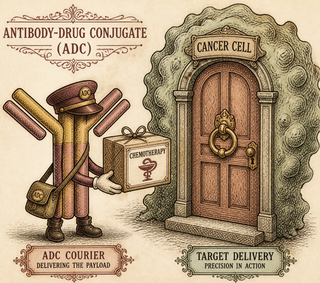
ADCs are often described as “smart chemotherapy,” which is fair, although I always imagine chemotherapy wearing reading glasses and saying, “Actually, I have a targeting ligand now.” The key difference is that ADCs try to concentrate the toxic drug in tumor cells rather than spraying the whole neighborhood.
TROP2 makes sense as a target because many epithelial cancers, including lung cancers, express it. But ICARUS-LUNG01 highlights the part that makes biomarker people clutch their coffee: having TROP2 on the surface may not be enough.
The Target Is There. Great. Now What?
The ICARUS-LUNG01 phase 2 study treated 100 previously treated patients with advanced NSCLC using Dato-DXd and built in serious translational science: tumor biopsies, spatial analyses, genomics, transcriptomics, circulating tumor cells, the works. Scientists poked around in tumor samples, as one does when Tuesday gets ambitious, and asked why some cancers responded while others shrugged.
The clinical signal was real but not magical. Dato-DXd produced responses in about a quarter of patients, with better activity in non-squamous NSCLC than squamous disease. That is meaningful in a heavily pretreated population, but it is also not “everyone wins, roll credits.” Cancer biology remains committed to being the most exhausting group project.
The more interesting part, and yes, I am contractually obligated by my inner grad student to say fascinating, is the biomarker story. The study suggests response depends on more than TROP2 abundance. It may depend on where TROP2 sits, whether the ADC gets pulled into the cell, and what resistance circuits the tumor flips on afterward.
In plain English: the drug can find the address, but the cancer cell still has to open the door.
Internalization: The Cellular Bouncer Problem
Internalization is the process where the cell takes in the antibody-drug complex. For Dato-DXd, that matters because the payload needs to end up inside the cell to be released efficiently. If the ADC binds but does not internalize well, the whole operation starts to look like a delivery driver leaving a chemotherapy burrito on the porch.
Recent preclinical work on TROP2 biology supports this idea: TROP2 membrane expression appears necessary for Dato-DXd activity, but not sufficient, and computational pathology measures such as TROP2 normalized membrane ratio may better capture whether the target is arranged in a way that predicts internalization and drug effect.
That is a big deal because oncology has a long history of biomarkers that look wonderfully clean on slides and then behave like feral spreadsheets in patients. ICARUS-LUNG01 is trying to move beyond “is the marker present?” toward “is the marker biologically useful for this specific drug?”
Why This Could Matter in Real Life
If these findings hold up in larger studies, they could help clinicians choose Dato-DXd for patients whose tumors are more likely to benefit, while sparing others a treatment that may bring side effects without much payoff. That matters because ADCs are targeted, not harmless. Interstitial lung disease, stomatitis, nausea, eye issues, and other toxicities still show up to the party uninvited.
This research also points toward smarter combinations. If resistance involves DNA repair activation or changes in the immune microenvironment, future strategies might pair ADCs with drugs that block those escape routes. Tumors are cellular rebels with backup plans. Annoying? Yes. Potentially targetable? Also yes.
The Necessary Wet Blanket Section
Limitations, because I have survived journal club and learned fear: ICARUS-LUNG01 was a phase 2 study with 100 patients, biomarker findings need validation, and “predictive” is a word we should use carefully until prospective testing proves it. Also, ADC biology can vary by tumor type, histology, prior treatments, and assay methods. The same target can behave differently depending on the cellular neighborhood, because apparently cancer cells read zoning law.
Still, the study pushes the field in a useful direction. It asks not just whether Dato-DXd works, but why, for whom, and how tumors dodge it. That is where oncology needs to go if ADCs are going to become more than fancy toxic payloads with good branding.
References
-
Sun H, Zhao S, Li J, Zhang L. Targeting internalization, resistance, and response: Insights from ICARUS-LUNG01. Cancer Cell. 2026. DOI: 10.1016/j.ccell.2026.03.001
-
Planchard D, et al. Efficacy, safety, and biomarker analysis of datopotamab deruxtecan in advanced non-small cell lung cancer: ICARUS-LUNG01 phase 2 study. Cancer Cell. 2026. DOI: 10.1016/j.ccell.2026.03.017
-
Ahn MJ, Tanaka K, Paz-Ares L, et al. Datopotamab deruxtecan versus docetaxel for previously treated advanced or metastatic non-small cell lung cancer: The randomized, open-label phase III TROPION-Lung01 study. Journal of Clinical Oncology. 2025;43:260-272. DOI: 10.1200/JCO-24-01544
-
Belluomini L, Avancini A, Sposito M, Milella M, Rossi A, Pilotto S. Antibody-drug conjugates targeting TROP-2 in lung cancer. Expert Opinion on Biological Therapy. 2023;23:1077-1087. DOI: 10.1080/14712598.2023.2198087
-
Passaro A, et al. Antibody-drug conjugates in lung cancer: dawn of a new era? NPJ Precision Oncology. 2023. DOI: 10.1038/s41698-022-00338-9
Disclaimer: The image accompanying this article is for illustrative purposes only and does not depict actual experimental results, data, or biological mechanisms.