This study reads like a molecular heist movie: the researchers did not just dust the crime scene, they followed the getaway car from the first biopsy to recurrence, checked the tire tracks, subpoenaed the getaway driver’s genome, and then asked every cell what it was wearing that night.
The culprit is IDH-mutant glioma, a brain tumor that often shows up in younger adults, can grow slowly for years, and still has the deeply rude habit of coming back after surgery, radiation, and chemotherapy. In trial language, recurrence is not a quirky secondary endpoint. It is the problem.
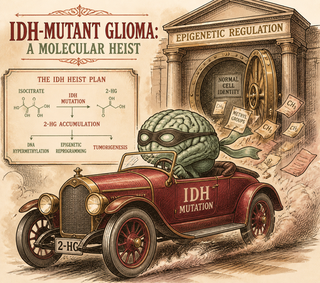
IDH stands for isocitrate dehydrogenase, an enzyme that normally helps cells run metabolism without making a mess in the break room. When IDH1 or IDH2 mutates, the enzyme starts producing 2-hydroxyglutarate, a chemical that can scramble gene regulation and nudge cells into cancer-friendly states. That is one reason IDH-mutant gliomas are biologically distinct, and why drugs like vorasidenib, an IDH inhibitor, have recently changed the clinical conversation for some lower-grade tumors Ruda et al., 2024; Mellinghoff et al., 2023.
The Methods Section Has an Alibi
Johnson and colleagues studied 75 tumor samples from 35 patients, including both major IDH-mutant glioma types: astrocytoma and oligodendroglioma. Importantly, these were temporally separated samples, meaning the team could compare earlier tumors with later recurrent ones from the same patient. That is the good stuff. Cross-sectional studies are useful, but longitudinal samples are where cancer evolution stops waving vaguely and starts leaving fingerprints.
The researchers combined single-nucleus RNA sequencing, single-nucleus chromatin accessibility profiling, and bulk DNA/RNA sequencing Johnson et al., 2026. Translation: they looked at what individual tumor cell nuclei were doing, what genes were physically open for business, and what new genetic damage the tumor picked up over time. Somewhere, a data monitoring committee just nodded quietly.
Tumor Cells Have Career Paths, Sadly
The big finding: as IDH-mutant gliomas progress, many tumor cells become less differentiated and more proliferative. Differentiated cells are like employees with job descriptions. Less differentiated cells are interns with badge access and no supervision. They can be more flexible, more stem-like, and harder to pin down therapeutically.
The team identified malignant cell states resembling normal brain developmental lineages: oligodendrocyte progenitor-like, astrocyte-like, neural progenitor-like, mesenchymal-like, cycling, and undifferentiated states. With increasing grade and recurrence, the tumors tended to lose astrocyte-like differentiation and gain undifferentiated, neural progenitor-like, cycling, and mesenchymal-like flavors.
That fits with other recent work showing that IDH-mutant gliomas can shift from slower, progenitor-like programs toward more proliferative neural progenitor-like states during progression Wu et al., 2025. Cancer biology, apparently, is a career ladder where every promotion makes everyone else’s job worse.
Two Ways to Cause Trouble
The study points to two broad progression routes.
First, some tumors acquired genetic changes at recurrence: hypermutation, more copy-number alterations, small deletions, or cell-cycle pathway hits. These tumors were more likely to shift toward reduced differentiation and increased proliferation. In plain English, the tumor picked up new genetic tools and used them to become more aggressive. Not subtle. More “protocol amendment at 11:57 p.m.” than elegant.
Second, mesenchymal-like states increased even when those acquired genetic changes were not obvious. These states tracked more with macrophage-related signals in the tumor microenvironment. Macrophages are immune cells that should help clean up trouble, but inside tumors they can become suspiciously cooperative, like security guards who keep holding the door open for the burglars. Recent glioma work has shown how myeloid cells can adopt immunosuppressive programs shaped by the local tumor environment Miller et al., 2025.
That distinction matters. Some progression may be driven by tumor-intrinsic genetic evolution. Some may be driven by the neighborhood. If you only sequence DNA, you may miss part of the plot.
Why This Could Change the Trial Playbook
For patients, the real-world hope is not that this paper magically cures glioma. It does not. This is not a phase 3 trial, and nobody should start high-fiving the Kaplan-Meier curve until there is a Kaplan-Meier curve.
But it gives trialists and clinicians a sharper map. If recurrent tumors become more stem-like and proliferative after specific genetic events, future trials might stratify patients by those changes. If mesenchymal-like states depend partly on macrophage-rich microenvironments, combinations that target both tumor cells and immune context may deserve a serious look. And if IDH inhibitors can push some tumors toward differentiation, as suggested in oligodendroglioma studies Spitzer et al., 2024, then knowing which cell states remain or escape could help explain response and resistance.
The caveats are real. The cohort required repeat surgeries, which can select for patients healthy enough and tumors accessible enough to resect again. Treatments varied. Spatial heterogeneity can still confuse the story. As every trialist knows, biology loves confounding almost as much as sponsors love optimistic subgroup slides.
Still, this paper does something valuable: it shows that IDH-mutant glioma progression is not just “the tumor got worse.” It is a coordinated shift in genes, cell identity, chromatin, and microenvironment. The tumor is not one villain. It is a crew.
References
-
Johnson KC, Spitzer A, Varn FS, et al. Acquired genetic and cell-state changes in IDH-mutant glioma progression. Nature. 2026. DOI: 10.1038/s41586-026-10612-6
-
Ruda R, Horbinski C, van den Bent M, Preusser M, Soffietti R. IDH inhibition in gliomas: from preclinical models to clinical trials. Nature Reviews Neurology. 2024;20:395-407. DOI: 10.1038/s41582-024-00967-7
-
Mellinghoff IK, van den Bent MJ, Blumenthal DT, et al. Vorasidenib in IDH1- or IDH2-mutant low-grade glioma. New England Journal of Medicine. 2023;389:589-601. DOI: 10.1056/NEJMoa2304194; PMCID: PMC11445763
-
Wu J, Gonzalez Castro LN, Battaglia S, et al. Evolving cell states and oncogenic drivers during the progression of IDH-mutant gliomas. Nature Cancer. 2025;6:145-157. DOI: 10.1038/s43018-024-00865-3
-
Spitzer A, et al. Mutant IDH inhibitors induce lineage differentiation in IDH-mutant oligodendroglioma. Cancer Cell. 2024;42:904-914.e9. DOI: 10.1016/j.ccell.2024.03.008; PMCID: PMC11096020
-
Miller TE, El Farran CA, Couturier CP, et al. Programs, origins and immunomodulatory functions of myeloid cells in glioma. Nature. 2025;640:1072-1082. DOI: 10.1038/s41586-025-08633-8
Disclaimer: The image accompanying this article is for illustrative purposes only and does not depict actual experimental results, data, or biological mechanisms.