Meanwhile, in the metastatic breast tissue undergrowth, a tiny organoid sits like a suspicious berry in a lab dish, quietly harboring a population of breast cancer cells that have learned an old survival trick: when therapy tries to make them die politely, they refuse the invitation.
That polite death is called apoptosis. It is the cellular equivalent of tidying your desk, labeling your folders, and exiting through the side door without disturbing anyone. Many cancer treatments try to push tumor cells into apoptosis. But cancer cells, those restless little escape artists, often evolve ways to block it. Once that happens, the usual “please self-destruct” memo starts landing in spam.
The new study by Wächtershäuser and colleagues asks a wonderfully dramatic question: if metastatic breast cancer cells will not die quietly, can we make them die noisily enough that the immune system notices?
The Loud Death in the Grass
The noisy option is necroptosis, a programmed form of cell death that looks less like a tidy retirement party and more like a cabin door bursting open in a wildlife documentary. Unlike accidental necrosis, necroptosis is regulated. The cell activates machinery involving proteins such as RIPK1, RIPK3, and MLKL, then ruptures and releases internal distress signals known as DAMPs. Nearby immune cells, ever the neighborhood watch with biochemical binoculars, can detect these signals.
That matters because cancer therapy has a visibility problem. Killing a tumor cell is good. Killing it in a way that teaches the immune system what to hunt next may be better. A 2024 review in Nature Reviews Cancer described necroptosis as a form of immunogenic cell death that can alert antigen-presenting cells and support anti-tumor immune responses, although the same review also warns that this strategy needs careful handling because inflammation is not automatically your friend (doi:10.1038/s41568-024-00674-x).
Cancer biology rarely gives you a golden key. Usually it gives you a keyring, three jammed locks, and a raccoon wearing a lab coat. Fine, not the raccoon. The point is: context matters.
Enter the Organoids
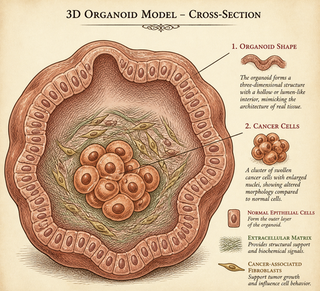
Instead of using flat cancer cells growing on plastic, this study used patient-derived metastatic human mammary organoids. These are 3D mini-tumor models grown from patient tissue. They are not tiny patients, and they do not capture the full body-wide ecosystem of cancer, but they do preserve more of the architecture and behavior of real tumors than standard cell lines.
The researchers treated these organoids with Smac mimetics, drugs designed to push cancer cells toward programmed death pathways. In several breast cancer organoids, Smac mimetics triggered apoptosis. Then the scientists blocked caspases, the enzymes that help execute apoptosis. In plain English: they closed the tidy exit.
And here we observe the cancer cell doing something rather unexpected.
When apoptosis was blocked, the organoids rapidly shifted into necroptosis. The team saw strong phosphorylation of MLKL, a telltale sign that the necroptosis machinery had marched onto the scene with tiny molecular boots. The organoids changed shape, cells swelled, and the death program became inflammatory rather than silent (doi:10.1038/s41392-026-02755-9).
The Interferon Alarm Call
The most intriguing part was what happened before and during this noisy death. The organoids switched on inflammatory genes, including interferon-related signals. Interferons are immune alarm molecules, the sort of biochemical calls that say, “Something weird is happening in quadrant seven, please send backup.”
That backup may include natural killer cells, immune cells that patrol for stressed, infected, or abnormal cells. The study found that necroptosis-associated inflammatory messengers could activate NK-cell-related immune functions. In the tissue savanna, the tumor cell’s dramatic exit may leave tracks for the hunters.
This fits with other work showing that interferon signaling can shape breast cancer treatment response. For example, a 2022 Nature Cancer study using breast cancer patient-derived organoids found that NCOR2 can repress IRF1-dependent interferon signaling, and that loosening this repression improved therapy response and anti-tumor immunity in models (doi:10.1038/s43018-022-00375-0).
The Catch, Because Biology Has Excellent Lawyers
Necroptosis is not always heroic. In some settings, tumor necroptosis may help metastasis by reshaping the tumor microenvironment. A 2023 study in Breast Cancer Research found that MLKL-driven shedding of cell-surface proteins could suppress T-cell activity and promote breast cancer metastasis in mouse models (doi:10.1186/s13058-023-01604-9).
So the goal is not “more necroptosis everywhere, all the time.” That would be like solving a kitchen fire by inviting a volcano. The real goal is precision: trigger the right kind of inflammatory death, in the right tumor context, with the right immune partners nearby.
The authors also tested a control lever: linear ubiquitination, a signaling system regulated by LUBAC. When they inhibited HOIP, part of the LUBAC machinery, necroptosis and inflammatory messenger release decreased. That suggests this organoid platform can do more than observe cell death. It can test how to tune it.
Why This Little Lab Safari Matters
Metastatic breast cancer remains hard to treat partly because tumor cells adapt, resist therapy, and hide from immune attack. This study offers a human, patient-derived model for watching those escape routes in 3D and testing ways to reroute them.
If future work confirms these findings in larger organoid collections, immune-cell co-cultures, animal models, and eventually patients, Smac mimetics or related strategies might help turn apoptosis-resistant breast cancer cells into immune-visible targets. Not a cure in a dish. Not yet. But a sharper map of where the therapeutic trail might go next.
And in cancer research, a better map is no small thing. Especially when the terrain is full of cellular rebels, immune scouts, and one very dramatic form of death that refuses to leave quietly.
References
-
Wächtershäuser KN, Schneider JV, Gessner A, et al. Necroptosis triggers inflammatory interferon signatures in patient-derived metastatic breast cancer organoids. Signal Transduct Target Ther. 2026;11:204. doi:10.1038/s41392-026-02755-9
-
Meier P, Legrand AJ, Adam D, Silke J. Immunogenic cell death in cancer: targeting necroptosis to induce antitumour immunity. Nat Rev Cancer. 2024;24:299-315. doi:10.1038/s41568-024-00674-x
-
Chen Y, et al. Screening of organoids derived from patients with breast cancer implicates the repressor NCOR2 in cytotoxic stress response and antitumor immunity. Nat Cancer. 2022;3:734-752. doi:10.1038/s43018-022-00375-0
-
Liu Z, Choksi S, Kwon HJ, et al. Tumor necroptosis-mediated shedding of cell surface proteins promotes metastasis of breast cancer by suppressing anti-tumor immunity. Breast Cancer Res. 2023;25:10. doi:10.1186/s13058-023-01604-9
Disclaimer: The image accompanying this article is for illustrative purposes only and does not depict actual experimental results, data, or biological mechanisms.