The problem with triple-negative breast cancer is that it plays defense, offense, and special teams at the same time. It tends to recur, spread, and shrug at standard treatments like a cellular menace wearing noise-canceling headphones. That is why this new paper on lanthanum cuprate nanosheets feels so interesting: instead of asking the tumor politely to stop being awful, the researchers built a tiny ultrasound-activated trap that turns the tumor’s own chemistry into a bad day.
The study, published in Small, tested high-index facet-distorted lanthanum cuprate, or LCO, nanosheets as a kind of switchable antitumor material. Once hit with ultrasound, the nanosheets set off a chain reaction inside triple-negative breast cancer cells: oxidative stress goes up, antioxidant defenses go down, copper-related cell death kicks in, inflammatory cell death joins the party, and the immune system gets a louder alarm bell to notice the mess (Wang et al., 2026).
A Tumor With Too Many Escape Routes
Triple-negative breast cancer, or TNBC, is the subtype that lacks the usual hormone receptors and HER2 target, which means many of oncology’s favorite guided missiles do not apply. Picture a subway map with the major stations ripped off. You can still travel, but the route gets ugly fast.
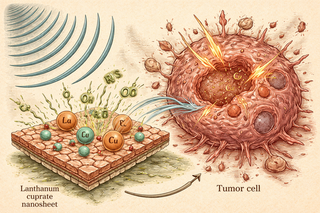
That is where the idea here gets clever. Instead of chasing one receptor, the authors went after the tumor’s stress machinery and metabolism. Their LCO nanosheets sit quietly until ultrasound shows up. Then they start generating reactive oxygen species, the chemically grumpy molecules that damage cells, while also lowering glutathione, one of the cell’s main antioxidant shields. In tumor biology terms, that is like cutting the power to the building and then pulling the fire alarm.
Cuproptosis, Which Sounds Made Up but Is Very Real
One of the stars of this paper is cuproptosis, a newer form of programmed cell death tied to copper overload and mitochondrial metabolism. The basic idea, first nailed down in 2022, is that too much intracellular copper can gum up lipoylated proteins in the TCA cycle, creating toxic protein stress in cells that rely on mitochondrial respiration (Tsvetkov et al., 2022). Later reviews have framed cuproptosis as an intriguing vulnerability in cancer, especially where copper handling and metabolism already run a little weird (Xie et al., 2023; PMCID: PMC9990368).
In this study, ultrasound appears to help the LCO system push copper between Cu2+ and Cu+, which helps trigger that copper-dependent stress. If you want a mental picture, imagine the tumor cell’s mitochondria as a power plant. Cuproptosis is what happens when someone dumps conductive confetti into the turbines and then acts surprised when sparks fly.
Then the Paper Adds Pyroptosis Because Apparently One Explosion Wasn’t Enough
The second death pathway here is pyroptosis, an inflammatory kind of cell death where the cell membrane becomes porous and the cell essentially bursts, releasing distress signals. It is less “quiet retirement,” more “dramatic exit through the drywall.” In cancer, pyroptosis matters because it can help turn tumor destruction into an immune-stimulating event rather than a silent cleanup job (Tan et al., 2023; PMCID: PMC10407856).
The authors propose that lanthanum ions from LCO behave like “super calcium,” pushing mitochondrial calcium uptake higher, worsening organelle damage, boosting ROS, and activating the NLRP3 inflammasome. That helps drive pyroptosis. So now the tumor is not just dying. It is dying noisily enough for the immune system to notice. That part matters because immunogenic cell death is often what separates “we killed some cells in a dish” from “we may have changed the tumor neighborhood in a useful way.”
Why Ultrasound Makes This More Than Nanoparticle Mad Libs
Ultrasound is doing real work here. It is noninvasive, it can be focused, and it gives researchers a way to activate therapy where they want it instead of everywhere at once. Sonodynamic therapy has been gaining attention for exactly that reason: sound can act like a remote control for tumor-killing chemistry without needing a scalpel to RSVP (Dimcevski et al., 2022; PMCID: PMC8918024).
That broader idea is not science fiction anymore. Ultrasound-based cancer treatments are already entering clinical use in some settings, such as histotripsy for liver tumors, though that is a different technology and not the same thing as this nanoparticle approach (Cleveland Clinic, April 10, 2024). Meanwhile, newer preclinical TNBC work is exploring focused ultrasound to reshape the tumor microenvironment and improve immune responsiveness (Lee et al., 2025).
What This Could Mean, If the Results Hold Up
The appeal here is the cascade. Not one trick, several. The nanosheets appear to reverse the tumor’s antioxidant bias, trigger cuproptosis, pile on ion stress, induce pyroptosis, and potentially wake up antitumor immunity. In the paper’s reported preclinical results, that translated into strong tumor suppression, including a 92.4% tumor inhibition rate (Wang et al., 2026).
That does not mean patients should expect ultrasound-powered copper confetti in clinic next Tuesday. This is still preclinical work, and complex nanomaterials always come with the usual grown-up questions: biodistribution, clearance, off-target toxicity, manufacturing consistency, and whether mouse immune drama translates to human tumors, which are notoriously less cooperative.
Still, the concept is sharp. TNBC often survives by controlling its metabolic streets, buffering oxidative stress, and keeping immune cells at arm’s length. This strategy tries to redraw that whole map at once. For a cancer that loves escape routes, that is a pretty satisfying bit of urban planning.
References
Wang J, He G, Chen J, et al. High-Index Facet-Distorted Lanthanum Cuprate for Ultrasound-Triggered Cuproptosis and Cascade-Amplified Antitumor Therapy. Small. 2026. DOI: https://doi.org/10.1002/smll.73512
Tsvetkov P, Coy S, Petrova B, et al. Copper induces cell death by targeting lipoylated TCA cycle proteins. Science. 2022;375(6586):1254-1261. DOI: https://doi.org/10.1126/science.abf0529 PMCID: https://pmc.ncbi.nlm.nih.gov/articles/PMC9273333/
Xie J, Yang Y, Gao Y, He J. Cuproptosis: mechanisms and links with cancers. Molecular Cancer. 2023;22(1):46. DOI: https://doi.org/10.1186/s12943-023-01732-y PMCID: https://pmc.ncbi.nlm.nih.gov/articles/PMC9990368/
Tan J, Zhuo Z, Si Y. Application of pyroptosis in tumor research. Oncology Letters. 2023;26(3):376. DOI: https://doi.org/10.3892/ol.2023.13962 PMCID: https://pmc.ncbi.nlm.nih.gov/articles/PMC10407856/
Dimcevski G, Kotopoulis S, Bjånes T, et al. Sonodynamic therapy: Rapid progress and new opportunities for non-invasive tumor cell killing with sound. Cancer Letters. 2022;532:215592. DOI: https://doi.org/10.1016/j.canlet.2022.215592 PMCID: https://pmc.ncbi.nlm.nih.gov/articles/PMC8918024/
Lee Y, Kim H, Park J, et al. Focused ultrasound-triggered doxorubicin liposomes reshape tumor microenvironment to boost checkpoint depletion in triple-negative breast cancer model. Journal of Controlled Release. 2025. DOI: https://doi.org/10.1016/j.jconrel.2025.114389
Disclaimer: The image accompanying this article is for illustrative purposes only and does not depict actual experimental results, data, or biological mechanisms.