The magician shows you a stem cell transplant in one hand, waves the other hand over a tiny pill called ibrutinib, and then asks the audience the truly awkward question: what if the pill was doing more of the dramatic survival work than the big, smoke-machine treatment?
That is the dinner-table version of a new Nature Reviews Clinical Oncology highlight on mantle cell lymphoma, a B-cell blood cancer with a name that sounds like it should come with medieval armor but unfortunately comes with real clinical stubbornness. Mantle cell lymphoma, or MCL, tends to affect older adults, often behaves aggressively, and has long been treated with a greatest-hits album of oncology intensity: immunochemotherapy, high-dose cytarabine, autologous stem cell transplantation, and maintenance therapy. A lot of syllables. A lot of hospital time. Not exactly a spa weekend.
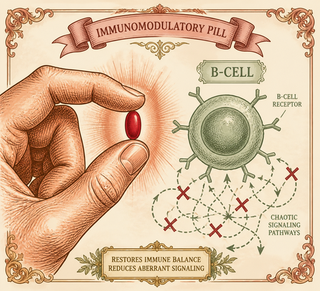
The new buzz comes from longer follow-up of the phase 3 TRIANGLE trial, which tested whether adding ibrutinib to first-line treatment helps younger, transplant-eligible patients with MCL live longer, and whether transplant still earns its seat at the table when ibrutinib is already in the room.[1]
The Cancer Cell Group Chat Gets Muted
Ibrutinib is a BTK inhibitor. BTK stands for Bruton tyrosine kinase, a protein that helps B cells receive survival and growth signals. Normal B cells use these signals responsibly, like adults with shared calendars. Malignant B cells can use them like a chaotic group chat that never stops yelling, "Divide! Survive! Ignore consequences!"
Ibrutinib blocks that signaling. It does not carpet-bomb cells like classic chemotherapy. It jams a communication line that lymphoma cells often rely on. That is why BTK inhibitors have become such a major part of the MCL story, first in relapsed disease and increasingly up front.[2]
TRIANGLE Walks Into the Party
The TRIANGLE trial enrolled patients aged 18 to 65 with previously untreated MCL who were candidates for intensive therapy. Researchers compared three strategies: standard immunochemotherapy plus autologous stem cell transplantation, the same approach with ibrutinib added, and an ibrutinib-containing regimen that skipped transplant.[1,3]
After about 4.5 years of follow-up, the ibrutinib-containing groups looked better than standard therapy alone. Four-year overall survival was about 88% with standard therapy plus ibrutinib and transplant, 90% with ibrutinib without transplant, and 81% with standard therapy and transplant.[1] Failure-free survival also favored the ibrutinib arms.
That is the part that makes oncologists sit up straighter and quietly stop stirring their coffee.
The really spicy bit, scientifically speaking, is that adding transplant to the ibrutinib-containing approach did not clearly improve outcomes. For decades, transplant has been the heavy artillery for fit younger patients. Now TRIANGLE suggests that when targeted therapy joins the opening act, transplant may not always add enough benefit to justify the extra toxicity.
A Pill Is Not a Fairy Godmother
Before anyone starts tossing transplant programs into the nearest lake, the caveats matter. TRIANGLE studied younger, fit patients. MCL is biologically messy, because of course it is. Some patients have high-risk features such as blastoid morphology, very high Ki-67, or TP53 abnormalities, and those groups may still need different strategies or more aggressive treatment. Cancer biology loves exceptions. It basically has a punch card.
Ibrutinib also has baggage. It can cause atrial fibrillation, bleeding, infections, high blood pressure, and other problems that make clinicians reach for the careful-face. In older transplant-ineligible patients, the SHINE trial showed that adding ibrutinib to bendamustine-rituximab improved progression-free survival, but it did not clearly improve overall survival and increased some toxicities.[4] So the message is not "ibrutinib for everyone, confetti cannon activated." It is more interesting than that.
The message is: targeted therapy may be changing the architecture of MCL treatment. Less reflexive transplant. More tailoring. More attention to who truly benefits from what.
Why This Matters at the Human Level
For patients, avoiding transplant can mean avoiding weeks of intense treatment, infection risk, fatigue, and the general indignity of having your immune system rebooted like a laptop from 2009. If similar outcomes hold up in broader practice, some people may get long remissions with less physical disruption.
That is a big deal. Not flashy in the movie-trailer sense. More like: fewer hospital days, fewer complications, more time being a person instead of a calendar full of infusion appointments.
Meanwhile, the field keeps moving. Reviews now describe MCL treatment as increasingly shaped by BTK inhibitors, measurable residual disease testing, CAR T-cell therapy, BCL-2 inhibitors like venetoclax and sonrotoclax, and smarter sequencing rather than one-size-fits-all escalation.[5,6] The future may look less like "hit everything harder" and more like "find the lymphoma's weak spot and press there, repeatedly, with excellent manners."
The Takeaway
Sidaway's highlight points to a real shift: in younger patients with mantle cell lymphoma, ibrutinib added to first-line therapy improved survival outcomes, and transplant may no longer be the automatic star of the show.[7] It is still a complicated show. There are understudies, trapdoors, and at least one prop table labeled "toxicity."
But the trick is getting clearer. The disappearing act may not be cancer vanishing forever. Not yet. It may be something subtler and still very welcome: some of the harshest treatment assumptions starting to disappear.
References
-
Dreyling M, Doorduijn JK, Giné E, et al. Addition of autologous stem-cell transplantation to an ibrutinib-containing first-line treatment in patients aged 18-65 years with mantle cell lymphoma (TRIANGLE): 4.5-year follow-up. Lancet. 2026. https://doi.org/10.1016/S0140-6736(26)00362-4
-
Wang ML, Rule S, Martin P, et al. Targeting BTK with ibrutinib in relapsed or refractory mantle-cell lymphoma. N Engl J Med. 2013;369:507-516. https://doi.org/10.1056/NEJMoa1306220
-
Dreyling M, Doorduijn JK, Giné E, et al. Ibrutinib combined with immunochemotherapy with or without autologous stem-cell transplantation in previously untreated mantle cell lymphoma (TRIANGLE). Lancet. 2024;403:2293-2306. https://doi.org/10.1016/S0140-6736(24)00184-3
-
Wang ML, Jurczak W, Jerkeman M, et al. Ibrutinib plus bendamustine and rituximab in untreated mantle-cell lymphoma. N Engl J Med. 2022;386:2482-2494. https://doi.org/10.1056/NEJMoa2201817
-
Wang M, et al. Ibrutinib plus venetoclax in relapsed or refractory mantle cell lymphoma (SYMPATICO). Lancet Oncology. 2025. https://doi.org/10.1016/S1470-2045(24)00682-X
-
Maddocks K, et al. Modern management of mantle cell lymphoma. ASCO Educational Book. 2026. https://doi.org/10.1200/EDBK-26-517468
-
Sidaway P. Ibrutinib improves overall survival in patients with mantle cell lymphoma. Nature Reviews Clinical Oncology. 2026. https://doi.org/10.1038/s41571-026-01166-7
Disclaimer: The image accompanying this article is for illustrative purposes only and does not depict actual experimental results, data, or biological mechanisms.