Take one scarred lung, add years of survivorship, sprinkle in invisible dust from the air, and hope the recipe does not produce a second tumor - because apparently cancer was not satisfied with one appearance and wanted a franchise deal.
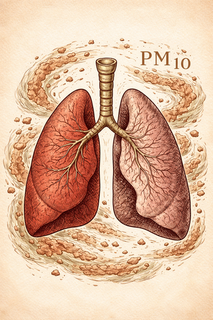
That is the uncomfortable idea behind a new UK Biobank study looking at second primary lung cancer, or SPLC, in people who already survived an initial lung cancer. And here is where it gets interesting: this was not a tiny, hand-wavy signal. Among 2,439 lung cancer survivors, 92 developed a second primary lung cancer over 6,561 person-years of follow-up, with a 10-year cumulative incidence of 3.98%. The eye-popping part was the air pollution signal. People in the highest category of PM10 exposure had an adjusted hazard ratio of 6.43 compared with the lowest category (Choi et al., 2026).
Wait, what exactly is PM10?
PM10 is shorthand for inhalable particulate matter up to 10 micrometers across - tiny bits of dust, soot, brake wear, construction crud, and other airborne junk. Not all of it gets deep into the lungs the way smaller PM2.5 particles do, but PM10 is still very much on the respiratory system’s guest list, and not in a fun way (Wikipedia: Particulate matter). Nitrogen dioxide, or NO2, mostly comes from combustion, especially traffic, and it can stir up airway inflammation and oxidative stress (Wikipedia: Nitrogen dioxide).
So yes, the air outside your window can behave like an annoying background character in lung biology. Quiet. Persistent. Bad boundaries.
The number that makes you sit up straighter
This paper asked a pretty sharp question: once someone has already had lung cancer, could ongoing exposure to air pollution help set the stage for a second, distinct lung cancer later on?
The answer was not "definitely, case closed, everyone go home." Science rarely gives you that neat little bow. But it was a strong "this deserves attention." The authors saw a dose-response relationship with PM10. In normal human language, that means risk went up as PM10 exposure went up, which is a lot more persuasive than one lonely significant comparison trying to impress the room.
Even more interesting, the association looked stronger in never-smokers. For never-smoking survivors who later developed non-small cell SPLC, the adjusted hazard ratio was 2.26 (Choi et al., 2026). That matters because air pollution has increasingly looked like one of the major villains in lung cancer among people who never smoked. In 2025, a large Nature study linked higher PM2.5 exposure with more cancer-driving mutations in tumors from never-smokers, which is the sort of sentence that makes molecular epidemiologists reach for both coffee and a whiteboard (Díaz-Gay et al., 2025).
Why this hits differently for survivors
Lung cancer survivors already live with a weird math problem. Their future risk is not just "will the original cancer return?" It is also "could a new one start?" Reviews over the past few years have emphasized that multiple primary lung cancers are a real and growing issue as more people live longer after treatment (Tian et al., 2022). Smoking remains a major driver, obviously. A 2021 study found current smoking was tied to a higher SPLC risk, which is not shocking, but still worth quantifying because biology enjoys making the obvious both true and brutal (Aredo et al., 2021).
What this new paper adds is the idea that survivor risk models may be missing a whole environmental lane. If two patients look similar on tumor stage, treatment history, and smoking status, but one is breathing consistently dirtier air, that may matter more than we used to think.
The real-world angle
This does not mean every lung cancer survivor should panic every time a bus drives by. It does mean clinicians and researchers may need to think beyond the usual checklist. Surveillance strategies for SPLC could eventually include environmental exposure, especially in higher-risk regions. Public health policy suddenly looks less abstract too. Clean air is not just about population averages and annual reports. It may affect who gets a second shot from a disease that already took its first.
And the broader air-quality backdrop is not exactly calming. In the American Lung Association’s 2025 State of the Air report, 156 million people in the U.S. lived in areas with failing grades for at least one major pollution measure (American Lung Association, April 23, 2025). That is not a niche problem. That is a "maybe the atmosphere should stop freelancing as a risk factor" problem.
The catch, because there is always a catch
This was an observational study, so it cannot prove PM10 directly caused those second cancers. Exposure estimates came from residential data, which is smart but imperfect. People move. People commute. People do not spend their entire lives standing politely at their mailing address. The confidence intervals were also wide in some comparisons, which is statistics for "strong signal, but do not get cocky."
Still, the study lands because the pattern makes biological sense, matches broader air pollution literature, and points to something modifiable. That last part matters. You cannot change your past lung cancer. You might be able to change the air you breathe, the places you live, or the way surveillance is tailored after treatment. That is not a miracle. It is something better: a practical lever.
References
-
Choi E, Luo S, Ding VY, et al. Air pollution and the risk of second primary lung cancer among lung cancer survivors: the prospective UK Biobank cohort study. Br J Cancer. 2026. DOI: 10.1038/s41416-026-03454-6
-
Berg CD, Schiller JH, Boffetta P, et al. Air Pollution and Lung Cancer: A Review by International Association for the Study of Lung Cancer Early Detection and Screening Committee. J Thorac Oncol. 2023;18(10):1277-1289. DOI: 10.1016/j.jtho.2023.05.024
-
Tian H, Bai G, Yang Z, et al. Multiple primary lung cancer: Updates of clinical management and genomic features. CA Cancer J Clin. 2022;72(1):7-33. DOI: 10.3322/caac.21708
-
Aredo JV, Luo SJ, Gardner RM, et al. Tobacco Smoking and Risk of Second Primary Lung Cancer. J Thorac Oncol. 2021;16(6):968-979. DOI: 10.1016/j.jtho.2021.02.024
-
Myers R, Brauer M, Dummer T, et al. High-Ambient Air Pollution Exposure Among Never Smokers Versus Ever Smokers With Lung Cancer. J Thorac Oncol. 2021;16(11):1850-1858. DOI: 10.1016/j.jtho.2021.06.015
-
Díaz-Gay M, Zhang T, Ho PH, et al. The mutagenic forces shaping the genomes of lung cancer in never smokers. Nature. 2025;644(8075):133-144. DOI: 10.1038/s41586-025-09219-0
Disclaimer: The image accompanying this article is for illustrative purposes only and does not depict actual experimental results, data, or biological mechanisms.