That is the basic plot twist from a new Journal of Hepatology study on hepatocellular carcinoma, the most common form of liver cancer. The treatment in question - atezolizumab plus bevacizumab - is the current first-line celebrity duo for many patients with advanced disease. Think of it as the Marvel crossover event of liver cancer therapy: one drug helps remove immune brakes, the other cuts off the tumor’s blood-supply hustle. Great on paper. Often great in real life. But not always.
This study asks a blunt question: why do some tumors basically shrug and say, "No thanks"?
When the hot new combo gets left on read
Atezolizumab is an immunotherapy drug that blocks PD-L1, a molecule tumors use like a fake backstage pass to avoid immune attack. Bevacizumab targets VEGF, which helps tumors build blood vessels and also contributes to an immune-suppressive environment. Together, they’re supposed to make tumors more vulnerable to the immune system.
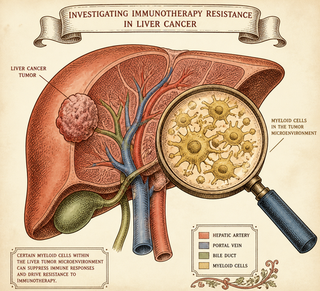
But in this massive analysis, researchers found that a big chunk of patients had what’s called primary refractoriness - meaning the treatment failed early, either with rapid progression or only very short-lived disease control. In the real-world cohort and trial cohorts combined, this was not some rare weird exception. It was common enough to be a real clinical headache.
And the survival difference was brutal. Patients with primary refractoriness had median overall survival of 7.3 months in the real-world cohort, compared with 31.5 months in patients who responded or benefited longer from therapy (Lombardi et al. 2026, DOI: 10.1016/j.jhep.2026.05.018).
That’s not a subtle difference. That’s "season canceled after the pilot" territory.
Meet the usual suspects: myeloid cells behaving badly
The study points to a particular kind of tumor microenvironment - basically the neighborhood around the cancer cells. In patients whose tumors were refractory from the start, that neighborhood looked deeply unfriendly to T cells, which are the immune system’s front-line fighters.
Instead, these tumors were packed with immunosuppressive myeloid cells, especially cells with markers like CD163. If T cells are the Avengers, these myeloid cells are the bureaucrats from The Office who keep locking the conference room and shredding the mission plan.
The researchers used a whole toolbox of modern methods - machine learning analysis of tissue slides, imaging mass cytometry, RNA sequencing, and single-cell RNA sequencing - to show that these refractory tumors tended to have:
- More systemic inflammation at baseline, including higher neutrophil-to-lymphocyte ratio
- Fewer effective T cells in the tumor
- Repression of interferon-gamma signaling, which normally helps coordinate anti-tumor immune responses
- A spatial layout that physically and biologically favored immune suppression
In other words, some tumors are not merely hiding from the immune system. They seem to have hired security, installed blackout curtains, and disconnected the Wi-Fi.
Why this matters beyond one paper
Liver cancer is already a hard customer. It often arises in chronically inflamed, cirrhotic livers, so the immune environment starts out complicated before the tumor even enters the chat. Reviews over the last few years have highlighted how the liver’s naturally tolerogenic immune setting can make immunotherapy responses uneven (Greten and Sangro, 2022, DOI: 10.1038/s41571-022-00623-1).
The original IMbrave150 trial changed the field by showing atezolizumab plus bevacizumab outperformed sorafenib in unresectable HCC (Finn et al. 2020, DOI: 10.1056/NEJMoa1915745). Since then, researchers have been racing to figure out who actually benefits most, and who doesn’t. Biomarker reviews keep circling the same problem: we still don’t have reliable, clinic-ready predictors of response in HCC immunotherapy (Llovet et al. 2022, DOI: 10.1038/s41571-022-00631-1).
This new paper adds something valuable. It doesn’t just say, "some patients don’t respond." It sketches a plausible biological reason why.
The practical takeaway: maybe test the neighborhood, not just the tumor
If these findings hold up, they could help doctors identify patients who are less likely to benefit from atezolizumab plus bevacizumab before precious time is lost. That matters because advanced liver cancer does not usually offer the luxury of leisurely trial-and-error.
The paper suggests a few possible red flags:
- High neutrophil-to-lymphocyte ratio
- Low interferon-gamma signature
- Heavy myeloid infiltration
- T-cell depletion in the tumor microenvironment
That opens the door to more tailored strategies. Instead of giving everyone the same combo and hoping for the best, future trials could test ways to target myeloid-driven immune suppression up front. That might mean adding therapies that reprogram or block those suppressive myeloid cells, especially in high-risk patients.
Basically, if the tumor microenvironment is a nightclub and the T cells are stuck outside in the rain, maybe the answer is not just "send more T cells." Maybe it’s "deal with the extremely shady doorman."
The catch, because biology loves a catch
This is a strong translational study, but it does not instantly hand us a new standard of care. The biomarker patterns need prospective testing. Some of the tissue-based analyses are complex and not yet routine in everyday oncology clinics. And HCC is not one disease wearing one outfit - it’s a messy family of biologically different tumors.
Still, this is the kind of work that nudges cancer treatment away from one-size-fits-all and toward something smarter. Not glamorous, maybe, but very real. Sometimes progress in oncology is less "cure discovered" and more "we finally figured out why the map was upside down."
References
-
Lombardi P, Ramon-Gil E, Raja RQ, et al. A myeloid immunosuppressive phenotype defines primary refractoriness to atezolizumab plus bevacizumab in hepatocellular carcinoma. J Hepatol. 2026. DOI: 10.1016/j.jhep.2026.05.018. PubMed: 42297215
-
Finn RS, Qin S, Ikeda M, et al. Atezolizumab plus bevacizumab in unresectable hepatocellular carcinoma. N Engl J Med. 2020;382(20):1894-1905. DOI: 10.1056/NEJMoa1915745
-
Greten TF, Sangro B. Targets for immunotherapy of liver cancer. Nat Rev Clin Oncol. 2022;19:151-172. DOI: 10.1038/s41571-022-00623-1
-
Llovet JM, Kelley RK, Villanueva A, et al. Hepatocellular carcinoma. Nat Rev Dis Primers. 2021;7:6. DOI: 10.1038/s41572-020-00240-3
-
Llovet JM, Castet F, Heikenwalder M, et al. Immunotherapies for hepatocellular carcinoma. Nat Rev Clin Oncol. 2022;19:151-172. DOI: 10.1038/s41571-022-00631-1
Disclaimer: The image accompanying this article is for illustrative purposes only and does not depict actual experimental results, data, or biological mechanisms.