Cancer treatment sometimes feels less like bulldozing a field and more like yanking a few ugly weeds while hoping the rest of the garden behaves itself for another season. That is basically the promise of stereotactic body radiation therapy, or SBRT, in oligoprogressive prostate cancer - a phrase that sounds like it was assembled by a committee paid by the syllable, but the idea is simple enough: a patient is doing reasonably well on systemic treatment, except for a small number of spots that have decided to go feral.
A recent letter in European Urology responds to the TRAP trial, which looked at SBRT for oligoprogressive disease in men with androgen-suppressed prostate cancer.[1] Even from the title alone, this sits in a clinically juicy space. Not "burn everything down and start over," and not "shrug and wait." More like: can we zap the few lesions causing trouble and keep the current treatment working longer?
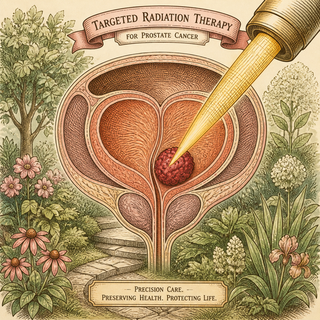
That question matters a lot more than it might sound at first glance.
When a few lesions start acting like tiny union rebels
Prostate cancer often depends on androgens - hormones like testosterone - to grow. So one of the main treatment strategies for advanced disease is androgen deprivation therapy, which basically cuts off the tumor's favorite supply line. Sometimes this works well for quite a while. Then, plot twist, a few cancer spots start growing anyway while the rest remain controlled.
That is oligoprogression. "Oligo" means few. Progression means, well, the scans have stopped being polite and started getting real.
This creates a very practical dilemma. If only one to three lesions are misbehaving, do you switch the whole systemic treatment plan - often to something more toxic, more expensive, or both - or do you locally treat those specific spots and buy more time? Trialists love this kind of question because it sounds tidy, but then the endpoint definitions show up wearing fake mustaches.
SBRT: the sniper, not the carpet bomber
SBRT delivers highly focused radiation to a target over a small number of sessions. It is designed to hit the lesion hard while sparing nearby normal tissue as much as possible. In plain English, it is radiotherapy with a very fine aim and very little patience.
In oligoprogressive prostate cancer, the hope is that SBRT can knock out the resistant clones that have broken rank, allowing the patient to stay on the same hormone-based treatment longer. That may mean delaying the next line of therapy, delaying side effects, and delaying the moment when everyone in clinic starts using the phrase "limited remaining options," which nobody enjoys.
The broader evidence base has been building in this area. The randomized ORIOLE trial showed that metastasis-directed therapy could improve progression outcomes in oligometastatic hormone-sensitive prostate cancer.[2] The STOMP trial also suggested that metastasis-directed therapy can delay the need for androgen deprivation in men with recurrent oligometastatic prostate cancer.[3] More recent reviews have tried to sort out where this strategy truly helps and where oncology may be getting slightly overexcited by a beautiful radiation plan.[4,5]
Why the TRAP conversation is interesting
Even though this publication is a response to the TRAP trial rather than a full primary paper with a nice meaty abstract sitting in front of us, the subject hits a live wire in oncology right now. We are moving away from the old all-or-nothing mindset and toward a more adaptive approach. If most disease sites remain controlled, maybe you do not need to throw out a working systemic regimen just because two bone lesions have chosen chaos.
That is appealing for obvious reasons. Patients may keep benefiting from a treatment they already tolerate. Clinicians may postpone escalation. Health systems may avoid burning through therapies too early. Everyone likes a strategic delay - except perhaps the protocol amendment team, who somehow always end up with more paperwork.
But there are caveats, and they are not decorative.
The fine print, where all the grown-up problems live
First, patient selection is everything. Oligoprogression is not one thing. A patient with one slow-growing lesion on a PSMA PET scan is not the same as a patient with several biologically aggressive sites that just happen to fit an arbitrary cutoff.
Second, imaging has changed the game. Newer scans, especially PSMA PET, can detect disease that older imaging misses.[5] That is good, but it also means trial populations can get slippery. If one study defines oligoprogression using conventional imaging and another uses highly sensitive molecular imaging, they may be talking about slightly different universes.
Third, local control is not the same as curing systemic biology. SBRT can remove visible troublemakers, but it may not solve the deeper problem that some cancer clones are evolving resistance. Sometimes you are pruning a rose bush. Sometimes you are arguing with bamboo.
And finally, we need proper trial data with solid endpoints - not just lovely waterfall plots and optimistic conference slides. Delaying progression is useful. Delaying the next systemic therapy is useful. Improving quality of life is useful. Improving overall survival is the hard currency. Those are not interchangeable, no matter how charming the subgroup analysis may look after a late-night statistical grooming.
Where this could matter in the real world
If the benefits seen in this research lane hold up, SBRT for oligoprogressive prostate cancer could become a practical way to extend control without immediately escalating treatment. For patients, that might mean more time with fewer side effects. For doctors, it offers a middle path between "do nothing yet" and "switch everything now."
That is why this topic keeps showing up. It fits the modern oncology instinct to be more precise, more selective, and slightly less theatrical. Not every flare on a scan requires a whole new war. Sometimes it requires a very accurate shovel.
References
-
Yusuf S, Azam A, Sood I, Al-Sattar H, Mullassery V, Adeleke S. Re: Stereotactic Body Radiation Therapy for Oligoprogressive Disease in Androgen-suppressed Prostate Cancer: Primary Endpoint Analysis of the TRAP Trial. Eur Urol. 2026. doi:10.1016/j.eururo.2026.05.023
-
Phillips R, Shi WY, Deek M, et al. Outcomes of Observation vs Stereotactic Ablative Radiation for Oligometastatic Prostate Cancer: The ORIOLE Phase 2 Randomized Clinical Trial. JAMA Oncol. 2020;6(5):650-659. doi:10.1001/jamaoncol.2020.0147 | PMCID:PMC7225913
-
Ost P, Reynders D, Decaestecker K, et al. Surveillance or Metastasis-Directed Therapy for Oligometastatic Prostate Cancer Recurrence: A Prospective, Randomized, Multicenter Phase II Trial. J Clin Oncol. 2018;36(5):446-453. doi:10.1200/JCO.2017.75.4853
-
Deek MP, Phillips R, Tran PT. Stereotactic ablative radiotherapy for oligometastatic and oligoprogressive prostate cancer. Nat Rev Urol. 2021;18(11):641-654. doi:10.1038/s41585-021-00520-4
-
Gillessen S, Attard G, Beer TM, et al. Management of patients with advanced prostate cancer: report of the Advanced Prostate Cancer Consensus Conference 2022. Eur Urol. 2023;84(4):370-396. doi:10.1016/j.eururo.2023.06.014
Disclaimer: The image accompanying this article is for illustrative purposes only and does not depict actual experimental results, data, or biological mechanisms.