The cell has a supply chain, and in pancreatic cancer the package labeled "please show this to the immune system" seems to get intercepted before it reaches the loading dock.
That package is MHC class I, or MHC-I if you prefer your biology in license-plate form. Nearly every cell uses MHC-I molecules to display tiny protein fragments on its surface. These fragments are like menu cards for patrolling T cells: "Here is what is cooking inside me." If the menu includes something suspicious, say a viral protein or a cancer-related mutation, a CD8 T cell may decide the restaurant has failed inspection and shut it down.
Pancreatic ductal adenocarcinoma, the most common form of pancreatic cancer, has long been annoyingly good at dodging that inspection. Immunotherapy, which can be marvelous in melanoma and some lung cancers, often strolls into pancreatic cancer like a substitute teacher in a cafeteria riot. The tumor neighborhood is dense, suppressive, low on helpful T cells, and full of signals saying, in effect, "Nothing to see here, officer" [1,2].
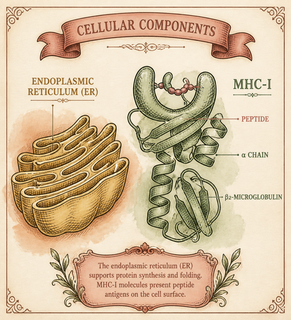
The Disappearing Name Tag Trick
Back in 2020, researchers showed that pancreatic cancer cells can use autophagy to degrade MHC-I, lowering how much of it appears on the cell surface [3]. Autophagy is the cell's recycling system. In ordinary life, it is housekeeping: damaged parts go to lysosomes, the acidic recycling bins. In cancer, alas, housekeeping sometimes gets promoted to witness relocation.
The new Molecular Cell study by Berquez and colleagues asks a sharper question: how does MHC-I get selected for disposal in the first place? It is one thing to say the immune name tag got thrown away. It is another to catch the fellow carrying it to the trash chute.
The team found that pancreatic cancer cells hold MHC-I in the endoplasmic reticulum, or ER, longer than expected. The ER is where many proteins fold, assemble, and receive their first quality-control inspection. I spent enough decades watching cellular pathways acquire new acronyms to say this with confidence: the ER is not merely a factory floor. It is also customs, packaging, and a rather fussy passport office.
In these cancer cells, MHC-I does not efficiently move from the ER to the cell surface. While stalled there, it can be captured by a complex involving TEX264, an ER-phagy receptor, and NBR1, a cargo receptor. Together they help route MHC-I toward autophagic degradation. Block either receptor, and the cells show more total MHC-I and more surface MHC-I [4].
That is the biological equivalent of discovering that the missing packages were not lost. Someone had built a side door to the shredder.
A Badly Loaded Package Gets Flagged
Here is the elegant bit. MHC-I normally needs to carry a peptide. A well-loaded MHC-I molecule is more likely to leave the ER and appear at the cell surface, where T cells can inspect it. Berquez and colleagues found that when peptide loading was impaired, MHC-I bound more strongly to the TEX264-NBR1 capture machinery. When high-affinity peptides were supplied, MHC-I binding to that machinery fell, and more MHC-I reached the surface.
So the cancer cell seems to exploit a quality-control process. Poorly loaded MHC-I, instead of getting another fair chance at public service, gets routed into lysosomal oblivion. One imagines a tiny bureaucrat stamping "insufficient paperwork" while the immune system waits outside, tapping its foot.
The authors also used a genome-wide CRISPRi screen and identified NFXL1, an ER-localized E3 ligase, as a mediator of MHC-I ubiquitylation and capture. Ubiquitin is often described as a molecular tag, but after fifty years in this field I think of it as a multipurpose Post-it note: recycle this, move that, assemble these, panic slightly. In this case, NFXL1 appears to help mark MHC-I for capture. Higher NFXL1 correlated with lower MHC-I expression and worse prognosis in patient data [4].
Why This Matters, If the Biology Holds Up
This work does not mean we have a new pancreatic cancer treatment next Tuesday. Biology rarely arrives with same-day shipping, despite what grant abstracts may imply. But it does point to a more precise way of thinking about immune evasion.
Broadly blocking autophagy has been attractive because pancreatic cancers often depend on lysosomal recycling, and newer work suggests autophagy inhibition can make tumors more visible to immune attack [5]. The trouble is that autophagy also helps normal cells survive stress. It is not a villain so much as a useful employee with a regrettable side hustle.
Targeting the capture machinery, TEX264, NBR1, NFXL1, or the specific steps that trap ER-stalled MHC-I, could in theory restore antigen display without simply smashing the entire recycling center. That distinction matters. In immunotherapy, showing T cells the right target is half the battle. The other half is getting those T cells into the tumor and convincing the tumor microenvironment to stop behaving like a private club with a velvet rope and terrible lighting.
The larger story is an old one with a modern twist. Cancer immunology began with the idea that the immune system can recognize abnormal cells. Then came the long, humbling realization that tumors edit, hide, suppress, and reroute the evidence. Pancreatic cancer has been especially adept. This study gives us a new diagram of one hiding place: not at the cell surface, not in the T cell, but upstream in the ER, where the immune display molecule gets detained before it can testify.
Not bad for a little shipping problem.
References
-
Hilmi M, Delaye M, Muzzolini M, et al. The immunological landscape in pancreatic ductal adenocarcinoma and overcoming resistance to immunotherapy. Lancet Gastroenterol Hepatol. 2023;8:1129-1142. doi:10.1016/S2468-1253(23)00207-8
-
Hu ZI, O'Reilly EM. Therapeutic developments in pancreatic cancer. Nat Rev Gastroenterol Hepatol. 2024;21:7-24. doi:10.1038/s41575-023-00840-w
-
Yamamoto K, Venida A, Yano J, et al. Autophagy promotes immune evasion of pancreatic cancer by degrading MHC-I. Nature. 2020;581:100-105. doi:10.1038/s41586-020-2229-5
-
Berquez M, Li AL, Luy MA, et al. A multi-subunit autophagic capture complex facilitates degradation of ER-stalled MHC class I in pancreatic cancer. Molecular Cell. 2026. doi:10.1016/j.molcel.2026.05.005
-
Oyama K, Nakata K, Tsutsumi C, et al. Combined autophagy inhibition and dendritic cell recruitment induces antitumor immunity and enhances immune checkpoint blockade sensitivity in pancreatic cancer. Cancer Research. 2024;84:4214-4232. doi:10.1158/0008-5472.CAN-24-0830
Disclaimer: The image accompanying this article is for illustrative purposes only and does not depict actual experimental results, data, or biological mechanisms.