Renovating a cell is normally a terrible idea, like rewiring your kitchen while the toaster is on and the contractor is made of wet spaghetti. But Gao and colleagues just described a microscopic upgrade package: a DNA tetrahedron that slips into a cell, reads three molecular signals, does logic, and only then releases its therapeutic payload. Very HGTV, if HGTV involved microRNAs and fewer open-concept islands.
A Little Pyramid With a Spreadsheet Brain
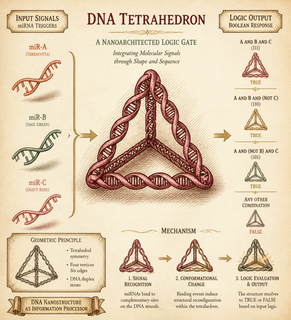
The paper is about DNA tetrahedron processors, tiny four-sided DNA structures built from programmable strands. DNA is useful here because it follows base-pairing rules with the stubborn consistency of a statistician correcting your axis labels. A pairs with T, C pairs with G, and suddenly you can build nanoscale shapes, switches, and circuits.
This team designed tetrahedral framework nucleic acids that respond to three endogenous microRNAs, or miRNAs. These are short RNA molecules that help regulate genes. Cancer cells often carry odd miRNA patterns, like a molecular playlist that screams, "Something weird is happening in aisle seven."
The processor can run seven Boolean operations: OR, AND, NOR, NAND, XOR, majority, and OR-AND. In normal human words, it asks: are these signals present, absent, or present in the right combination? Only if the answer matches the programmed rule does the device act.
And here is where it gets interesting: their proof-of-concept cancer version used a majority gate. That means the processor did not need all three miRNA inputs to say "yes." It needed at least two out of three. Statistically speaking, this is the nanomedicine version of "two witnesses are better than one, because biomarkers are messy little drama queens."
The Payload: Silencing Survivin
The treatment side of this platform carried siRNA against survivin, a protein many cancer cells lean on to avoid death. Survivin is basically the "I refuse to leave this meeting" of cancer survival proteins.
The researchers tested the system in MCF-7 breast cancer cells, which matched the chosen tri-miRNA signature. When the majority condition was met, the device released siRNA and silenced survivin. Cells without the right signal pattern were largely spared. That matters because precision therapy is not just about hitting harder. It is about not punching the furniture, the lamps, and your innocent neighbor's mailbox on the way there.
The authors also report tumor suppression in vivo, meaning in animal models, with high specificity and minimal off-target effects [1]. That is encouraging, but let us keep our confidence interval emotionally responsible: this is preclinical work. No patients were treated. No hazard ratio is walking into the room wearing a tiny tuxedo. We are still in the "does this clever molecular gadget work in controlled systems?" phase, not the "change the standard of care" phase.
Why Three Inputs Beat One Very Confident Input
Single biomarkers can mislead. A cancer-associated miRNA might show up in normal tissue at low levels, or vary across patients, tumor regions, and biological Tuesday moods. Multi-input logic tries to reduce false positives by asking for a pattern instead of a lone clue.
This is the same reason your bank does not let someone empty your account with only your favorite pizza topping. One signal is flimsy. Three signals, interpreted together, carry more context.
Recent reviews have been circling this idea for a while. DNA logic circuits can respond to tumor markers and release drugs or produce imaging signals [2]. Dynamic DNA nanostructures may improve sensitivity and specificity in cancer diagnosis and therapy [3]. Stimulus-responsive nanomaterials with logic gates have also moved from simple yes/no responses toward more complex Boolean decisions [4]. Translation: the field is trying to teach nanoparticles to stop being enthusiastic interns and start being careful professionals.
The Big Caveats, Because Biology Likes Pranks
Several questions remain. Can these DNA processors survive long enough in the human body? Can they reach tumors reliably after injection? Will the immune system ignore them, tolerate them, or file a strongly worded complaint? Can the tri-miRNA rules be customized across tumor types and patients?
There is also the manufacturing question. Making elegant DNA devices in a lab is one thing. Making them reproducibly, safely, and affordably at clinical scale is where many beautiful ideas discover the spreadsheet has teeth.
Still, the concept is sharp. This work points toward therapies that do not just deliver a drug, but decide whether delivery makes sense after reading the local molecular room. If future studies reproduce and expand these results, logic-gated nanomedicine could help make cancer treatment more selective, especially for tumors where the right move depends on a combination of signals rather than a single biomarker waving a tiny flag.
For now, the takeaway is simple: scientists built a DNA-based processor that can enter cells, count molecular clues, and release therapy only when the math says go. That is not a cure. But it is a very clever renovation plan for a very unruly house.
References
-
Gao Y, Wang Y, Qin Y, et al. Intracellular logic computing with DNA tetrahedron processors enables precision cancer theranostics. Signal Transduction and Targeted Therapy. 2026. DOI: 10.1038/s41392-026-02767-5
-
Chen J, Fu S, Zhang C, Liu H, Su X. DNA logic circuits for cancer theranostics. Small. 2022;18(20):2108008. DOI: 10.1002/smll.202108008
-
Bi S, Yang R, Ju H, Liu Y. Dynamic nanostructure-based DNA logic gates for cancer diagnosis and therapy. ChemBioChem. 2025;26(4):e202400754. DOI: 10.1002/cbic.202400754
-
Luo C, He L, Chen F, et al. Stimulus-responsive nanomaterials containing logic gates for biomedical applications. Cell Reports Physical Science. 2021;2(2):100350. DOI: 10.1016/j.xcrp.2021.100350
-
Okumura S, Gines G, Lobato-Dauzier N, et al. Nonlinear decision-making with enzymatic neural networks. Nature. 2022;610:496-501. DOI: 10.1038/s41586-022-05218-7
Disclaimer: The image accompanying this article is for illustrative purposes only and does not depict actual experimental results, data, or biological mechanisms.