If Mission: Impossible took place inside a cancer cell, p53 would be the security chief tied to a chair in the basement while the thieves raided the vault upstairs. This paper hands that security chief a very specific rescue tool: a DARPin, which is a small engineered protein built to latch onto mutant p53 and help it hold itself together again.
That matters because p53 is one of cancer biology’s biggest celebrities, and not in a fun red-carpet way. It is often called the “guardian of the genome” because it helps damaged cells stop dividing, repair themselves, or bow out gracefully when the DNA situation has become fully unhinged (Wikipedia: p53; Liu et al. 2024). The problem is that TP53 is mutated in roughly half of human cancers, and many of those mutations hit the DNA-binding domain, the part p53 uses to read the genetic sheet music and conduct the right response. When that domain gets wobbly, p53 can misfold and lose function. Cancer loves that. Obviously.
The Mutant Protein With Stage Fright
This new study focuses on temperature-sensitive p53 mutants - versions of p53 that are especially unstable at normal body temperature. Think of them as proteins that can almost play the song, but under the bright lights they forget the chords. Some p53 mutants fail because they cannot contact DNA properly. Others fail because the whole protein shape becomes less stable. Those second ones are the interesting target here.
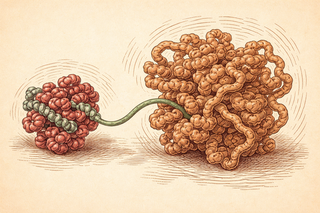
Münick and colleagues designed and tested a DARPin - short for designed ankyrin repeat protein - that binds folded p53 without blocking its normal DNA-binding face (Wikipedia: DARPin; Wikipedia: ankyrin repeat). In plain English, this DARPin acts less like a drug that jams a switch and more like a molecular hand on someone’s shoulder saying, “Stay upright, champ.”
Using structural studies, the team showed the DARPin bound several mutant forms of p53 and physically stabilized them. In cell-based reporter assays across a broad panel of cancer-associated mutants, it reactivated most of the temperature-sensitive structural mutants they tested. It did not rescue the usual troublemakers you would expect it to miss, including DNA-contact mutants like R248W and R273H, or zinc-binding/local-misfolding mutants such as R175H and G245S. That is actually reassuring. When a therapy claims to fix everything, your scientific eyebrow should go up so hard it needs its own grant.
Why This Is More Interesting Than Another “Promising Lab Study”
The big attraction here is breadth. Small molecules have made real progress for specific p53 mutants, especially Y220C, which creates a pocket a drug can fit into. Rezatapopt, a Y220C-specific reactivator, has now shown clinical proof of concept in patients, which is a genuine key change for the field (Dumbrava et al. 2026). But Y220C is just one mutant. Cancer, being an overachieving little menace, has produced thousands of TP53 variants.
That is where this DARPin idea gets spicy. Instead of waiting for each mutant to present a neat little drug pocket like a polite guest, the DARPin binds a broader surface and stabilizes many mutants that share the same core problem: they are too flimsy. The authors estimate that 15% to 25% of the p53 mutome may be temperature-sensitive and therefore potentially addressable by this kind of approach. If that estimate holds up, this is not niche. This is a whole section of the concert hall.
They also showed the reactivated mutants turned on classic p53 target genes like p21, PUMA, and MDM2, and slowed cancer-cell growth. In primary human fibroblasts, the DARPin alone did not meaningfully switch on wild-type p53 target genes, which hints at a useful safety feature: less random activation in normal cells. That is early, limited evidence, not a clean safety bill, but it is the sort of detail you want to see before getting too carried away.
The Catch, Because Biology Always Brings One
This is still a preclinical paper. No patients were treated with this DARPin. Delivery is the elephant tap-dancing in the room. Proteins do not casually stroll into tumor cells whenever we ask nicely. The authors suggest pairing the DARPin with mRNA/lipid nanoparticle delivery, which is clever and timely, but still a proposal rather than a finished therapy.
There is also a deeper lesson from the p53 field: cancer adapts. The Y220C story already shows both promise and resistance. Rezatapopt has shown responses in patients with TP53 Y220C-mutant cancers, but newer work also shows tumors can evolve secondary TP53 changes that block reactivation (Dumbrava et al. 2026; Bick et al. 2026). So even if DARPins work, the encore may involve combinations - chemotherapy, MDM2 modulation, or other partners - not a solo act.
Still, this paper adds something the field badly needs: a plausible path toward pan-reactivation of a whole class of p53 mutants, rather than yet another one-mutant-one-drug saga. For a protein that has spent decades being called undruggable, that is a pretty nice plot twist.
References
-
Münick P, Balourdas DI, Funk JS, et al. DARPins as pan-reactivators of temperature-sensitive p53 cancer mutants. Proc Natl Acad Sci U S A. 2026. DOI: 10.1073/pnas.2531747123
-
Liu Y, Su Z, Tavana O, Gu W. Understanding the complexity of p53 in a new era of tumor suppression. Cancer Cell. 2024;42(6):946-967. DOI: 10.1016/j.ccell.2024.04.009. PMCID: PMC11190820
-
Oren M, Rotter V. Drugging p53 in cancer: one protein, many targets. Nat Rev Drug Discov. 2023;22:127-144. DOI: 10.1038/s41573-022-00571-8
-
Lu J, Chen L, Song Z, Das M, Chen J. Hypothermia effectively treats tumors with temperature-sensitive p53 mutations. Cancer Res. 2021;81(14):3905-3915. DOI: 10.1158/0008-5472.CAN-21-0033. PMCID: PMC8286308
-
Dumbrava EE, Shapiro GI, Parikh AR, et al. Phase 1 study of rezatapopt, a p53 reactivator, in TP53 Y220C-mutated tumors. N Engl J Med. 2026;394:872-883. DOI: 10.1056/NEJMoa2508820
-
Bick M, Schram AM, Hyman DM, et al. Acquired on-target alterations drive clinical resistance to p53-Y220C reactivators. Cancer Discov. 2026. DOI: 10.1158/2159-8290.CD-25-1055. PMCID: PMC13040207
Disclaimer: The image accompanying this article is for illustrative purposes only and does not depict actual experimental results, data, or biological mechanisms.