Biological pathways are supposed to work like plumbing: block the pipe upstream, and everything downstream dries up nicely, preferably while the scientist nods in a clean lab coat and nobody has to say “chromatin architecture” before dinner.
This paper ruins that tidy little fantasy. Politely. With data.
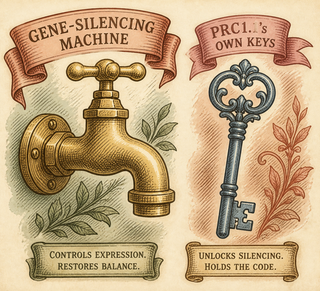
Mojallali and colleagues studied a gene-silencing machine called PRC1.1 in acute myeloid leukemia, or AML, and found that it does not behave like a simple upstream valve feeding into PRC2.2. Instead, PRC1.1 can keep genes shut down on its own, even when PRC2.2 is gone. Leukemia cells, naturally, use this arrangement to stay immature and avoid becoming useful adult blood cells. Very on brand.
The Cell Has Sticky Notes, Locks, and Bad Management
Your DNA is not just a recipe book sitting open on the counter. It is more like a city archive with locks, labels, bookmarks, and several exhausted clerks deciding which pages anyone gets to read.
Polycomb proteins are part of that filing system. They help keep certain genes quiet. This matters because cells need memory. A skin cell should not wake up and decide to become a neuron just because it had a difficult morning.
Two major Polycomb crews get a lot of attention: PRC1 and PRC2. PRC2 adds a repressive mark called H3K27me3. PRC1 adds another called H2AK119ub. If those names look like someone dropped a keyboard into a centrifuge, yes. Welcome to epigenetics.
PRC1.1 is a “non-canonical” PRC1 complex, which is science-speak for “same family, different toolbox.” One of its components is BCOR. That name shows up in AML because loss-of-function mutations in BCOR occur in myeloid cancers and often point to worse-risk disease Sportoletti et al., 2021. Prior work showed BCOR and BCORL1 mutations can disconnect PRC1.1 from proper gene repression, unleashing signaling programs that help leukemia behave badly Schaefer et al., 2022.
So, yes, BCOR matters. It is not decorative plumbing.
The Experiment: Yank Out the Parts and See Who Screams
The authors used degron models, which are basically molecular trapdoors. Add the right compound, and a chosen protein disappears quickly. This lets scientists ask what happens when PRC1.1 loses BCOR or KDM2B, another key PRC1.1 subunit.
When BCOR vanished, PRC1.1 target genes rapidly lost H2AK119ub, the PRC1-associated “keep quiet” mark. But H3K27me3, the PRC2 mark, largely stayed put. That is already suspicious. If PRC1.1 only worked by dragging PRC2.2 into place, you would expect the whole repression setup to collapse in a neat sequence.
It did not. Biology saw the neat sequence and filed a complaint.
Some genes woke up early. Others woke up later. The late risers tended to carry heavier repressive decoration, including H3K27me3. That suggests these genes were more deeply locked down, like the hospital printer settings menu that no one has successfully opened since 2014.
Then came the sharper test. The team removed JARID2 and AEBP2, components needed for PRC2.2. PRC1.1 loss still activated its target genes. They also knocked out SUZ12, which cripples PRC2 more broadly. Still, PRC1.1 loss could wake genes up. Not perfectly. But enough to make the point.
PRC1.1 is not just the guy calling PRC2.2. It has its own keys.
Why Leukemia Cares
AML is often a disease of cells that refuse to grow up. Myeloid precursor cells should mature into functioning blood cells. AML blasts instead loiter in the bone marrow, multiply, and generally turn hematopoiesis into a poorly supervised group project.
The striking part of this study is what happened when the authors hit both systems at once. PRC1.1 depletion plus PRC2 inhibition reduced leukemia cell growth and pushed cells toward differentiation. In K562 models, the cells began showing megakaryocytic markers such as CD61 and CD41. In THP-1 cells, combined targeting also worsened the growth disadvantage.
That is not the same as curing AML. Let us all take one calming sip before anyone writes the victory headline.
These were cell-line experiments using engineered degron systems and research inhibitors like GSK343 or UNC1999. Patients are not K562 flasks with insurance cards. Also, directly drugging PRC1.1 in a clean, selective, tolerable way remains a serious challenge.
But the concept is enticing: instead of simply poisoning leukemia cells, maybe you force some of them to mature out of their dangerous identity. Differentiation therapy already changed the story in acute promyelocytic leukemia. Extending that logic to broader AML would be a major prize, though the road is long and covered in grant applications.
The Real Takeaway, Without the Fog Machine
This paper argues that PRC1.1 and PRC2 cooperate to maintain leukemia’s immature state, but PRC1.1 can also repress genes independently of PRC2.2. That matters because combination targeting may be more powerful than blocking either pathway alone.
It also helps explain why AML biology can look contradictory. BCOR loss can contribute to leukemia in some contexts, yet BCOR-wild-type leukemic cells may depend on intact PRC1.1 activity. Cancer does this constantly. It takes a molecule, gives it two jobs, and then acts offended when we ask for clarity.
Still, the study gives us a better map. PRC1.1 is not a minor side pipe in the Polycomb plumbing. It is a separate shutoff valve helping leukemia cells keep differentiation genes silent. If future work confirms this in patient-derived models and finds practical ways to target the pathway, AML therapy may gain a new strategy: stop letting leukemia cells hide behind epigenetic locks, and make them grow up.
Relatable, honestly.
References
-
Mojallali F, De Meis A, Alkema SG, et al. Sustained PRC1.1 activity preserves gene repression independently of PRC2.2 and restrains leukemic cell differentiation. Nucleic Acids Research. 2026. DOI: 10.1093/nar/gkag529
-
Sportoletti P, Sorcini D, Falini B. BCOR gene alterations in hematologic diseases. Blood. 2021;138(24):2455-2468. DOI: 10.1182/blood.2021010958. PMCID: PMC8887995
-
Schaefer EJ, Wang H, Karp HQ, et al. BCOR and BCORL1 mutations drive epigenetic reprogramming and oncogenic signaling by unlinking PRC1.1 from target genes. Blood Cancer Discovery. 2022;3(2):116-135. DOI: 10.1158/2643-3230.BCD-21-0115. PMCID: PMC9414116
-
Sugishita H, Kondo T, Ito S, et al. Variant PCGF1-PRC1 links PRC2 recruitment with differentiation-associated transcriptional inactivation at target genes. Nature Communications. 2021;12:5341. DOI: 10.1038/s41467-021-24894-z. PMCID: PMC8429492
-
Parreno V, Martinez AM, Cavalli G. Mechanisms of Polycomb group protein function in cancer. Cell Research. 2022;32:231-253. DOI: 10.1038/s41422-021-00606-6
Disclaimer: The image accompanying this article is for illustrative purposes only and does not depict actual experimental results, data, or biological mechanisms.