Solve for x: if one tumor contains billions of cells, each cell can rewrite parts of its survival playlist, and your immune system has to catch every bad remix before it goes platinum, what is x? Roughly: a very tired T cell standing under fluorescent lights, wondering why cancer biology always orders the combo meal.
That is the central problem in adaptive resistance, the topic of a 2026 review by Yang and colleagues in Cellular & Molecular Immunology https://doi.org/10.1038/s41423-026-01424-9. Immunotherapy can make cancer treatment feel like a key change in a great jazz solo: suddenly the immune system is not background music anymore. It is the band.
But sometimes the tumor changes tempo.
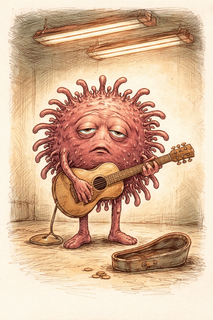
The Immune System Has a Great Setlist, Until the Tumor Starts Heckling
Cancer immunotherapy is built on a gorgeous idea: your immune system can recognize cancer cells as trouble and attack them. T cells are the featured players here, tiny cellular musicians with knives, basically. Checkpoint inhibitors such as anti-PD-1 and anti-CTLA-4 try to remove the brakes that tumors exploit to quiet those T cells.
When it works, it can work beautifully. Some patients get long remissions that would have sounded like science fiction a generation ago.
The problem is that many patients do not respond, or they respond at first and then the cancer returns with a new arrangement. Yang and colleagues describe two big versions of this mess. First, the tumor starts growing again during treatment after an initial response, because the immune attack cannot kill enough cancer cells. Second, the patient reaches remission, but later relapses because the immune system fails to build durable antitumor memory.
Same club, different bad lighting.
T Cells Get Exhausted, Because Apparently Even Cells Have Burnout
T-cell exhaustion is not laziness. It is what happens when T cells face chronic stimulation, suppressive signals, poor nutrients, low oxygen, and a tumor microenvironment that behaves like a sketchy neighborhood where every streetlight is broken.
Exhausted T cells often express inhibitory receptors such as PD-1, CTLA-4, LAG-3, TIM-3, and TIGIT. They lose killing power. They divide less. Their gene programs and epigenetic settings can become locked into a less flexible state. In music terms, the T cell is still on stage, but someone detuned the instrument, stole the sheet music, and replaced the drummer with a fax machine.
Recent reviews have sharpened this picture. Chow and colleagues explained that exhaustion has real clinical consequences for checkpoint inhibitors and CAR T-cell therapies, but also warned that simply “reinvigorating” every exhausted cell may not be enough https://doi.org/10.1038/s41571-022-00689-z. Vignali and colleagues framed exhaustion as a regulated state shaped by transcriptional and epigenetic programs, not just a tired-cell shrug https://doi.org/10.1146/annurev-immunol-090222-110914.
That matters because checkpoint blockade seems to work best on T cells that are exhausted but not terminally cooked. The “somewhat worn down but still reachable” T cells can respond. The deeply exhausted ones may stare at anti-PD-1 therapy like it is a motivational poster in a break room.
Immunoediting: Cancer Learns the Tune
The immune system does not just attack tumors. It edits them.
This process, called cancer immunoediting, means immune pressure can eliminate sensitive cancer cells while leaving behind variants that hide better, present fewer antigens, resist killing, or remodel their surroundings. It is natural selection with worse branding.
A tumor might lose antigen presentation, block T-cell entry, recruit suppressive immune cells, or flood the area with signals that dampen attack. The tumor microenvironment becomes less concert hall, more exclusive nightclub where the T cells are technically on the guest list but somehow never get past the rope.
Yang and colleagues argue that adaptive resistance sits right at this moving balance between immune attack and tumor evasion. The cancer is not always “immune invisible” from the start. Sometimes it becomes harder to hit because treatment pressure changes the ecosystem.
The Memory Problem: No Encore, No Cure
One of the review’s strongest points is that killing tumor cells today is not the whole gig. The immune system also needs memory.
Antitumor immunological memory means the body can recognize and respond if cancer tries to come back. Without that durable memory, remission can become a pause instead of a finish. That is the relapse scenario: the first solo sounded great, but nobody wrote down the changes for the encore.
This is why researchers are studying stem-like exhausted T cells, tumor-draining lymph nodes, combination therapies, vaccines, cytokines, metabolic rewiring, and epigenetic interventions. A 2022 Nature study found that combining PD-1 blockade with IL-2 could reshape exhausted CD8 T-cell programs in ways PD-1 blockade alone did not https://doi.org/10.1038/s41586-022-05257-0. A 2024 Cell study showed that blocking both LAG-3 and PD-1 can push CD8 T cells into a state combining cytotoxic and exhaustion-related gene modules, which sounds contradictory until you remember biology loves a messy chord https://doi.org/10.1016/j.cell.2024.06.036.
The Next Key Change
If this line of research keeps holding up, future immunotherapy may become less like pressing one big “immune boost” button and more like conducting a band: restore killing power, preserve memory, prevent terminal exhaustion, open access to the tumor, and stop the tumor from changing the tune every eight bars.
That could mean smarter combinations, better timing, and biomarkers that tell doctors whether a patient’s T cells are ready to swing or already face-down on the piano.
Cancer will still improvise. That is what makes it dangerous. But the better scientists understand adaptive resistance, the better chance clinicians have of answering with a sharper, louder, more durable immune response.
References
-
Yang K, Yang C, Xiong K, Hao J, Ye L. Adaptive resistance in cancer immunotherapy. Cellular & Molecular Immunology. 2026. DOI: 10.1038/s41423-026-01424-9
-
Chow A, Perica K, Klebanoff CA, Wolchok JD. Clinical implications of T cell exhaustion for cancer immunotherapy. Nature Reviews Clinical Oncology. 2022;19:775-790. DOI: 10.1038/s41571-022-00689-z
-
Vignali PDA, DePeaux K, Watson MJ, et al. T Cell Exhaustion. Annual Review of Immunology. 2024;42:179-206. DOI: 10.1146/annurev-immunol-090222-110914
-
Hashimoto M, Araki K, Cardenas MA, et al. PD-1 combination therapy with IL-2 modifies CD8+ T cell exhaustion program. Nature. 2022;610:173-181. DOI: 10.1038/s41586-022-05257-0. PMCID: PMC9793890
-
Cillo AR, Cardello C, Shan F, et al. Blockade of LAG-3 and PD-1 leads to co-expression of cytotoxic and exhaustion gene modules in CD8+ T cells to promote antitumor immunity. Cell. 2024;187:4373-4388.e15. DOI: 10.1016/j.cell.2024.06.036
Disclaimer: The image accompanying this article is for illustrative purposes only and does not depict actual experimental results, data, or biological mechanisms.