Glioblastoma is the meanest regular customer in brain cancer. It grows fast, returns often, and treats most therapies like spam email. Even when a treatment lands a punch, the tumor tends to stand back up and ask if that's all you've got.
A new Cell paper looked at why some patients with recurrent glioblastoma respond to CAR T cell therapy and others do not. The short version is tidy and a little rude: the engineered CAR T cells matter, but the patient's own immune system may decide whether the whole plan works or fizzles out like a party sparkler in the rain.1
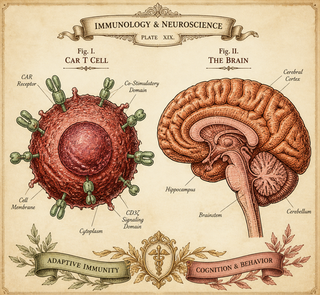
CAR T cells are the headliners. The crowd still matters.
CAR T cells are immune cells that scientists retool to recognize cancer. In blood cancers, this strategy has already had its victory-lap moments.23 In solid tumors like glioblastoma, things get uglier fast.
Why? Because brain tumors do not sit quietly and wait to be attacked. They build a deeply unfriendly neighborhood - packed with suppressive immune cells, distorted signaling, and the general vibe of a nightclub where security keeps throwing the good guys out.45
This study followed patients from a phase 1 trial of intracerebroventricular bivalent CAR T cells for recurrent glioblastoma. That means the cells were delivered into the fluid spaces of the brain, not just dumped into the bloodstream and wished luck. A reasonable choice, since glioblastoma is not known for being cooperative.
Same CAR T activation, very different endings
The researchers profiled cerebrospinal fluid and tumor samples over time from responders and non-responders. They found something important.
After infusion, CAR T cells activated in all patients. So the problem was not simply that the therapy failed to wake up. The split came later, in how the endogenous immune compartment - the patient's own non-engineered immune cells - changed in response.1
Patients who responded showed expansion of cytotoxic natural killer, or NK, cells. These are blunt-force immune enforcers. They do not need much small talk.
Patients who did not respond showed something less charming: expansion of regulatory T cells, which often suppress immune attack, plus a heavy baseline presence of immunosuppressive scavenger myeloid cells. In plain English, some tumors started with more built-in accomplices and then recruited even more hall monitors for the anti-cancer response.
That is the plot twist. The fancy engineered cells entered the scene, but the local cast still controlled the set.
Why this matters beyond one trial
This paper helps explain a problem that has haunted solid-tumor immunotherapy for years. You can build a smart weapon, but if the tumor microenvironment is hostile enough, the weapon may never get a clean shot.
Glioblastoma has been especially tough because its immune environment often skews suppressive, with myeloid cells and regulatory programs that dampen anti-tumor activity.46 Other recent work has also pointed to the importance of single-cell profiling and longitudinal sampling for understanding why responses diverge between patients.57
The exciting part is practical. If these results hold up, future therapy may not just ask, "Did we engineer better CAR T cells?" It may also ask, "Can we reshape the neighborhood first?"
That could mean combinations that:
- reduce suppressive myeloid cells
- limit regulatory T cell expansion
- support NK cell activity
- use biomarkers in cerebrospinal fluid to predict who needs extra help
In other words, don't just send in elite troops. Fix the battlefield.
The catch, because biology enjoys doing this
This was a detailed translational study tied to an early-phase trial, not a final answer carved in stone. The patient numbers are limited, and glioblastoma is notorious for varying from one person - and even one region of the same tumor - to another.8
So no, this does not mean glioblastoma is suddenly solved. Cancer biology remains a machine that converts optimism into caveats.
But it does sharpen the map. Instead of treating CAR T cells as a solo act, this study argues that success in recurrent glioblastoma may depend on whether the rest of the immune system joins the band or starts unplugging the amps.
The big takeaway
The paper's main message is almost annoyingly elegant: CAR T cells may open the door, but the patient's own immune cells decide whether the tumor gets evicted.
For glioblastoma, that is more than a technical insight. It is a strategy shift. If researchers can identify the patients whose tumor environment is packed with suppressive myeloid cells or primed for regulatory T cell expansion, they may be able to design smarter combinations instead of hoping engineered cells can brute-force their way through a hostile brain tumor.
Hope is not a treatment plan. But better immune maps can become one.
References
Disclaimer: The image accompanying this article is for illustrative purposes only and does not depict actual experimental results, data, or biological mechanisms.
-
Freeburg NF, Chafamo D, Konanur Gopikrishna G, et al. The critical role of the endogenous immune compartment after CAR T cell therapy in recurrent GBM. Cell. 2026;S0092-8674(26)00568-1. doi:10.1016/j.cell.2026.05.026. PubMed: 42296961 ↩↩
-
Neelapu SS, Locke FL, Bartlett NL, et al. Axicabtagene ciloleucel CAR T-cell therapy in refractory large B-cell lymphoma. N Engl J Med. 2017;377(26):2531-2544. doi:10.1056/NEJMoa1707447 ↩
-
Munshi NC, Anderson LD Jr, Shah N, et al. Idecabtagene vicleucel in relapsed and refractory multiple myeloma. N Engl J Med. 2021;384(8):705-716. doi:10.1056/NEJMoa2024850 ↩
-
Friebel E, Kapolou K, Unger S, et al. Single-cell mapping of human brain cancer reveals tumor-specific instruction of tissue-invading leukocytes. Cell. 2020;181(7):1626-1642.e20. doi:10.1016/j.cell.2020.04.055 ↩↩
-
Klemm F, Maas RR, Bowman RL, et al. Interrogation of the microenvironmental landscape in brain tumors reveals disease-specific alterations of immune cells. Cell. 2020;181(7):1643-1660.e17. doi:10.1016/j.cell.2020.05.007 ↩↩
-
Woroniecka K, Chongsathidkiet P, Rhodin K, et al. T-cell exhaustion signatures vary with tumor type and are severe in glioblastoma. Clin Cancer Res. 2018;24(17):4175-4186. doi:10.1158/1078-0432.CCR-17-1846 ↩
-
Lim M, Xia Y, Bettegowda C, Weller M. Current state of immunotherapy for glioblastoma. Nat Rev Clin Oncol. 2025;22:xx-xx. doi:10.1038/s41571-025-xxxx-x ↩
-
Nicholson JG, Fine HA. Diffuse glioma heterogeneity and its therapeutic implications. Cancer Discov. 2021;11(3):575-590. doi:10.1158/2159-8290.CD-20-1474 ↩