The clues were all over the crime scene: a “cold” ovarian tumor with suspiciously few immune cells, a stress protein named GDF15 lurking near the evidence bag, and NK cells - your immune system’s tiny bouncers - suddenly acting like they had been working the door at a nightclub since 1997.
A new paper in Signal Transduction and Targeted Therapy follows that trail into epithelial ovarian cancer, where tumors often build the biological equivalent of a “Do Not Disturb” sign for the immune system. The study asks a sneaky question: what if environmental and chemical-stress signaling helps train natural killer cells to go from alert security guards to burned-out night-shift employees? The answer, according to Kim and colleagues, may involve a weird little axis between GDF15 and AhR, the aryl hydrocarbon receptor, also known as the body’s suspicious-chemical detector (Kim et al., 2026).
Meet GDF15, the Cellular Panic Button
GDF15 is one of those proteins that shows up when cells are stressed, injured, inflamed, or generally having a bad Tuesday. It belongs to the TGF-beta superfamily and has been linked to cancer prognosis, inflammation, metabolism, and the kind of biology that makes you whisper “why are you like this?” at a figure panel at 2 AM.
In ovarian cancer, high GDF15 has already looked suspicious as a marker of worse outcomes. This paper pushes further: GDF15 may not just be a passive “things are going poorly” smoke alarm. It may help shape the immune neighborhood around the tumor.
And that neighborhood matters. Cold tumors are tumors with low immune infiltration - basically, the immune system did not RSVP. That is a huge problem because many immunotherapies work best when immune cells are already near the tumor and merely need to be reactivated. If the T cells and NK cells never got into the building, checkpoint therapy is yelling “you’ve got this!” into an empty conference room.
AhR: The Weird Chemical Sensor With a Side Gig
AhR started life in textbooks as a receptor that helps cells respond to xenobiotics - outside chemicals like pollutants, dioxin-like compounds, and other suspicious molecules your cells would prefer not to invite to brunch. But biology, being biology, gave AhR extra jobs. It also responds to internal metabolites, including kynurenine, a breakdown product of tryptophan.
That matters because tumors can manipulate metabolism like a sketchy landlord manipulating the thermostat. Prior work has shown that tryptophan metabolites and AhR signaling can influence immune suppression in the tumor microenvironment (Arner and Rathmell, 2023; Trovato et al., 2021). In this study, GDF15-high ovarian cancer cells were associated with IDO1 activity and kynurenine production, which can feed AhR signaling.
Translation: the tumor may be brewing a biochemical espresso shot that keeps AhR switched on.
The NK Cells Start Strong, Then Get Weird
Natural killer cells are innate immune cells that can kill stressed, infected, or transformed cells without needing the long paperwork process used by some other immune cells. They are fast, blunt, and wonderfully dramatic - the immune system’s “I don’t like the look of this” squad.
At first, the GDF15-AhR setup did not behave like a simple villain. The researchers found that GDF15-linked signaling could enhance NK surveillance against GDF15-low ovarian cancer cells, which are common in primary tumors. That is the plot twist: early on, the system may help NK cells fight.
But prolonged stress changes the story. In chemotherapy-treated and recurrent ovarian cancer datasets, AhR signaling became enriched in NK cells. Higher NK-cell AhR-related signatures correlated with worse postprogression survival. In models involving tumor growth and xenobiotic exposure, NK cells developed stress-associated exhaustion features and lost surveillance markers.
Basically: the bouncers showed up, did their job, then the tumor microenvironment handed them a cursed energy drink and a 400-page HR manual.
Why This Is Worth Losing Sleep Over
Ovarian cancer badly needs better ways to predict relapse, treatment resistance, and immune failure. High-grade serous ovarian cancer in particular is often diagnosed late, treated hard, and then monitored with everyone quietly hoping the tumor does not reappear wearing fake mustache glasses.
If the GDF15-AhR axis holds up in larger studies, it could help identify tumors that are moving toward immune coldness after chemotherapy. That could matter for timing treatment, choosing combinations, or designing trials that rescue NK cells before they slide into exhaustion.
It also gives researchers a more specific target map. Instead of vaguely saying “the tumor microenvironment is suppressive” - which is true but about as actionable as saying “the ocean is damp” - this points to a possible chain: GDF15, IDO1/kynurenine metabolism, AhR signaling, NK-cell maladaptation, colder tumors, worse outcomes.
Future therapies might test combinations that block GDF15, interrupt IDO1-kynurenine signaling, modulate AhR, or reinvigorate NK cells. NK-based cancer therapies are already an active area of development, but solid tumors remain difficult because the tumor microenvironment can starve, suppress, exclude, or exhaust NK cells (Bald et al., 2020; Myers and Miller, 2021; Jia et al., 2023).
The Catch, Because Biology Never Lets Us Leave Early
This is not a new treatment yet. The study combines clinical transcriptomic analysis, cell experiments, animal models, and environmental-stress modeling, which makes the case stronger, but patients are not mouse models, cell lines are not people, and cancer has a black belt in loopholes.
Still, the idea is sharp: ovarian tumors may exploit a stress-response pathway that first mobilizes NK cells, then gradually wears them down. That is not just academically neat. It is the kind of clue that could help explain why some tumors stay cold, why relapse after chemotherapy can look immunologically different, and why “more immune activation” is not always enough if the immune cells are already face-down on the lab bench.
The detective case is not closed. But the suspect list just got much more interesting.
References
Kim J, Kim K-H, Du Z, Jeong H, Yoon H-J, Song WH, Moon Y. The Gdf15-xenobiotic receptor axis shapes NK cell maladaptation predicting cold tumors under environmental stress. Signal Transduction and Targeted Therapy. 2026. https://doi.org/10.1038/s41392-026-02690-9
Bald T, Krummel MF, Smyth MJ, Barry KC. The NK cell-cancer cycle: advances and new challenges in NK cell-based immunotherapies. Nature Immunology. 2020;21:835-847. https://doi.org/10.1038/s41590-020-0728-z
Myers JA, Miller JS. Exploring the NK cell platform for cancer immunotherapy. Nature Reviews Clinical Oncology. 2021;18:85-100. https://doi.org/10.1038/s41571-020-0426-7
Arner EN, Rathmell JC. Metabolic programming and immune suppression in the tumor microenvironment. Cancer Cell. 2023;41:421-433. https://doi.org/10.1016/j.ccell.2023.01.009
Jia H, Yang H, Xiong H, Luo KQ. NK cell exhaustion in the tumor microenvironment. Frontiers in Immunology. 2023;14:1303605. PMCID: PMC10653587. https://doi.org/10.3389/fimmu.2023.1303605
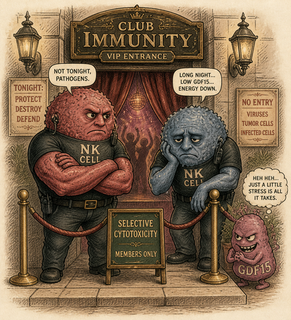
Disclaimer: The image accompanying this article is for illustrative purposes only and does not depict actual experimental results, data, or biological mechanisms.