Ovarian cancer has a talent for behaving like the most slippery creature on the savanna - quiet at first, then suddenly everywhere, having already learned how to dodge the usual predators. In this new study, researchers asked a smart question: what if we stop judging a tumor by one flashy gene and instead watch the whole ecosystem, especially the cells that die, the cells that should die, and the cells that technically retired but keep hanging around like they still have opinions about the office thermostat? [1]
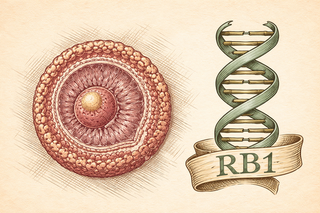
When cells refuse to leave the campsite
Two big ideas drive this paper: cell death and senescence.
Cell death is the obvious one. A damaged cell realizes the gig is up and exits the stage. Senescence is weirder. A senescent cell stops dividing, which sounds helpful, but it does not simply vanish in a puff of biological dignity. It lingers. It sends signals. It reshapes the neighborhood. Sometimes that helps the immune system spot trouble. Sometimes it turns the tumor microenvironment into a swamp where cancer cells can hide, adapt, and keep plotting [2,3].
That matters in ovarian cancer, where the microenvironment often behaves less like a clean battlefield and more like dense brush full of mixed signals, exhausted T cells, suppressive myeloid cells, and bad timing. This is one reason immunotherapy has had a rougher road here than in melanoma or lung cancer. The immune system shows up, looks around, and apparently decides the venue is not ideal [4,5].
The AI birdwatcher enters the marsh
Yu and colleagues built a machine learning model around genes linked to cell death and senescence, then used it to create what they call the Cell Death and Senescence Learning Signature, or CDSLS. They tested it across multiple ovarian cancer cohorts totaling 1,858 patients, plus immunotherapy datasets [1].
What did the signature do? It separated tumors into more dangerous and less dangerous ecological zones. High CDSLS scores tracked with poorer survival and a more immunosuppressive environment. In plain English: the tumors that scored badly looked better at building a moat.
The team did not stop at bulk data. They layered in multi-omics analysis and single-cell RNA sequencing to see which creatures were occupying the territory. That matters because ovarian cancer is famously heterogeneous. Two tumors can share a zip code and still behave like completely different species.
RB1, unexpectedly stealing the scene
The standout gene here was RB1, a classic tumor suppressor with a résumé longer than most of us keep on LinkedIn. In this study, RB1 was not just passively associated with outcome. The researchers actually pushed it around in lab models.
When they knocked RB1 down, ovarian cancer cells proliferated more and showed less senescence. When they overexpressed RB1, the opposite happened: more senescence, more DNA damage signaling, and better activation of CD8+ T cells, which are the immune system's sharper-nosed hunters [1].
In mouse experiments, tumors with higher RB1 grew less and attracted more immune infiltration. That is the kind of result that makes researchers sit up a little straighter and say, very calmly, "well, that is interesting," while internally doing jazz hands.
This fits with a broader picture emerging in the field. Senescence is not simply good or bad. It is context-dependent. In some settings, senescent tumor cells can become more visible to immune attack. In others, senescence-associated signaling can feed chronic inflammation and tumor support. Biology, as usual, refuses to be a tidy screenplay [2,3,6].
Why this is more than a fancy risk score
The most interesting part of the paper is not just prognosis. Plenty of signatures can tell you a tumor is bad news after the fact. The more useful question is: can the signature point toward treatment choices?
Here, the answer is maybe - and that is a meaningful maybe. The authors linked CDSLS to differential drug sensitivity, including agents such as brivanib and azacitidine, and used AI-based structural tools to predict small molecules that might target RB1-related vulnerabilities, including a compound called ZINC001175043471 [1].
That puts this work in the growing category of "not just what is the tumor doing, but what might actually corner it." Ovarian cancer badly needs that kind of map. Reviews and clinical studies over the past few years keep landing on the same theme: immune checkpoint drugs alone have generally underperformed, and the real future probably lies in combinations guided by better biomarkers and a clearer readout of the tumor microenvironment [4,5]. Recent spatial mapping studies of high-grade serous ovarian cancer make the same point from another angle - immune evasion is not random chaos, it is organized chaos [6].
The part where we keep our lab goggles on
This is not a ready-for-clinic victory lap. The paper is strong in scope, but much of the signature work is computational and retrospective, and the drug predictions still need serious real-world validation. Also, RB1 biology is complicated. If cancer research were a nature documentary, this would be the moment the narrator says, "and just when the expedition believed it had found the trail, the marsh produced another surprise."
Still, the study gives us something valuable: a way to connect senescence, immune behavior, and drug design in one framework rather than treating them like separate weather reports.
And in ovarian cancer, where the beast often survives by changing the landscape around it, learning the landscape may be half the hunt.
References
- Yu G, Yuan Q, Sun Z, et al. A machine learning-driven framework integrating cell death and senescence signatures for multi-target drug design and immunotherapy optimization in ovarian cancer. npj Precision Oncology. Published online April 26, 2026. doi:10.1038/s41698-026-01448-4
- Chibaya L, Snyder J, Ruscetti M. Senescence and the tumor-immune landscape: Implications for cancer immunotherapy. Semin Cancer Biol. 2022;86(Pt 3):827-845. doi:10.1016/j.semcancer.2022.02.005 PMCID:PMC9357237
- Ruhland MK, Alspach E. Senescence and Immunoregulation in the Tumor Microenvironment. Front Cell Dev Biol. 2021;9:754069. doi:10.3389/fcell.2021.754069 PMCID:PMC8529213
- Gupta R, Kumar R, Penn CA, Wajapeyee N. Immune evasion in ovarian cancer: implications for immunotherapy and emerging treatments. Trends Immunol. 2025;46(2):166-181. doi:10.1016/j.it.2024.12.006
- Leary A, Tan D, Ledermann J. Immune checkpoint inhibitors in ovarian cancer: where do we stand? Ther Adv Med Oncol. 2021;13:17588359211039899. doi:10.1177/17588359211039899 PMCID:PMC8377306
- Yeh CY, Aguirre K, Laveroni O, et al. Mapping spatial organization and genetic cell-state regulators to target immune evasion in ovarian cancer. Nat Immunol. 2024;25(10):1943-1958. doi:10.1038/s41590-024-01943-5 PMCID:PMC11436371
Disclaimer: The image accompanying this article is for illustrative purposes only and does not depict actual experimental results, data, or biological mechanisms.