Forget that T cells are always brave little cancer-fighting knights. Forget that “boosting the immune system” means flooring the gas pedal and hoping nobody hits a tree. Forget that exhausted T cells are useless couch potatoes in microscopic sweatpants. In this new study, the plot is more interesting: some tired T cells may still be the exact cells you want to help, if you can deliver the pep talk directly to their doorstep.
The paper, published in Signal Transduction and Targeted Therapy, focuses on a familiar immunotherapy headache: tumors are full of T cells that recognize cancer, but many of them become exhausted. Not sleepy in the “grad student after journal club” way, though honestly, relatable. Exhausted T cells lose killing power, express inhibitory receptors, and generally behave like security guards who have been working a double shift in a sketchy neighborhood with no snacks.
The Weirdly Useful Name Tag: LAG3
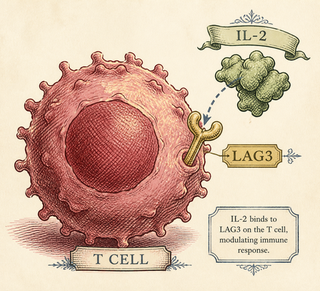
LAG3 is an immune checkpoint receptor found on activated and exhausted T cells. In cancer, it often shows up on tumor-infiltrating lymphocytes, especially CD8+ T cells that have been hanging around the tumor microenvironment too long. That makes LAG3 a brake, but also a useful address label.
Clinically, LAG3 is already a real target. The FDA approved nivolumab plus relatlimab, a PD-1 plus LAG3-blocking combination, for unresectable or metastatic melanoma in 2022. That approval came after RELATIVITY-047 showed better progression-free survival than nivolumab alone. So LAG3 is not some random molecular doodle in the margins. It is already in the immunotherapy conversation, wearing a name badge and trying not to spill coffee.
This study asks a sharper question: what if LAG3 is not only something to block, but also a delivery address?
IL-2: Great Cytokine, Terrible Freelance Driver
Interleukin-2, or IL-2, is a cytokine that helps T cells grow, activate, and form immune memory. It has a long cancer immunotherapy history, including melanoma and kidney cancer, but traditional IL-2 can be messy. It spreads through the body, has a short half-life, can cause toxicity at high doses, and may feed regulatory T cells, which are the immune system’s “everyone calm down” department. Useful in moderation. Less useful when you are trying to fight a tumor.
The researchers built a fusion protein called LAG3-LaIL2: an anti-LAG3 targeting component linked to a low-affinity IL-2 variant. Translation: instead of blasting IL-2 everywhere like a confetti cannon in a hospital hallway, they tried to hand-deliver a gentler IL-2 signal to LAG3+ CD8+ T cells inside tumors.
That is a fascinating idea. Yes, I said fascinating. I am legally required by my inner grad student.
What Happened in the Mice?
In MC38 colon cancer models, the authors found that tumor-specific CD8+ T cells were largely LAG3-positive, but their IL-2 signaling looked impaired as tumors progressed. The LAG3-LaIL2 treatment restored IL2R-JAK3-STAT5 signaling, increased CD122, and shifted T cells away from terminal exhaustion toward pre-exhausted and intermediate effector-like states.
Put less alphabetically: it helped the tired-but-not-dead T cells stay useful.
The treatment improved tumor control in multiple mouse models, including MC38 colon cancer, CT26 colon tumors, and B16-F10 melanoma. In a humanized mouse model implanted with pancreatic cancer cells, the treatment produced complete tumor eradication. That sentence is impressive, but please imagine me underlining “mouse model” three times while nervously clearing my throat. Preclinical wins are exciting. They are not the same as human benefit.
The authors also showed that CD8+ T cells were required for the therapy’s effect. Depleting CD8+ cells wiped out the benefit, while NK and CD4+ depletion did not appear essential. The treatment also seemed to generate systemic antitumor immunity, with effects on untreated distant tumors and tumor-specific T cells appearing in blood and draining lymph nodes.
Why This Could Matter
If these results reproduce and expand into human studies, the real-world impact could be substantial. Solid tumors often resist checkpoint inhibitors because the immune cells inside them are battered, suppressed, or stuck in bad functional states. This strategy tries to solve two problems at once: identify the tumor-reactive T cells by their LAG3 expression, then give them a carefully aimed IL-2 signal before they slide into terminal exhaustion.
That is the immunotherapy equivalent of finding the right exhausted employee and giving them caffeine, backup, and access to the building. Not perfect management science, but better than emailing the entire company “pls be productive.”
The safety angle also matters. Targeted cytokine therapy could, in theory, reduce the systemic toxicity that has limited older IL-2 approaches. The study reported minimal toxicity in treated mice compared with constructs using wild-type IL-2, which is encouraging. Still, humans are not large mice with better insurance paperwork. We need pharmacokinetics, dose-finding, immune toxicity data, tumor-type selection, biomarkers, and boring-but-essential clinical trial reality.
The Bottom Line
This paper presents a clever way to treat LAG3 not just as an immune brake, but as a GPS pin for exhausted tumor-specific T cells. By delivering low-affinity IL-2 directly to LAG3+ CD8+ T cells, the therapy helped preserve antitumor function, avoid terminal exhaustion, and trigger broader immune activity in preclinical models.
It is early. It is complicated. It is, unfortunately for my vocabulary restraint, fascinating.
References
-
Yu X, Liao H, Lv J, et al. Targeting tumor-specific T cells with LAG3-directed interleukin-2 prevents T-cell exhaustion and reinvigorates antitumor immunity. Signal Transduction and Targeted Therapy. 2026;11:207. https://doi.org/10.1038/s41392-026-02667-8
-
Andrews LP, Butler SC, Cui J, et al. LAG-3 and PD-1 synergize on CD8+ T cells to drive T cell exhaustion and hinder autocrine IFN-gamma-dependent anti-tumor immunity. Cell. 2024;187(16):4355-4372.e22. https://doi.org/10.1016/j.cell.2024.07.016
-
Tawbi HA, Schadendorf D, Lipson EJ, et al. Relatlimab and nivolumab versus nivolumab in untreated advanced melanoma. New England Journal of Medicine. 2022;386:24-34. https://doi.org/10.1056/NEJMoa2109970
-
Shouse AN, LaPorte KM, Malek TR. Interleukin-2 signaling in the regulation of T cell biology in autoimmunity and cancer. Immunity. 2024;57(3):414-428. https://doi.org/10.1016/j.immuni.2024.02.001
-
Spangler JB, Moraga I, Mendoza JL, Garcia KC. Insights into cytokine-receptor interactions from cytokine engineering. Annual Review of Immunology. 2023;41:139-168. https://doi.org/10.1146/annurev-immunol-101921-042337
Disclaimer: The image accompanying this article is for illustrative purposes only and does not depict actual experimental results, data, or biological mechanisms.