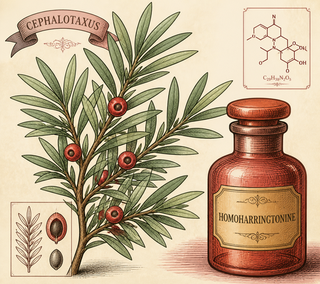
Somewhere in the evolutionary group chat, Cephalotaxus trees apparently decided that photosynthesis was not enough. They also started making elaborate alkaloids, including homoharringtonine, better known in drug form as omacetaxine, a compound used against certain leukemias. Casual hobby. Very "I knit sweaters and also interrupt cancer cell protein production."
The problem is that these molecules are not easy to get. Homoharringtonine comes from endangered plum yew relatives, and relying on rare trees for medicine is a little like asking the last Blockbuster to run Netflix. Chemists can help with semi-synthesis, but the starting material still has to come from somewhere. That bottleneck has haunted this field for decades.
In a new Cell paper, Tian and colleagues went after the missing recipe. They mapped the complete biosynthesis of cephalotaxinone and homoerythratine, two structurally related alkaloids in this medicinally valuable family, then rebuilt those pathways inside Nicotiana benthamiana, a tobacco cousin that plant biologists use the way Hollywood uses green screens: to make complicated things happen fast.
The Tree Had the Script, Scientists Found the Cast
Natural products are basically tiny chemical props made by living organisms. Some are boring background extras. Some become blockbuster drugs. Cephalotaxus alkaloids land in the second category because homoharringtonine can block protein synthesis at the ribosome, which is terrible news for fast-dividing cancer cells that need constant molecular construction crews.
But plants do not hand over their recipes in a cute little cookbook. They hide them across genes, tissues, enzymes, and chemical intermediates. Tian's team used multi-omics, meaning they combined different layers of biological data, plus synthesized standard compounds, to identify the enzymes that build these alkaloid skeletons step by step.
This matters because knowing the pathway changes the game. Instead of harvesting scarce plants and hoping chemistry can clean up the mess, researchers can start thinking about engineered production: put the right genes into a workable host, feed it the right ingredients, and let biology do the assembly. Less "Indiana Jones raids the endangered forest," more "The Great British Bake Off, but with enzymes."
Two Enzymes Walk Into a Lab
The most cinematic twist involves two cytochrome P450 enzymes, CfCYP2 and CfCYP3. P450s are enzymes that often install oxygen atoms into molecules, which sounds simple until you realize they can redirect an entire chemical storyline. They are the directors who say, "Actually, in this cut, Spider-Man enters from the ceiling."
CfCYP2 and CfCYP3 are highly similar, yet they push oxidation in different directions, helping create two distinct alkaloid families. The researchers also identified key amino acid residues that influence those outcomes. Translation: tiny edits in the enzyme's active site can change which chemical scene gets filmed.
That is a big deal for synthetic biology. If scientists can understand why nearly matching enzymes make different products, they may eventually tune them to make useful analogs, improve yields, or build related molecules that nature never bothered to audition.
Why Cancer People Should Care
This paper is not saying, "New leukemia treatment drops tomorrow, ask your doctor for tree juice." Please do not do that. The immediate achievement is more foundational: a long-missing biosynthetic map.
But maps are how you stop wandering around the biochemical woods with a flashlight and vibes. Homoharringtonine and omacetaxine have a long clinical history in chronic myeloid leukemia, especially in settings involving resistance or intolerance to tyrosine kinase inhibitors, though treatment landscapes continue to evolve. The broader point is that difficult-to-source plant molecules can become easier to study, modify, and potentially manufacture once their pathways are known.
Recent work in plant synthetic biology has shown the same larger trend: researchers are increasingly turning plants like N. benthamiana into temporary biofactories for complex natural products. Other teams have rebuilt routes to molecules such as colchicine and etoposide-related intermediates, and reviews now frame pathway discovery as one of the main engines driving next-generation natural product production.
The Real-World Dream
If these findings reproduce and scale, the payoff could be practical: more sustainable access to rare alkaloid scaffolds, less pressure on endangered plant sources, and better tools for making new drug-like variants. Think of it as moving from bootleg VHS chemistry to a clean streaming library of biosynthetic options.
The hard parts are still hard. Engineered plants must make enough product. Pathways can clog, enzymes can misbehave, intermediates can be toxic, and scaling biology loves to humble everyone. Biology is a prestige TV series with twelve writers and no continuity supervisor.
Still, this study gives the field something it badly needed: a completed route through a chemically strange, medically relevant neighborhood. The trees had been guarding the recipe for years. Scientists finally got a look at the script.
References
-
Tian R, Lin F, Guo N, Liu C, Chen K, Han Y, Lan R, Li Q, Yan J, Lei X. Complete biosynthesis of the anticancer cephalotaxinone and homoerythratine. Cell. 2026. DOI: 10.1016/j.cell.2026.06.007
-
Dho Y, Smith K, Sattely ES. Discovery of homoharringtonine pathway enzymes reveals a whole plant model for coordinated biosynthesis. 2025. PMCID: PMC12407900, DOI: 10.1101/2025.08.26.672243
-
Zhu X, Liu X, Liu T, Wang Y, Ahmed N, Li Z, Jiang H. Synthetic biology of plant natural products: From pathway elucidation to engineered biosynthesis in plant cells. Plant Communications. 2021;2:100229. DOI: 10.1016/j.xplc.2021.100229
-
Nguyen TD, Dang TTT. Cytochrome P450 enzymes as key drivers of alkaloid chemical diversification in plants. Frontiers in Plant Science. 2021;12:682181. DOI: 10.3389/fpls.2021.682181
-
Nett RS, Sattely ES. Total biosynthesis of the tubulin-binding alkaloid colchicine. Journal of the American Chemical Society. 2021;143:19454-19465. DOI: 10.1021/jacs.1c08659
Disclaimer: The image accompanying this article is for illustrative purposes only and does not depict actual experimental results, data, or biological mechanisms.