Customer review, posted by a pancreatic tumor: "Five stars for Fra-2. Showed up whenever KRAS got blocked, rewired the whole office, kept growth signals humming, no notes." Which is funny right up until you remember the office in question is pancreatic ductal adenocarcinoma, a cancer with the social charm of a sinkhole.
That is the setup behind a new 2026 PNAS paper on Fra-2, a stress-response transcription factor, and its role in helping pancreatic cancer dodge MRTX-1133, a drug designed to hit KRAS G12D, the most common KRAS mutation in this disease [1]. If KRAS is the tumor's gas pedal, MRTX-1133 is supposed to jam a wrench into it. The problem, as cancer keeps reminding us with the confidence of a villain in the third act, is that tumors are very good at finding side streets.
The Tumor’s Backup Generator
A bit of background, because cancer biology is weird and refuses to introduce itself politely. KRAS is a signaling protein that helps cells decide when to grow, divide, and survive. In pancreatic ductal adenocarcinoma, KRAS is mutated in the large majority of cases, which means the growth signal can get stuck in the "on" position [2,3]. For years KRAS had a reputation as "undruggable," which in biotech is basically the scientific version of "this jar refuses to open, fetch a stronger cousin."
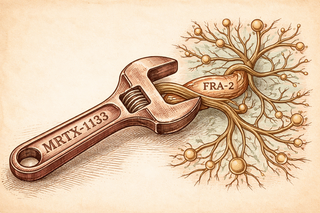
Then drugs like MRTX-1133 arrived, built to target the G12D version of KRAS with impressive preclinical activity [4]. That was the good news. The less festive news was that resistance showed up fast, because of course it did. As Heraclitus nearly said, no one steps into the same signaling pathway twice, because by then the pathway has already activated three backups and filed an appeal.
This new paper points a finger at Fra-2, also known as FOSL2, a member of the AP-1 family of transcription factors. AP-1 proteins act a bit like emergency editors for the cell, changing which genes get read when stress hits. The researchers found that when pancreatic cancer cells, xenografts, and patient-derived organoids encountered MRTX-1133, Fra-2 levels went up [1]. Not coincidentally, resistance went up with them.
When the Tumor Starts Freelancing
Why does Fra-2 matter? Because it does not just sit there looking biochemically moody. It appears to rewrite the tumor's survival program.
The study suggests Fra-2 helps resistant cells crank up mTOR, a major growth-and-survival pathway that cells use to sense nutrients, energy, and whether life is worth continuing in a Petri dish [1]. In other words, when KRAS gets blocked, the tumor may not simply give up and take up birdwatching. It recruits Fra-2, which helps switch on an alternate growth route through mTOR. That is less a simple detour and more a full municipal corruption scandal.
This fits with a broader pattern in recent pancreatic cancer research. Other groups have shown that KRAS inhibition often triggers adaptive responses rather than clean surrender. Some tumors reactivate ERBB signaling and become more vulnerable to combinations like MRTX-1133 plus afatinib [5]. Others slip into resistant cell states, including epithelial programs and PI3K-AKT-mTOR-associated escape routes [6,7]. Cancer, apparently, does not believe in monogamy with signaling pathways.
Why This Actually Matters Outside the Lab
The big appeal of this paper is not merely "we found another complicated protein doing complicated protein things." It is that the authors connect a specific stress-response factor, Fra-2, to a specific drug-resistance mechanism in a cancer that badly needs better options.
Pancreatic cancer remains one of the toughest major cancers to treat, and targeted therapy has lagged behind other tumor types. So when a KRAS G12D inhibitor shows real promise, the next question is immediate and merciless: what will the tumor do to ruin this? This paper offers one answer. It suggests resistance is not just random bad luck. It may be organized, transcriptionally programmed, and therefore potentially interruptible [1].
That opens the door to combination strategies. Not "MRTX-1133 cures pancreatic cancer, roll credits," because biology laughs at neat endings. More like: MRTX-1133 might work better and longer if paired with therapies that block the survival script Fra-2 helps write, or the mTOR pathway that script amplifies. That is still preclinical territory, so nobody should start composing victory sonnets. But it is the sort of mechanistic clue that turns a decent drug into a smarter treatment plan.
And perhaps that is the deeper lesson here, one cancer biologists keep relearning with slightly haunted eyes: tumors are not only fast-growing lumps of bad decisions. They are adaptable systems, opportunistic and annoyingly creative. If you block the front door, they check the windows, the basement, and whatever cursed architectural feature is represented by AP-1.
References
-
Testa E, Dezi C, Lovat F, et al. Fra-2 controls the response to the KRAS inhibitor MRTX-1133 in pancreatic ductal adenocarcinoma. Proc Natl Acad Sci U S A. 2026;123(18):e2601788123. DOI: 10.1073/pnas.2601788123. PubMed: 42054368
-
Drizyte-Miller K, Cox AD, Der CJ. KRAS: the Achilles' heel of pancreas cancer biology. J Clin Invest. 2025;135(16):e191939. DOI: 10.1172/JCI191939
-
Wei D, Wang L, Zuo X, Maitra A, Bresalier RS. A Small Molecule with Big Impact: MRTX1133 Targets the KRASG12D Mutation in Pancreatic Cancer. Clin Cancer Res. 2024;30(4):655-662. DOI: 10.1158/1078-0432.CCR-23-2098. PMCID: PMC10922474
-
Kemp SB, Cheng N, Markosyan N, et al. Efficacy of a Small-Molecule Inhibitor of KrasG12D in Immunocompetent Models of Pancreatic Cancer. Cancer Discov. 2023;13(2):298-311. DOI: 10.1158/2159-8290.CD-22-1066. PMCID: PMC9900321
-
Gulay KCM, Zhang X, Pantazopoulou V, et al. Dual Inhibition of KRASG12D and Pan-ERBB Is Synergistic in Pancreatic Ductal Adenocarcinoma. Cancer Res. 2023;83(18):3001-3012. DOI: 10.1158/0008-5472.CAN-23-1313. PMCID: PMC10502451
-
Dilly J, Lyu M, Zhang Y, et al. Mechanisms of Resistance to Oncogenic KRAS Inhibition in Pancreatic Cancer. Cancer Discov. 2024. DOI: 10.1158/2159-8290.CD-24-0177
-
Burkhart RA, Guibao CD, Lavallée VP, et al. A Classical Epithelial State Drives Acute Resistance to KRAS Inhibition in Pancreatic Cancer. Cancer Discov. 2024. DOI: 10.1158/2159-8290.CD-24-0740
Disclaimer: The image accompanying this article is for illustrative purposes only and does not depict actual experimental results, data, or biological mechanisms.