That last question sounds cold, but for patients and families it is painfully practical. How risky is this tumor? How much does surgery help? Which clues matter now, and which matter later? A new study in Radiology: Artificial Intelligence tries to answer that with a multimodal deep learning model that combines preoperative MRI, clinical details, and molecular markers to predict survival in glioblastoma more intelligently than MRI alone (Lee et al., 2026).
And honestly, this is where things get kind of fascinating. Sorry. I know that word is doing a lot of work in science writing, but in this case it earned its keep.
Your MRI is not a crystal ball, but maybe it can stop being a shrug
Glioblastoma is the most aggressive common primary brain cancer in adults. Even with surgery, radiation, and temozolomide chemotherapy, median survival is often only about 12 to 17 months. MRI is already the workhorse for diagnosis and follow-up, but turning scans into a meaningful survival forecast has been messy because glioblastoma is wildly heterogeneous. Two tumors can look somewhat similar on imaging and then behave like completely different villains.
Lee and colleagues pulled together data from 1,883 patients across institutional and public datasets. They used a Vision Transformer, which is a deep learning architecture built to spot patterns in images, to create an imaging score called a deep learning-based prognostic index. Then they combined that score with age, sex, Karnofsky performance status, extent of resection, IDH mutation, MGMT promoter methylation, histopathology, and WHO grade.
The result beat the image-only model. The multimodal version reached C-indexes of 0.77 internally and 0.73 and 0.63 on two external test sets, versus 0.73, 0.65, and 0.60 for MRI alone (Lee et al., 2026). In plain English: not magic, not destiny, but better-than-before odds of sorting patients into more realistic risk groups. In survival modeling, a C-index of 0.5 is coin-flip territory, so any consistent move upward matters.
The useful plot twist: prognostic factors are not equally bossy forever
The clever part was not just predicting survival. It was showing how the importance of each factor changed over time.
Extent of resection mattered most early, peaking around 12 months. MGMT promoter methylation, which often predicts better response to temozolomide, peaked around 24 months. Meanwhile, IDH mutation and WHO grade became more important later on (Lee et al., 2026). That makes intuitive sense once you stop and think about it. Surgery affects what is left behind right now. Chemo sensitivity matters during treatment. Underlying tumor biology keeps playing the long game like a deeply annoying chess opponent.
This time-dependent view fits with other recent work. The GRASP study in Neuro-Oncology showed that post-radiotherapy MRI plus clinical data can help predict which patients with IDH-wildtype glioblastoma will survive beyond 8 months after radiotherapy (Chelliah et al., 2024, PMCID: PMC11145448). Another Neuro-Oncology study found that physiologic MRI-defined tumor habitats predicted short-term outcomes in IDH-wildtype glioblastoma (Moon et al., 2025). Meanwhile, large multicenter analyses keep reinforcing that extent of resection is a big deal, especially when paired with molecular context like MGMT status (Karschnia et al., 2023, PMCID: PMC10158281; Park et al., 2024, PMCID: PMC12125701).
So the broader story is not "AI replaces doctors." It is more "AI helps organize the chaos." Which, frankly, is relatable.
Why this could matter in the real world
If these models keep holding up, they could help with treatment planning, trial enrollment, counseling, and follow-up scheduling. A patient whose imaging and molecular profile suggest higher early risk might need closer surveillance or faster trial consideration. A patient with a more favorable pattern might avoid some of the guesswork that currently makes glioblastoma care feel like trying to navigate a haunted house with a flashlight from 2009.
That said, limitations matter. This was retrospective. Performance dropped on external data, which is the part I always squint at because biology loves humbling neat models. Some outside datasets had missing variables that had to be imputed. And no matter how elegant the algorithm is, a survival estimate is still a probability, not a prophecy handed down from Mount MRI.
Still, this paper gets at something genuinely useful: prognosis is not one static number taped to the chart. It changes over time, and different signals matter at different moments. That is a much more human way to think about a disease that refuses to sit still.
References
Lee J, Jeon YH, Jang J, et al. Deep Learning for Survival Prediction in Glioblastoma: Time-dependent Model Interpretability Using MRI, Clinical, and Molecular Data. Radiology: Artificial Intelligence. 2026;8(3):e250675. DOI: https://doi.org/10.1148/ryai.250675
Chelliah A, et al. Glioblastoma and radiotherapy: A multicenter AI study for Survival Predictions from MRI (GRASP study). Neuro-Oncology. 2024;26(6):1138-1151. DOI: https://doi.org/10.1093/neuonc/noae017. PMCID: https://pmc.ncbi.nlm.nih.gov/articles/PMC11145448/
Moon HH, Park JE, Kim N, et al. Prospective longitudinal analysis of physiologic MRI-based tumor habitat predicts short-term patient outcomes in IDH-wildtype glioblastoma. Neuro-Oncology. 2025;27(3):841-853. DOI: https://doi.org/10.1093/neuonc/noae227
Karschnia P, Young JS, Dono A, et al. Prognostic validation of a new classification system for extent of resection in glioblastoma: A report of the RANO resect group. Neuro-Oncology. 2023;25(5):958-972. DOI: https://doi.org/10.1093/neuonc/noac193. PMCID: https://pmc.ncbi.nlm.nih.gov/articles/PMC10158281/
Park YW, Choi KS, Foltyn-Dumitru M, et al. Incorporating Supramaximal Resection into Survival Stratification of IDH-wildtype Glioblastoma: A Refined Multi-institutional Recursive Partitioning Analysis. Clinical Cancer Research. 2024;30(21):4866-4875. DOI: https://doi.org/10.1158/1078-0432.CCR-23-3845. PMCID: https://pmc.ncbi.nlm.nih.gov/articles/PMC12125701/
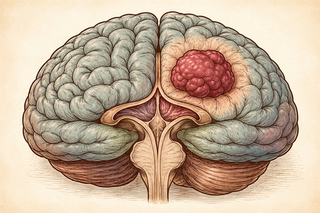
Disclaimer: The image accompanying this article is for illustrative purposes only and does not depict actual experimental results, data, or biological mechanisms.