The problem with many tumor-killing ideas is delivery: you can build the biochemical equivalent of the Death Star, but if it cannot reach the tumor, switch on in the right place, and avoid blasting healthy tissue, congratulations, you have invented expensive chaos.
That is why ultrasound-triggered cancer therapy keeps attracting attention. Ultrasound already knows how to sneak deep into the body without requiring a dramatic sci-fi portal. In the new study by Zhuang and colleagues, researchers took a material called calcium copper titanate, or CaCu3Ti4O12 if you enjoy chemistry formulas that look like Wi-Fi passwords, and engineered tiny missing oxygen spots into it. Those missing atoms, called oxygen vacancies, changed how the material behaved under ultrasound.
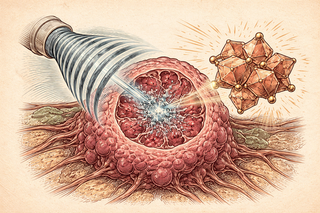
The result: a nanocatalyst designed to help tumor cells die in several different ways at once. Not one exit ramp. More like a Marvel finale where every hero arrives, the sky opens, and someone is definitely getting yeeted.
The Tiny Defect That Does the Big Job
CaCu3Ti4O12 is usually known as a dielectric material, meaning it responds to electric fields but is not automatically the first thing you would cast as the lead in a cancer therapy movie. The researchers changed that by adding oxygen vacancies. Think of an oxygen vacancy as an empty seat in a packed theater. It looks like absence, but in materials science, absence can be very bossy.
Those vacancies helped the material become piezoelectric, meaning it can generate electric charge when mechanically stimulated. Ultrasound provides that stimulation. Under ultrasound, the engineered particles separate electrical charges more effectively, which helps produce reactive oxygen species, or ROS. ROS are chemically aggressive molecules. In normal amounts, cells can handle them. In excess, they are like glitter after a craft party: everywhere, irritating, and impossible to ignore.
This matters because sonodynamic therapy, which uses ultrasound to activate sensitizers that produce tumor-damaging ROS, has long faced a basic challenge: making the sensitizer efficient enough inside tumors. Recent reviews describe ultrasound-based and piezoelectric biomedical approaches as promising but still dependent on better materials and smarter activation strategies Chen et al., 2023; Li et al., 2023.
Three Cell-Death Channels, One Very Bad Day
The study’s main trick is not just “make ROS.” It is the cascade.
First, ultrasound and the piezoelectric effect appear to disturb the cancer cell membrane, helping more of the material get into the cells. Once inside the tumor environment, the particles release copper and calcium ions. That matters because cells are extremely picky about ion balance. They are not chill. A little too much calcium or copper and suddenly the mitochondria, the cell’s tiny power plants, start behaving like the reactor room in a disaster movie.
The researchers propose that ROS plus calcium stress damages mitochondria and pushes cells toward apoptosis, the classic programmed cell death pathway. Apoptosis is the clean, scheduled “I am leaving this group chat” version of cell death, heavily governed by mitochondrial proteins Czabotar and Garcia-Saez, 2023.
Then copper enters the chat. In 2022, scientists described cuproptosis, a copper-triggered form of cell death tied to mitochondrial metabolism and lipoylated TCA cycle proteins Tsvetkov et al., 2022. In this new paper, copper release is meant to overload cancer cells and push them toward that copper-linked shutdown.
Finally, ROS and depletion of glutathione, a major antioxidant defense, may promote ferroptosis. Ferroptosis is iron-associated cell death driven by lipid damage, and cancer researchers are interested in it because some therapy-resistant cells may be vulnerable to this kind of biochemical trap Lee and Roh, 2023.
So the proposed sequence is: ultrasound activates the material, the material generates ROS, ions flood the cell, mitochondria get wrecked, copper handling collapses, antioxidant defenses weaken, and multiple death pathways pile on. It is less “silver bullet” and more “coordinated group project where, for once, everyone actually did the work.”
Why This Is Intriguing, With the Usual Lab-Coat Asterisks
The big appeal is control. Ultrasound can be aimed. The catalyst activates under ultrasound. Tumor chemistry, including high glutathione and abnormal redox balance, helps push the reaction forward. If this strategy holds up in larger studies, it could point toward treatments that use external energy to trigger local tumor damage while combining several biological pressures at once.
That said, this is early-stage nanomedicine, not a clinic-ready treatment. The key questions are the grown-up ones: How well do these particles accumulate in different tumors? How long do they stay in the body? What happens in healthy tissues exposed to ultrasound? Can manufacturing stay consistent? Does the immune system help, hinder, or file a complaint with management?
Still, the concept is clever. The researchers did not just add a drug to a nanoparticle. They redesigned a material so ultrasound could turn it into a catalytic troublemaker inside tumors. Cancer cells are famously adaptable, like villains who keep surviving the sequel. A therapy that pushes several self-destruct buttons at once might make adaptation harder.
For now, oxygen vacancy-engineered CaCu3Ti4O12 is a striking example of where cancer research is heading: less brute force, more smart activation, and a lot more chemistry doing stunts that would make a special-effects team jealous.
References
Zhuang Z, Han R, Hou Y, et al. Oxygen Vacancy-Engineered CaCu3Ti4O12 Nanocatalyst for Piezoelectrically Driven Cascade Apoptosis/Cuproptosis/Ferroptosis Therapy. Advanced Materials. 2026:e73482. https://doi.org/10.1002/adma.73482
Chen S, Zhu P, Mao L, et al. Piezocatalytic Medicine: An Emerging Frontier using Piezoelectric Materials for Biomedical Applications. Advanced Materials. 2023;35(25):e2208256. https://doi.org/10.1002/adma.202208256
Li Y, Chen W, Kang Y, et al. Nanosensitizer-mediated augmentation of sonodynamic therapy efficacy and antitumor immunity. Nature Communications. 2023;14:6973. https://doi.org/10.1038/s41467-023-42509-7
Tsvetkov P, Coy S, Petrova B, et al. Copper induces cell death by targeting lipoylated TCA cycle proteins. Science. 2022;375(6586):1254-1261. https://doi.org/10.1126/science.abf0529
Czabotar PE, Garcia-Saez AJ. Mechanisms of BCL-2 family proteins in mitochondrial apoptosis. Nature Reviews Molecular Cell Biology. 2023;24:732-748. https://doi.org/10.1038/s41580-023-00629-4
Lee J, Roh JL. Targeting GPX4 in human cancer: Implications of ferroptosis induction for tackling cancer resilience. Cancer Letters. 2023;559:216119. https://doi.org/10.1016/j.canlet.2023.216119
Disclaimer: The image accompanying this article is for illustrative purposes only and does not depict actual experimental results, data, or biological mechanisms.