“Metastases diverge markedly from their ancestral primary tumour,” the study authors write, which is scientist-speak for: the cancer did not just move house. It renovated, changed the locks, started a group chat, and may have opened branch offices.
That is the central puzzle in this Cancer Discovery research highlight on metastatic lung cancer: if you want to understand where advanced non-small cell lung cancer goes, when it goes, and what it becomes after it gets there, one tumor sample is like trying to solve a 1,000-piece jigsaw puzzle after your dog ate the sky pieces.
The Usual Suspect Was Not Acting Alone
Cancer metastasis is often described like a villain escaping headquarters: cells leave the primary tumor, travel through blood or lymph, and set up shop somewhere new. Clean story. Very movie-trailer friendly.
The newer picture is less “single getaway car” and more “badly supervised airport terminal.”
In the underlying Nature study highlighted here, researchers analyzed 501 primary and metastatic tumor samples from 24 people with non-small cell lung cancer in the TRACERx and PEACE programs. These were not just one-off biopsies. The team compared tumor samples across space, meaning different body sites, and across time, meaning from diagnosis through later disease and, in the PEACE autopsy program, after death.
The aha moment: metastases were often not simple copies of the original lung tumor. They kept evolving after spreading, picking up new driver alterations and sometimes undergoing genome doubling, which is exactly what it sounds like: the cancer genome hits “select all, duplicate,” because apparently chaos needed a productivity tool.
Metastases Can Seed More Metastases
One of the sharpest findings was that metastases were not always dead-end destinations. More than half of sampled metastases were seeded by other metastases, not directly by the primary tumor.
That matters because clinicians often biopsy one lesion and use it as a stand-in for the whole disease. Sometimes that works. But this study suggests that in advanced NSCLC, the body may contain several related-but-not-identical cancer outposts, each with its own little evolutionary resume.
In 62.5% of patients, multiple subclones from the primary tumor spread and founded different metastases. Translation: the primary tumor was not a single mastermind. It was more like a committee, and committees are how you get both cancer complexity and terrible meeting snacks.
The team also found that how long a metastasis had been sitting in place influenced whether it seeded more disease. That makes intuitive sense. A metastatic site that has had time to grow, adapt, and collect new mutations may become less like a campsite and more like a launchpad.
Location, Location, Mutation
The spatial part of the study adds another puzzle piece. Most metastatic migration started and ended within the same anatomical cavity. Cancer cells did travel, but they often behaved like commuters who strongly prefer not changing train lines.
The exceptions were important. A smaller number of subclones escaped the thorax and spread widely outside the chest. These were enriched for somatic copy-number alterations, a type of genomic scrambling where sections of DNA are gained or lost. That points toward chromosomal instability as a possible engine of wider metastatic spread.
This connects neatly with earlier TRACERx work showing that metastatic NSCLC can diverge early, spread through multiple clones, and generate clinically meaningful diversity between lesions. Another TRACERx study showed that circulating tumor DNA can sometimes reveal relapse before imaging catches it, which raises a tempting idea: maybe the future of tracking metastasis looks less like one static snapshot and more like serial weather radar for cancer evolution.
Why This Puzzle Piece Matters
The practical problem is brutal: metastatic lung cancer is hard to treat partly because it keeps changing. A therapy may hit one clone while another clone, lurking elsewhere, has already shuffled the genetic deck.
If these findings hold up in larger cohorts, they could push oncology toward smarter sampling and monitoring. Instead of asking, “What mutation does this tumor have?” doctors may increasingly ask, “Which lesion are we talking about, when did it appear, and what has it learned since then?”
That could influence when to use repeat biopsy, when liquid biopsy might help, how to interpret mixed treatment responses, and whether certain metastases deserve special attention because they act as launchpads. It may also sharpen interest in therapies that target chromosomal instability, metastatic niches, or the microenvironment that helps traveling tumor cells survive.
No, this does not mean every patient needs a full-body evolutionary crime board with red string. Though honestly, cancer biology keeps begging for one. It means the field is moving from “find the main villain” toward “map the network.”
The Catch, Because Science Has Receipts
This was a deeply sampled but small cohort: 24 patients. Autopsy-based studies can reveal extraordinary detail, but they also capture late-stage disease in a specific context. The findings need validation across more patients, treatment histories, and tumor subtypes.
Still, the message lands: metastatic lung cancer is not just cancer in more places. It is cancer with geography, history, family drama, and a suspicious number of sequels.
References
-
Hessey S, Bunkum A, Huebner A, et al. Evolutionary characterization of lung cancer metastasis. Nature. 2026;653:911-922. https://doi.org/10.1038/s41586-026-10428-4
-
Spatial and Temporal Analysis Characterizes Evolution of Metastatic Lung Cancer. Cancer Discovery. 2026. https://doi.org/10.1158/2159-8290.CD-RW2026-051
-
Al Bakir M, Huebner A, Martínez-Ruiz C, et al. The evolution of non-small cell lung cancer metastases in TRACERx. Nature. 2023;616:534-542. PMCID: PMC10115651. https://doi.org/10.1038/s41586-023-05729-x
-
Abbosh C, Frankell AM, Harrison T, et al. Tracking early lung cancer metastatic dissemination in TRACERx using ctDNA. Nature. 2023;616:553-562. PMCID: PMC7614605. https://doi.org/10.1038/s41586-023-05776-4
-
Ganesh K, Massagué J. Decoding the interplay between genetic and non-genetic drivers of metastasis. Nature. 2024;629:543-554. https://doi.org/10.1038/s41586-024-07302-6
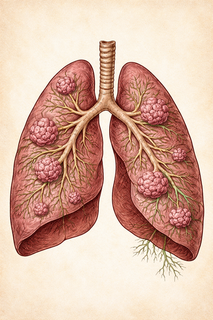
Disclaimer: The image accompanying this article is for illustrative purposes only and does not depict actual experimental results, data, or biological mechanisms.