Parenting a body is mostly telling rogue cells, "No, you may not climb the chromatin, rewrite the household rules, and start a leukemia franchise before dinner."
Most cells listen. Cancer cells, famously, have the compliance profile of toddlers with permanent markers. The new paper by Budinich and colleagues asks a very specific version of that chaos question: how does a mutant chromatin reader called ENL get so good at turning on leukemia-friendly genes?
The answer is delightfully rude. It borrows the cell's own RNA and uses it as reinforcement.
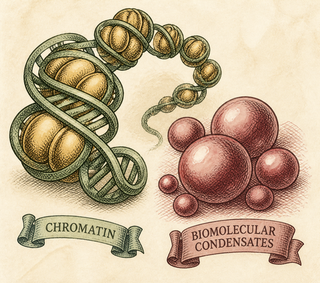
The Chromatin Party Nobody Approved
Chromatin is DNA plus the proteins that package, mark, and manage it. Think of it as the genome's filing system, except the folders are alive, chemically tagged, and occasionally involved in litigation.
ENL is a "reader" protein. Its YEATS domain recognizes certain chemical marks on histones, the spool-like proteins around which DNA wraps. In acute myeloid leukemia and Wilms tumor, gain-of-function mutations in ENL can make it behave badly: it gathers at select genes and helps form biomolecular condensates, little droplet-like clusters of molecules that concentrate transcription machinery in one spot.
Condensates are not automatically villains. Cells use them all the time, like temporary conference rooms without walls. The problem starts when an oncogenic protein books the room indefinitely, invites RNA polymerase, locks the door, and starts approving gene-expression budgets without a data monitoring committee.
Earlier work showed that mutant ENL condensates can drive oncogenic transcription and leukemia-like disease in mice (Liu et al., 2024). This new Molecular Cell study adds a sharper mechanism: local RNA transcripts help mutant ENL condensates form, return to chromatin, and crank up target genes (Budinich et al., 2026).
RNA Is Not Just the Receipt
Many of us learned RNA as the message copied from DNA so proteins can be made. Fine, yes. But in modern cell biology, RNA has side gigs. It can scaffold, recruit, repel, tune, and generally meddle. RNA is less "photocopy" and more "project manager with access to everyone's calendar."
Budinich and colleagues found that mutant ENL binds RNA partly through a basic patch in its YEATS domain. That RNA binding made ENL condensates form more readily in test-tube systems and in cells. When the team blocked ENL-RNA interactions or stopped transcription, condensates had trouble reforming at their natural genomic targets.
That point matters because condensates can be slippery experimentally. Anyone who has tried to infer biology from puncta under a microscope knows the feeling: are these meaningful structures, or did the cell just sneeze fluorescent protein? The authors used a chemically inducible displacement and renucleation system, which is exactly the kind of methods-section sentence that makes trialists reach for coffee and ask whether the control arms are behaving. Here, the design helped test whether ENL could return to the right chromatin sites after being moved away.
It could, unless RNA participation got disrupted.
Transcription Bursts, Now With Extra Fuel
Genes do not always transcribe smoothly like a printer. They often fire in bursts: quiet, quiet, quiet, then suddenly a flurry of RNA copies. This paper suggests RNA binding helps mutant ENL increase occupancy and transcriptional bursting at condensate-permissive loci.
That phrase, "condensate-permissive loci," is doing work. Mutant ENL did not simply coat the genome like bad wallpaper. It used particular chromatin neighborhoods where condensates could nucleate. Local RNA then reinforced the process, creating a feedback loop: transcription produces RNA, RNA supports ENL condensate formation, ENL condensates amplify transcription. Somewhere, a protocol amendment is quietly weeping.
In mouse models, disrupting RNA binding suppressed mutant ENL-driven oncogenic transcription and leukemogenesis. That moves the story beyond pretty nuclear dots and into disease biology, although this is still preclinical work. Nobody should read "mouse model" and immediately start shopping for a phase III endpoint. We have all seen that movie, and the sequel is usually called "Not Reproducible in Humans."
Why This Is a Big Deal Without Saying Magic Words
Cancer therapy often targets enzymes: kinases, proteases, methyltransferases, the usual suspects. Condensates are trickier. They are assemblies, not single buttons. But if a cancer-driving condensate depends on specific interactions, such as ENL touching RNA through a defined patch, then maybe we can interfere with the assembly logic rather than smashing the whole nucleus with a pharmacologic chair.
That is the practical promise. If ENL mutant leukemias depend on RNA-reinforced chromatin condensates, then future drugs might weaken those contacts, displace mutant ENL, or make leukemia genes lose their transcriptional megaphone. Related work has already shown that targeting ENL's acetyl-lysine reading activity can delay AML progression in vivo (Liu et al., 2024), and broader condensate biology has linked abnormal phase separation to leukemia fusion proteins such as NUP98 fusions (Chandra et al., 2022).
The challenge is selectivity. Normal cells also use condensates and RNA-protein interactions. The goal is not "abolish condensates," which would be like treating traffic by removing roads. The goal is to find the malignant traffic pattern and close the suspicious off-ramp.
This study gives the field a more precise map: mutant ENL, local RNA, chromatin engagement, transcriptional bursting, leukemia. It is mechanistic, testable, and just annoying enough to be biologically plausible.
References
-
Budinich KA, Yao X, Gong C, et al. RNA reinforces condensate nucleation on chromatin to amplify oncogenic transcription. Molecular Cell. 2026. DOI: 10.1016/j.molcel.2026.05.024
-
Liu Y, Li Q, Song L, et al. Condensate-promoting ENL mutation drives tumorigenesis in vivo through dynamic regulation of histone modifications and gene expression. Cancer Discovery. 2024. DOI: 10.1158/2159-8290.CD-23-0876
-
Henninger JE, Oksuz O, Shrinivas K, et al. RNA-mediated feedback control of transcriptional condensates. Cell. 2021;184(1):207-225.e24. DOI: 10.1016/j.cell.2020.11.030
-
Chandra B, Michmerhuizen NL, Shirnekhi HK, et al. Phase separation mediates NUP98 fusion oncoprotein leukemic transformation. Cancer Discovery. 2022;12(4):1152-1169. DOI: 10.1158/2159-8290.CD-21-0674
-
Mathias KM, Liu Y, Wan L. Dysregulation of transcriptional condensates in human disease: mechanisms, biological functions, and open questions. Current Opinion in Genetics & Development. 2024;86:102203. PMID: 38788489
Disclaimer: The image accompanying this article is for illustrative purposes only and does not depict actual experimental results, data, or biological mechanisms.