Colorectal cancer screening sounds like the sort of topic that arrives wearing beige and carrying a clipboard. But this new analysis from the COLONPREV Trial turns out to ask a pretty juicy question: if people actually stick with the plan, is a one-time colonoscopy better than doing a FIT stool test every two years?
That matters because cancer is an evolutionary opportunist. Give it time, space, and a little privacy, and it starts making terrible life choices on your behalf. Screening is our attempt to interrupt the plot early - before a harmless-looking polyp decides it wants a career in chaos.
Two ways to ruin a tumor's day
The two strategies here are very different beasts.
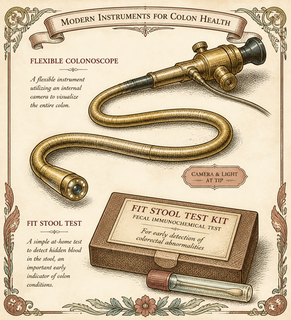
A colonoscopy is the full house inspection. A camera snakes through the colon, doctors can spot suspicious growths, and often remove precancerous polyps on the spot. It is screening plus a bit of preemptive gardening. Not glamorous, but effective.
The faecal immunochemical test, or FIT, is less invasive. You check stool for hidden blood, which can be an early signal of cancer or large polyps. If FIT turns up positive, then you move on to colonoscopy. Think of it as airport security with a metal detector first, then the full bag search if something beeps.
The catch? Real life is messy. Some people happily do repeated FIT testing. Some vanish after the first round. Some agree to colonoscopy, then ghost the appointment like it's a high school reunion.
The annoying but important problem: humans
Pragmatic screening trials often compare these two approaches in the wild, where adherence differs a lot. And that creates a headache. If one strategy looks better, is it because the test itself is better, or because people were more likely to actually do it?
This post hoc analysis tried to answer that by looking at 17,270 screening initiators aged 50-69 and estimating outcomes under a sustained strategy - basically, asking what happens when people follow through. The researchers used inverse probability weighting, which is statistical language for "we know people behave inconveniently, so let's try not to let that wreck the comparison."
What they found, minus the statistical fog machine
Over 10 years, the two strategies looked remarkably similar for the big outcomes.
- Colorectal cancer incidence: 0.80% with FIT vs 0.86% with colonoscopy
- All-cause mortality: 4.02% with FIT vs 4.09% with colonoscopy
That is not the sort of difference that makes scientists leap onto tables.
For colorectal cancer mortality, colonoscopy looked a bit better:
- 0.072% with FIT vs 0.042% with colonoscopy
But the estimate was imprecise, which is science's way of saying, "interesting, but don't get a tattoo of it yet."
The core message is simple: if people keep participating, repeated FIT and one-time colonoscopy can produce similar 10-year outcomes overall.
Why this is more interesting than it sounds
This is not just a duel between a camera and a poop test. It is a lesson in strategy.
Cancer screening is not one heroic moment. It is a system. And systems live or die on participation. A theoretically "better" test can lose in practice if people avoid it like an ex at the grocery store. Meanwhile, a less invasive option can punch above its weight if people actually keep doing it.
That is especially relevant for public health programs. A country deciding how to screen millions of people is not choosing in a vacuum. It is choosing among real humans with real schedules, fears, preferences, and a frankly understandable desire not to spend quality time thinking about their colon.
The evolutionary angle: intercepting rebellion early
From an evolutionary standpoint, colorectal cancer often starts as a slow-motion insurgency. Cells accumulate mutations, certain clones gain an edge, and natural selection does the rest. Polyps are not destiny, but they can be the opening scene.
Colonoscopy may have an advantage because it can find and remove precancerous lesions before they become dangerous. FIT, meanwhile, is better at catching trouble once it starts leaving traces like bleeding. One is more like removing dry brush before a wildfire. The other is spotting smoke early and calling the fire department fast.
Both approaches can work. The trick is making sure the surveillance system doesn't fall asleep on shift.
What this could mean in the real world
If these findings hold up, they support a practical idea: screening programs should focus as much on adherence as on test type.
That means:
- making FIT easy to repeat
- making follow-up colonoscopy seamless after a positive test
- reducing barriers like scheduling delays, fear, cost, and confusion
- matching people to the strategy they are most likely to complete
It is not always about picking the single "best" tool in a laboratory sense. Sometimes it is about choosing the tool people will actually use, repeatedly, correctly, and without requiring the motivational energy of climbing Everest.
The fine print, because science always has fine print
This was a post hoc per-protocol analysis, not the original randomized comparison alone. The authors used careful statistical adjustment, but adjustment is not magic. Unmeasured differences between participants can still sneak in.
Also, this paper looked at 10-year outcomes, which is meaningful but not the final word on lifetime benefit. And the lower colorectal cancer mortality signal with colonoscopy might matter - we just need more precision before acting like the case is closed.
Bottom line
This study suggests that sustained FIT screening and one-time colonoscopy deliver broadly similar 10-year outcomes overall, with a possible but uncertain mortality edge for colonoscopy. Which is a useful reminder that in cancer prevention, the best strategy is often the one that survives first contact with human behavior.
Tumors adapt. Health systems should too.
References
-
Castells A, Quintero E, Chen H, et al. Colonoscopy versus biennial FIT screening: a post hoc sustained-strategy analysis of the COLONPREV Trial. Gut. 2026. doi:10.1136/gutjnl-2026-338896
-
Bretthauer M, Løberg M, Wieszczy P, et al. Effect of Colonoscopy Screening on Risks of Colorectal Cancer and Related Death. N Engl J Med. 2022;387(17):1547-1556. doi:10.1056/NEJMoa2208375
-
Issaka RB, Somsouk M. Colorectal cancer screening and prevention in the COVID-19 era. JAMA Health Forum. 2021;2(5):e210845. doi:10.1001/jamahealthforum.2021.0845
-
Ladabaum U, Dominitz JA, Kahi C, Schoen RE. Strategies for Colorectal Cancer Screening. Gastroenterology. 2020;158(2):418-432. doi:10.1053/j.gastro.2019.06.043
-
Helsingen LM, Kalager M. Colorectal cancer screening - approach, evidence, and future directions. BMJ. 2022;378:e069578. doi:10.1136/bmj-2021-069578
Disclaimer: The image accompanying this article is for illustrative purposes only and does not depict actual experimental results, data, or biological mechanisms.