Maria, 59, had lung cancer that shrank beautifully on a targeted pill, then started growing again eight months later, because cancer apparently read the manual and skipped straight to the chapter titled "How To Be Annoying."
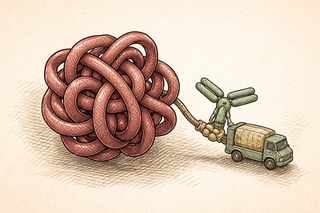
That is the patient sitting behind the new Cancer Discovery Q&A with Paul Mischel and Alice Shaw, the scientific program co-chairs of the AACR Annual Meeting 2026. The paper itself is not a lab study with mice, Kaplan-Meier curves, and one terrifyingly dense figure panel. It is a recap of the meeting's big scientific themes: resistance, precision oncology, immune escape, early detection, AI, KRAS drugs, antibody-drug conjugates, and the awkward fact that cancer is not a tidy villain. It is more like a committee of villains with a shared calendar and terrible vibes [1].
The Hype Was "Precision." The Better Word Is "Messy."
For years, precision oncology has been sold as a clean idea: find the mutation, match the drug, high-five responsibly. And sometimes it works. EGFR, ALK, BRAF, HER2, KRAS G12C - these are not trivia answers, they are reasons some patients get smarter treatment instead of one-size-fits-most chemotherapy.
But the more honest AACR 2026 takeaway is that precision is becoming less about one mutation and more about context. What kind of tumor neighborhood is this? Are immune cells nearby or locked outside like bouncers at a club they technically work for? Is the cancer changing shape under treatment? Are nerves, metabolism, inflammation, and the patient's environment helping the tumor behave badly?
That matters because tumors rarely lose by politely accepting their assigned therapy. They adapt. The current research frontier is not just "what drug kills this cancer?" It is "what escape routes will the cancer use after we hit it?" That is less glamorous, but much more useful. Nobody wants oncology to become Whac-A-Mole with copays.
KRAS: The Formerly "Undruggable" Drama Queen
One of the livelier themes from AACR 2026 was KRAS. For decades, KRAS had a reputation as an "undruggable" cancer driver, which is science-speak for "we tried, we failed, please stop asking at conferences." That wall has cracked. KRAS G12C inhibitors already exist, and newer drugs are pushing into other KRAS variants, including G12D, a major troublemaker in pancreatic and lung cancers [2].
The contrarian point: this is not a victory lap yet. KRAS drugs are exciting because they prove the target can be reached. But cancer cells can reroute signaling, acquire resistance mutations, or recruit backup pathways like a criminal franchise with regional managers. The win will not be one KRAS drug. It will be combinations, sequencing, biomarkers, and knowing when not to overpromise.
ADCs: Tiny Delivery Trucks With Very Serious Cargo
Antibody-drug conjugates, or ADCs, also kept showing up. The basic idea is wonderfully blunt: attach a toxic drug to an antibody that homes in on cancer cells. It is oncology's version of sending a package labeled "definitely not explosives" directly to the tumor.
The newer generation is trying to solve the old problems: tumors vary from cell to cell, targets are not always cleanly tumor-specific, and payloads can still injure normal tissue. Recent reviews describe bispecific ADCs, dual-payload ADCs, immune-stimulating ADCs, and other increasingly fancy molecular contraptions designed to deal with resistance and heterogeneity [3]. Translation: the delivery trucks are getting GPS, better brakes, and maybe a suspicious number of extra compartments.
The Real Enemy May Be What Survives
AACR's emphasis on minimal residual disease and treatment resistance is where the field gets especially interesting. A scan can look clean while tiny pockets of cancer remain below detection. Minimal residual disease is the cancer equivalent of the last glitter after a craft project: invisible until it ruins your day.
That is why liquid biopsies, circulating tumor DNA, single-cell tools, and spatial profiling matter. They may help detect relapse earlier, identify resistant cell states, and show which parts of the tumor ecosystem need targeting [4,5]. The hard part is proving that earlier detection leads to better outcomes, not just earlier anxiety. That distinction matters. A test is not helpful simply because it sees more. It has to help patients live longer, feel better, or avoid treatment they do not need.
AI Gets a Seat, But Not the Steering Wheel
AI was another major theme, and here skepticism is healthy. AI can help read images, integrate genomics, suggest trial matches, and make sense of medical data too large for one human brain, which is rude but true [6]. But oncology is not a spreadsheet wearing a lab coat. Models need validation, fairness checks, outcome data, and clinicians willing to ask, "Is this recommendation smart, or merely confident?"
The best version of AI in cancer care is not a robot oncologist. It is a very fast research assistant that does not sleep, complain, or forget where the PDF went.
Why This Recap Matters
The most useful message from Mischel and Shaw's AACR recap is that cancer research is becoming less siloed. Biology, technology, prevention, public health, drug development, and clinical trials are starting to talk to one another. About time. Cancer has been networking for years.
If these themes hold up, the real-world impact could be substantial: earlier detection of relapse, smarter drug combinations, better use of immunotherapy, more precise ADCs, broader KRAS targeting, and tools that help clinicians choose treatment based on the whole patient-tumor system rather than one lab result with delusions of grandeur.
The fair conclusion is not that AACR 2026 delivered one miracle. It is that the field is finally admitting the opponent is complicated. That may sound less thrilling than "cure discovered," but in science, admitting the mess is usually when the useful work begins.
References
-
Q&A: Paul Mischel and Alice Shaw Recap the AACR Annual Meeting. Cancer Discovery. 2026;OF1. DOI: 10.1158/2159-8290.CD-NW2026-0057
-
Singhal A, Li BT, O'Reilly EM. Targeting KRAS in cancer. Nature Medicine. 2024;30:969-983. DOI: 10.1038/s41591-024-02903-0
-
Tsuchikama K, Anami Y, Ha SYY, et al. Exploring the next generation of antibody-drug conjugates. Nature Reviews Clinical Oncology. 2024;21:203-223. DOI: 10.1038/s41571-023-00850-2
-
Sun X, Wu LF, Altschuler SJ, Hata AN. Targeting therapy-persistent residual disease. Nature Cancer. 2024;5:1298-1304. DOI: 10.1038/s43018-024-00819-9. PMCID: PMC12160366
-
Ignatiadis M, Sledge GW, Jeffrey SS. Liquid biopsy enters the clinic: implementation issues and future challenges. Nature Reviews Clinical Oncology. 2021;18:297-312. DOI: 10.1038/s41571-020-00457-x
-
Lotter W, Hassett MJ, Schultz N, et al. Artificial Intelligence in Oncology: Current Landscape, Challenges, and Future Directions. Cancer Discovery. 2024;14:711-726. DOI: 10.1158/2159-8290.CD-23-1199. PMCID: PMC11131133
Disclaimer: The image accompanying this article is for illustrative purposes only and does not depict actual experimental results, data, or biological mechanisms.