A tumor-draining lymph node and airport security have more in common than any of us wanted: both are supposed to catch dangerous things before they spread, and both can become weirdly inefficient when the wrong crowd starts influencing the process.
That is the suspicious little drama at the center of a new Gut paper by Wang and colleagues on colorectal cancer. The team studied tumor-draining lymph nodes, or TDLNs, which are the lymph nodes closest to a tumor. These are not random anatomical décor. They are immune meeting rooms where T cells, macrophages, and other tiny overworked employees decide whether to attack, tolerate, or accidentally help the problem.
In colorectal cancer, lymph node involvement matters a lot clinically. It helps stage the disease, guide treatment, and predict risk. But this paper asks a more biologically nosy question: what is actually happening inside those lymph nodes before and during invasion?
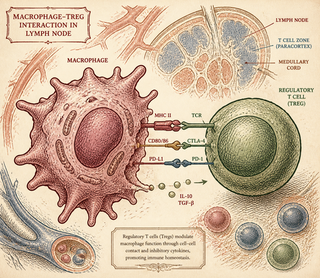
The answer, according to the authors, involves SPP1-positive macrophages teaching regulatory T cells to become better immune suppressors. Fascinating. Also mildly rude.
The Immune System Has a Middle Manager Problem
Macrophages are immune cells with many jobs: clean up debris, present danger signals, coordinate inflammation, and occasionally behave like the group project member who says, “I’ll handle it,” then somehow makes everything more complicated.
SPP1, also called osteopontin, is a signaling molecule involved in cell movement, inflammation, tissue remodeling, and cancer biology. In tumors, SPP1-positive macrophages have become a recurring suspect. Prior work has linked these cells to immune exclusion, worse outcomes, and resistance to immunotherapy in colorectal cancer and other tumors [2,3].
Wang and colleagues used single-cell RNA sequencing on 23 matched samples from seven colorectal cancer patients: primary tumors, adjacent normal tissue, tumor-free lymph nodes, and tumor-invaded lymph nodes. That design is tidy in the way grad students dream about and then wake up anxious because sample size exists.
Their big finding: tumor-invaded lymph nodes had a distinct immune ecosystem enriched for SPP1-positive macrophages. These macrophages appeared to communicate with regulatory T cells, or Tregs, through an SPP1-CD44-NF-kB1 signaling axis. The result was more mature CD137-positive Tregs, which are especially good at suppressing immune responses [1].
In plain English: the tumor-adjacent immune checkpoint got infiltrated by cells that may tell the immune system, “Nothing to see here,” while the cellular rebels quietly expand the franchise.
Tregs: The Bouncers Who Sometimes Guard the Wrong Door
Tregs are not villains. Your body needs them to prevent autoimmune chaos. Without them, your immune system can start treating your own tissues like a suspicious unattended suitcase.
But cancer has a talent for hiring normal biology as unpaid labor. In a tumor or metastatic lymph node, too many suppressive Tregs can calm down the very T cells that should be attacking cancer cells. If cytotoxic T cells are tiny bodyguards, Tregs can become the person in the headset telling them, “Stand down, this seems fine.” Reader, it is not fine.
The paper strengthens its case with functional experiments: in vitro assays, CRISPR knockout in primary Tregs, mouse lymph node metastasis models, lipid nanoparticle-delivered siSPP1, anti-CD44 antibody experiments, and multiomics validation in independent colorectal cancer cohorts [1]. That is a lot more than “we found a spicy cluster on a UMAP,” which, as someone who has stared too long at UMAPs, I appreciate deeply.
The therapeutic angle is particularly interesting. Targeting SPP1 with lipid nanoparticle siRNA and blocking CD44 seemed to reduce lymph node metastasis in the model system [1]. The authors are not saying this is ready for clinic tomorrow. Please do not sprint into a hospital demanding boutique macrophage sabotage. But as a concept, it suggests that lymph nodes may be treatable immune neighborhoods, not just staging paperwork.
Why This Matters Beyond One Protein With a Bland Name
Colorectal cancer immunotherapy has a frustrating split personality. Tumors with mismatch repair deficiency or microsatellite instability often respond well to checkpoint blockade. But microsatellite-stable colorectal cancers, the more common group, usually respond poorly. Recent clinical work is trying to change that, including combination checkpoint strategies for refractory MSS disease [5].
This study fits into a broader shift: researchers are paying more attention to where immune decisions happen. Tumor-draining lymph nodes may act as reservoirs for antitumor immunity, not just waystations for metastasis [4]. Reviews focused on colorectal cancer argue that TDLNs could become therapeutic targets, especially if we can identify which immune circuits need boosting or blocking [6].
That is what makes the SPP1-CD44-Treg story so fascinating. Sorry, there it is again. The paper connects a cell type, a signaling axis, a suppressive T cell state, and a possible intervention. It gives the field a more specific handle than “the tumor microenvironment is immunosuppressive,” which is true but about as actionable as saying “the ocean is damp.”
The Necessary Wet Blanket Section
The study is strong, but not magical. The human single-cell dataset came from seven patients, which is valuable but small. Mouse lymph node metastasis models help test mechanism, but mice are not tiny humans wearing lab-approved sweaters. Also, SPP1 and CD44 do many things in normal biology, so any therapy aimed at this axis would need careful safety work.
Still, the idea is compelling: if colorectal tumors use nearby lymph nodes to train immune suppressor cells, then treating the tumor alone may miss part of the command center. Future work could ask whether SPP1-positive macrophages predict recurrence, immunotherapy response, or benefit from therapies that reshape lymph node immunity.
For now, the paper gives us a sharper map of a sketchy neighborhood. The macrophages are chatting. The Tregs are maturing. The tumor is probably pretending it had nothing to do with it. Biology, as usual, is fascinating and deeply annoying.
References
-
Wang J, Zhou M, Tan B, Shi H, Liu L, Xu X, et al. SPP1+ macrophages facilitate the differentiation and maturation of regulatory T cells in tumour-draining lymph nodes of colorectal cancer. Gut. 2026. DOI: 10.1136/gutjnl-2025-337038. PMID: 42285754
-
Qi J, Sun H, Zhang Y, Wang Z, Xun Z, Li Z, et al. Single-cell and spatial analysis reveal interaction of FAP+ fibroblasts and SPP1+ macrophages in colorectal cancer. Nature Communications. 2022;13:1742. DOI: 10.1038/s41467-022-29366-6
-
Bill R, Wirapati P, Messemaker M, Roh W, Zitti B, Duval F, et al. CXCL9:SPP1 macrophage polarity identifies a network of cellular programs that control human cancers. Science. 2023;381:515-524. DOI: 10.1126/science.ade2292
-
Delclaux I, Ventre KS, Jones D, Lund AW. The tumor-draining lymph node as a reservoir for systemic immune surveillance. Trends in Cancer. 2024;10:28-37. DOI: 10.1016/j.trecan.2023.09.006
-
Bullock AJ, Fakih M, Mahadevan D, et al. Botensilimab plus balstilimab in relapsed/refractory microsatellite stable metastatic colorectal cancer: a phase 1 trial. Nature Medicine. 2024. DOI: 10.1038/s41591-024-03083-7
-
Wang Y, Zhu T, Shi Q, Zhu G, Zhu S, Hou F. Tumor-draining lymph nodes: opportunities, challenges, and future directions in colorectal cancer immunotherapy. Journal for ImmunoTherapy of Cancer. 2024;12:e008026. DOI: 10.1136/jitc-2023-008026
Disclaimer: The image accompanying this article is for illustrative purposes only and does not depict actual experimental results, data, or biological mechanisms.