Math problem: if measles can infect about 9 out of 10 non-immune people who get close to it, how many viral headaches do you get from one under-vaccinated room? Answer: enough to make public health spreadsheets start smoking.
That is the backdrop for a new study in Cell Host & Microbe from Acciani and colleagues, who went antibody-hunting in the memory B cells of someone vaccinated with MMR. Memory B cells are your immune system's archive cabinet, except instead of dusty tax forms, they store "please destroy this virus immediately" recipes. The researchers pulled out human monoclonal antibodies against two measles virus surface proteins: hemagglutinin, called H, and fusion protein, called F. H helps the virus grab cells. F helps it merge into them. Tiny viral burglary team. Very annoying. Very efficient.
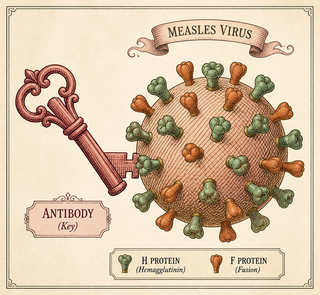
And here is where it gets interesting: some of these antibodies neutralized measles at picomolar levels. Picomolar is lab-speak for "we are measuring absurdly tiny amounts now, please respect the decimals." In a field where potency matters, that is the kind of number that makes a data person lean forward and accidentally ignore their coffee.
The Virus Has a Grabber and a Grappling Hook
Measles virus is a negative-sense RNA virus in the paramyxovirus family, which sounds like something a wizard would mutter while losing grant funding. Its outer surface carries H and F proteins. H binds receptors on human cells, including immune-cell receptors like SLAM/CD150 and epithelial-cell receptors like nectin-4. F then changes shape and fuses the viral envelope with the cell membrane.
If H is the doorbell, F is the crowbar.
Vaccination works beautifully for most people, and the MMR vaccine remains the main event. Two doses are the public health equivalent of installing a very judgmental bouncer at the club entrance. But measles keeps resurfacing when vaccination coverage drops, and some people cannot mount or keep strong protection: infants too young for vaccination, immunocompromised patients, and people in outbreak settings where timing is everything.
That is why antibodies are tempting. Not as a replacement for vaccination, because no. The vaccine is still the star player. But as emergency backup? Now we are talking.
The New Study Drew a Measles Antibody Map
Acciani and colleagues isolated human monoclonal antibodies targeting both H and F. Then they did the structural biology version of pinning strings on a detective wall: epitope mapping plus high-resolution cryo-electron microscopy. Translation: they figured out where the antibodies stick.
They found four major antibody-targeting clusters on H and five on F. That matters because viruses mutate. If an antibody targets a sloppy, variable patch, the virus may wriggle away. If it targets a conserved site, the virus has less room to improvise. Evolution is clever, but even evolution hates tight constraints.
The lead antibodies did more than look pretty in structural models. In animal experiments, antibodies reduced viral loads when given before exposure and also after exposure. That second part is the eyebrow-raiser. Post-exposure activity is the difference between "nice shield" and "possible rescue tool." One F-targeting antibody, 3A12, reportedly drove circulating virus below detection in the model. Somewhere, a p-value put on sunglasses.
Why F Is Having a Moment
For a long time, measles neutralization has often been discussed through H, because H is a major antibody target. But recent work has made F look like more than the quiet friend at dinner. A 2024 Science paper showed that a neutralizing antibody could lock measles F in its prefusion state, preventing the dramatic shape-change it needs to do its fusion job. A 2026 Nature Communications study added more mechanistic detail about how antibodies neutralize the measles fusion protein.
That is the fun part of structural immunology: suddenly the immune system is not just "making antibodies." It is throwing molecular wedges into viral machinery. Less Hallmark card, more sabotage.
The Real-World Angle, With Adult Supervision
If these findings hold up in larger studies, human monoclonal antibodies could help protect high-risk people after exposure, limit severe infection, or buy time during outbreaks. This could matter in hospitals, transplant units, infant care settings, and communities where measles gets a running start.
But let us keep the confidence interval honest. These are preclinical findings, not a licensed measles treatment. Cotton rats are useful models, but they are not tiny humans with insurance paperwork. Researchers still need safety studies, dosing work, manufacturing plans, resistance monitoring, and clinical trials.
The bigger picture is still simple: vaccination prevents the fire. Antibodies might become a better extinguisher for people already standing near the flames.
Measles is not "just a rash." It can cause pneumonia, encephalitis, death, and immune amnesia, where prior immune defenses get partially erased like someone spilled coffee on your body's contact list. In 2026, CDC reporting showed more than 2,000 confirmed U.S. measles cases by June 11, with declining kindergarten MMR coverage leaving more children vulnerable. That is not a rounding error. That is a warning label with a bar chart.
So yes, this antibody paper is exciting because it gives us a sharper map of human protection against measles. It shows where potent antibodies bind, which viral parts they jam, and how future prophylactic or therapeutic tools might be built. The measles virus brought two surface proteins to the fight. The immune system, apparently, brought receipts.
References
-
Acciani M, Zyla D, Niemeyer G, et al. Human neutralizing antibodies targeting the measles virus hemagglutinin and fusion surface proteins. Cell Host & Microbe. 2026. https://doi.org/10.1016/j.chom.2026.04.010
-
Zyla DS, Della Marca R, Niemeyer G, et al. A neutralizing antibody prevents postfusion transition of measles virus fusion protein. Science. 2024;384(6703):eadm8693. https://doi.org/10.1126/science.adm8693 PMCID: PMC12096318.
-
Zyla DS, et al. Structural and mechanistic basis for antibody neutralization of the measles fusion protein. Nature Communications. 2026. https://doi.org/10.1038/s41467-026-71373-4 PMCID: PMC12458459.
-
Moss WJ, Griffin DE. What's going on with measles? Journal of Virology. 2024;98(8):e00758-24. https://doi.org/10.1128/jvi.00758-24 PMCID: PMC11334507.
-
Hübschen JM, Gouandjika-Vasilache I, Dina J. Measles. The Lancet. 2022;399(10325):678-690. https://doi.org/10.1016/S0140-6736(21)02004-3
-
Wang Q, Wang W, Winter AK, et al. Long-term measles antibody profiles following different vaccine schedules in China, a longitudinal study. Nature Communications. 2023;14:1746. https://doi.org/10.1038/s41467-023-37407-x
Disclaimer: The image accompanying this article is for illustrative purposes only and does not depict actual experimental results, data, or biological mechanisms.