In pancreatic cancer, the tumor is not just a bad house on the block - it is the landlord, the contractor, the security desk, and the suspicious guy repainting the basement at 2 a.m.
That neighborhood is the tumor microenvironment, the messy mix of cancer cells, immune cells, scar-like tissue, blood vessels, and support cells surrounding a tumor. In pancreatic cancer, this neighborhood is famously hostile. Chemotherapy tries to get in, immune cells try to patrol, and the whole place responds by putting up collagen fencing and acting like it has a very strict HOA.
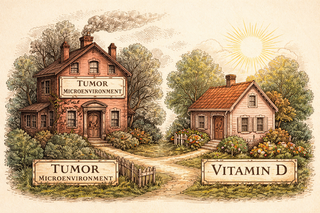
A new randomized run-in phase trial in Nature Cancer asks a provocative question: what if one way to improve pancreatic cancer treatment is not to hit the cancer cells harder, but to calm down the neighborhood around them?
The drug in question is paricalcitol, a vitamin D receptor agonist already used in kidney disease care. Researchers tested it with standard first-line chemotherapy, gemcitabine plus nab-paclitaxel, in 36 people with metastatic pancreatic cancer [1].
The Usual Story: More Firepower
The standard instinct in metastatic pancreatic cancer is understandable: bring stronger weapons. Gemcitabine plus nab-paclitaxel became a major treatment option after improving survival compared with gemcitabine alone in a large phase 3 trial [2]. Other regimens, such as FOLFIRINOX and newer combinations, also compete in this difficult space.
But pancreatic cancer has a talent for making good drugs look underdressed. One reason is the dense stroma, a fibrotic, scar-like support network packed with cancer-associated fibroblasts, or CAFs. Fibroblasts normally help build and repair tissue. In tumors, some become overcaffeinated construction managers, laying down matrix, sending chemical messages, and helping create an immune-suppressive zone where T cells wander around like bouncers who forgot which club they work for.
For years, people thought: great, destroy the stroma. Simple. Elegant. Wrong enough to be interesting.
Some preclinical work showed that wiping out parts of pancreatic stroma can make disease worse, not better. The neighborhood may be shady, but bulldozing every building can remove the few walls still slowing the fire. Modern reviews increasingly describe CAFs as a mixed cast: some tumor-promoting, some tumor-restraining, many annoyingly context-dependent [3,4].
So this trial takes the more subtle angle: do not burn down the neighborhood. Try rezoning it.
Vitamin D, But Not the Wellness Podcast Version
Paricalcitol activates the vitamin D receptor, or VDR. That receptor is a nuclear switch that can change gene expression. In earlier lab work, VDR activation pushed pancreatic stellate cells and fibroblast-like stromal cells toward a more quiet, less inflammatory state, and improved chemotherapy effects in models of pancreatic cancer [5].
This is where the raised eyebrow belongs. Vitamin D has been oversold in enough places to deserve a suspicious glance. If a supplement aisle had a hype alarm, vitamin D would have set it off sometime around 2009.
But this is not "take gummies, defeat cancer." This is a pharmacologic VDR agonist tested with biopsies before and during treatment, looking for measurable changes inside tumors. Less miracle smoothie, more tissue-level interrogation.
What the Trial Found
The study randomized 36 patients to one of three groups: chemotherapy plus placebo, chemotherapy plus intravenous paricalcitol, or chemotherapy plus oral paricalcitol [1].
The main goal was safety. The short answer: paricalcitol could be given with chemotherapy, but oral dosing caused trouble. Five patients receiving oral paricalcitol, or 42%, developed grade 2 to 4 hypercalcemia and needed dose reductions. Translation: when you start pushing vitamin D biology, calcium may show up like an uninvited cousin with luggage.
The more intriguing part came from the tumor biopsies. In the paricalcitol arms, on-treatment samples showed:
- Fewer alpha-SMA-positive fibroblasts, a marker associated with activated myofibroblast-like stroma
- Changes in a fibroblast VDR activation signature
- More CD8-positive T cells near tumor cells
- Evidence that baseline nuclear VDR expression predicted tumor response in the paricalcitol-treated groups
That last point is the spicy bit. Not every tumor had the same VDR expression. VDR appeared in tumor, immune, and stromal cells, but unevenly across patients. In other words, the drug may need the right biological wiring to matter. Cancer therapy, once again, refuses to behave like a vending machine.
The Contrarian Take
The easy headline would be: "Vitamin D drug helps pancreatic cancer." Too neat. Too shiny. Put it back.
The better headline is: a small clinical trial suggests pancreatic tumors with the right VDR biology may have a modifiable microenvironment, and paricalcitol can push that environment in directions that look more chemotherapy- and immune-friendly.
That is not a cure. It is not practice-changing by itself. Thirty-six patients is a serious scientific starting point, not a victory parade. The trial was built mainly to test safety and pharmacodynamic signals, not to prove a survival advantage.
But the concept matters because pancreatic cancer has repeatedly taught oncology a rude lesson: cancer cells do not live alone. They live in tissue, and tissue has politics. CAFs, immune exclusion, collagen, drug delivery, cell states - all of these can shape whether treatment lands or face-plants.
If larger trials confirm this signal, paricalcitol or related VDR strategies might become part of a smarter combination approach: chemotherapy plus a microenvironment modifier, possibly guided by VDR expression. That would mean selecting patients not just by tumor mutations, but by the neighborhood their tumors have built.
And honestly, that feels like the right level of humility for pancreatic cancer. Do not assume the tumor is only a villain in a lab coat. Sometimes it is also a zoning board.
References
-
Perez KJ, Dias Costa A, Jordan A, et al. Gemcitabine and nab-paclitaxel with or without the VDR agonist paricalcitol for metastatic pancreatic cancer: a randomized, multiarm, run-in phase trial. Nature Cancer. 2026. https://doi.org/10.1038/s43018-026-01165-8
-
Von Hoff DD, Ervin T, Arena FP, et al. Increased survival in pancreatic cancer with nab-paclitaxel plus gemcitabine. New England Journal of Medicine. 2013;369:1691-1703. https://doi.org/10.1056/NEJMoa1304369
-
Chen Y, McAndrews KM, Kalluri R. Clinical and therapeutic relevance of cancer-associated fibroblasts. Nature Reviews Clinical Oncology. 2021;18:792-804. https://doi.org/10.1038/s41571-021-00546-5
-
Hingorani SR. Epithelial and stromal co-evolution and complicity in pancreatic cancer. Nature Reviews Cancer. 2023;23:57-77. https://doi.org/10.1038/s41568-022-00530-w
-
Sherman MH, Yu RT, Engle DD, et al. Vitamin D receptor-mediated stromal reprogramming suppresses pancreatitis and enhances pancreatic cancer therapy. Cell. 2014;159:80-93. https://doi.org/10.1016/j.cell.2014.08.007
Disclaimer: The image accompanying this article is for illustrative purposes only and does not depict actual experimental results, data, or biological mechanisms.