A magician waves one hand at leukemia’s flashy KRAS mutation, asks everyone to watch the sparks, then quietly yanks a tiny fuel pass out of the mitochondria with the other hand. Ta-da: the cancer cell’s powerhouse starts looking less like a power plant and more like a phone at 1% battery during a group chat emergency.
That is the trick at the center of Jia and colleagues’ new Cell Metabolism paper on acute myeloid leukemia, or AML. The study focuses on KRAS-mutant AML, a particularly rowdy version of blood cancer where leukemia cells grow aggressively and keep going even when life gets metabolically annoying, like when glucose gets scarce. Cancer cells, those overachieving little rebels, do not just mutate and call it a day. They rewire their energy systems too.
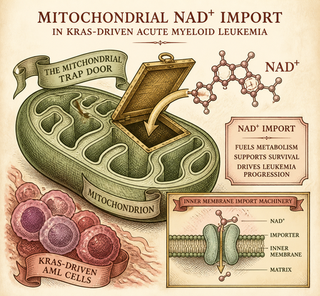
The team found a possible weak spot: hit both SLC25A51 and succinate dehydrogenase, and KRAS-driven AML cells may lose access to a mitochondrial resource they badly need: NAD+.
NAD+: The Cell’s Tiny Rechargeable Battery
NAD+ is one of those molecules biology teachers mention, students memorize, and then everyone quietly forgets until mitochondria start causing drama. But NAD+ is a big deal. Cells use it to move electrons around during metabolism, which is basically cellular accounting with sparks.
Mitochondria need their own NAD+ supply to run energy-producing pathways. The catch? NAD+ has to get into the mitochondrial matrix, the inner room where much of the metabolic action happens. That is where SLC25A51 comes in. It acts like a transport gate for mitochondrial NAD+ import, a job supported by several studies showing that SLC25A51 helps maintain mitochondrial NAD+ levels and respiration (Luongo et al., 2020; Goyal et al., 2023).
So if SLC25A51 is the delivery entrance, mitochondria are basically yelling, “Where is my NAD+ shipment?” while SLC25A51 is standing there with a clipboard.
The Double Hit
Jia and colleagues screened for compounds that could kill KRAS-mutant AML cells under both normal and glucose-deprived conditions. That second condition matters because tumors often live in chaotic, nutrient-stressed neighborhoods. If the tumor microenvironment were a city block, some cells would be grilling on the sidewalk while others are stealing extension cords from the laundromat.
Their screen identified compound 615, which appears to work by targeting two mitochondrial systems at once: SLC25A51 and succinate dehydrogenase, or SDH. SDH is part of both the TCA cycle and the electron transport chain, which makes it less like a single machine and more like the mitochondrion’s overworked middle manager.
Blocking both routes selectively depleted mitochondrial NAD+ and killed KRAS-mutant AML cells in the models studied. The key phrase is “selectively,” because cancer therapy is always trying to solve the same brutal problem: how do you hit cancer cells harder than normal cells? This paper suggests KRAS-mutant AML may be unusually dependent on keeping mitochondrial NAD+ topped up, especially when glucose stress forces cells to lean on mitochondrial metabolism.
Why AML Makes This So Interesting
AML is not one disease wearing one hat. It is a messy collection of genetically diverse leukemias, and patients still face tough odds despite real treatment progress. NCI data place 5-year survival for AML at roughly one-third of patients overall, and outcomes vary sharply by age, genetics, treatment fitness, and relapse risk.
That is why metabolism-targeted strategies keep getting attention. A 2023 review in Blood described AML as deeply shaped by metabolic rewiring, with different mutations pushing cells toward different nutrient dependencies (Mishra et al., 2023). Another recent leukemia metabolism study found that when leukemia cells lose easy access to glucose, they can compensate by leaning harder on mitochondrial respiration (Komza et al., 2025).
Translation: if you block the snack drawer, some leukemia cells sprint to the generator room. Jia’s paper asks, “What if we lock that room too?”
Not a Drug Yet, But a Sharp Idea
Compound 615 is not a standard AML treatment, and this is not a “new cure discovered” moment. Please keep the confetti cannon in storage. The work needs replication, optimization, toxicity testing, pharmacology, and eventually clinical trials before anyone knows whether this strategy can help patients.
But the concept is exciting because it is specific. Instead of treating mitochondria as a vague “energy factory,” the study points to a defined vulnerability: KRAS-mutant AML cells may depend on mitochondrial NAD+ import and SDH-linked metabolism in a way researchers can exploit. Recent work also shows that mitochondrial NAD+ gradients depend on transport and membrane potential, underscoring how carefully cells manage these compartments (Goyal et al., 2025). Apparently mitochondria are not just beans with opinions. They are gated biochemical nightclubs.
If this approach holds up, it could inspire therapies that pair metabolic pressure with genotype-specific targeting. That would be especially useful for aggressive AML subsets that resist existing inhibitors or survive nutrient stress. The dream is not “poison all metabolism,” because that sounds like a terrible wellness retreat. The dream is precision sabotage: find the cancer cell’s favorite backup system, then remove the backup.
References
-
Jia A, Zhang X, Zhou JH, et al. Dual targeting of SLC25A51 and succinate dehydrogenase selectively depletes mitochondrial NAD+ to eradicate KRAS-driven AML. Cell Metabolism. 2026. PMID: 41616775. DOI: 10.1016/j.cmet.2026.01.001
-
Mishra SK, Millman SE, Zhang L. Metabolism in acute myeloid leukemia: mechanistic insights and therapeutic targets. Blood. 2023;141(10):1119-1135. DOI: 10.1182/blood.2022018092. PMCID: PMC10375271
-
Goyal S, Paspureddi A, Lu MJ, et al. Dynamics of SLC25A51 reveal preference for oxidized NAD+ and substrate led transport. EMBO Reports. 2023;24:e56596. DOI: 10.15252/embr.202256596. PMCID: PMC10561365
-
Komza M, Khatun J, Gelles JD, et al. Metabolic adaptations to acute glucose uptake inhibition converge upon mitochondrial respiration for leukemia cell survival. Cancer & Metabolism. 2025;23:47. DOI: 10.1186/s12964-025-02044-y. PMCID: PMC11762851
-
Goyal S, Lyons SN, Cambronne XA. Mitochondrial NAD+ gradient sustained by membrane potential and transport. Science Advances. 2025;11(47):eaea7460. DOI: 10.1126/sciadv.aea7460. PMCID: PMC12637306
Disclaimer: The image accompanying this article is for illustrative purposes only and does not depict actual experimental results, data, or biological mechanisms.