"The risk-benefit profile remains favourable," write Edoardo Mannucci and Ilaria Dicembrini, "although caution is warranted in those with a low cardiometabolic risk." Translation from careful-scientist into bar-conversation: the blockbuster weight-loss drugs everyone's injecting probably aren't giving most people cancer, and might even be quietly fighting a few. But the story has villains, plot twists, and at least one suspect still under investigation.
Grab a seat. This one's got a whole cast.
Our Hero Has a Complicated Backstory
GLP-1 receptor agonists - the Ozempics and Wegovys of the world - showed up to do a simple job: lower blood sugar in type 2 diabetes, and later, at higher doses, melt away stubborn weight. Heroic stuff. But here's the thing the marketing never mentions: both diabetes and obesity are themselves cancer accomplices. Carrying extra weight and running high blood sugar for years is like leaving your cellular front door unlocked in a bad neighborhood.
So when a drug walks in and reverses both, you'd expect cancer rates to drop, right? Mostly. Intentional weight loss does seem to lower cancer risk. The blood-sugar part? Murkier. Scientists genuinely aren't sure whether taming hyperglycemia does much on its own. Our hero, it turns out, has powers nobody fully understands yet.
The Good Guys at the Table
When the authors sorted through the preclinical and clinical evidence, a hopeful pattern emerged. The incidence of several cancers - hepatocellular (liver), oesophageal, endometrial, ovarian, and prostate - might actually go down in people taking these drugs.
That's a genuinely exciting list. Liver and endometrial cancers in particular are tightly tied to obesity and metabolic chaos, so a drug that fixes the metabolism doing double duty as a cancer-dampener is the kind of plot development you root for. The researchers are even floating the idea of testing GLP-1 drugs as adjuvant cancer therapies - sidekicks to existing treatments. Imagine that origin story: the diabetes drug that moonlights fighting tumors.
Every Story Needs a Villain (Or At Least a Suspect)
Don't get too comfortable. Lurking in the corner of this saga is the thyroid.
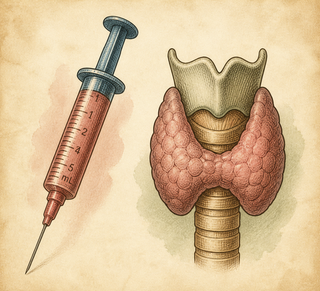
Safety concerns persist around thyroid carcinomas - both the medullary kind and the more common non-medullary types. This worry isn't new; it traces back to rodent studies where GLP-1 drugs nudged thyroid cells in unsettling directions. Whether that fully translates to humans is still being argued, but it's enough that the authors keep the warning lights on. The thyroid is the character you're not sure you can trust until the final chapter.
The Twist: The Prime Suspect Was Innocent All Along
Here's the redemption arc. For years, the pancreas was the boogeyman of the GLP-1 story. Early signals hinted these drugs might raise pancreatic cancer risk, which is terrifying - pancreatic cancer is one of oncology's most ruthless antagonists.
Plot twist: those initial concerns have not been confirmed. The longer and harder researchers looked, the more the pancreas faded from the lineup. The scary suspect from act one turned out to be a red herring. Somewhere, a screenwriter is annoyed they wasted a perfectly good villain.
The Unknown: Why Nobody Can Just Tell You The Answer
If you're waiting for a tidy verdict, here's the frustrating truth the authors are honest about. The data is wobbly. Observational studies suffer from detection bias (people on these drugs see doctors more, so cancers get found more) and prescription bias (who gets the drug isn't random). The randomized trials? Too short, with too few cancer cases, to settle anything. Cancer plays a long game, and these drugs haven't been around long enough to see the whole match.
So the message isn't "everyone take these" or "everyone panic." It's nuanced: for people with diabetes or obesity, the benefits still tip the scale favorably. But for someone with low cardiometabolic risk popping these purely for cosmetic weight loss, the math gets dicier - the unknown cancer risks might not be worth chasing.
The good, the bad, and the unknown, indeed. The story's still being written, and the authors are refreshingly honest that they're reading it one chapter at a time, same as the rest of us.
Disclaimer: The image accompanying this article is for illustrative purposes only and does not depict actual experimental results, data, or biological mechanisms.
Reference
Mannucci, E., & Dicembrini, I. (2026). Glucagon-like peptide 1 receptor agonists and cancer risk: the good, the bad and the unknown. Nature Reviews Clinical Oncology. https://doi.org/10.1038/s41571-026-01135-0 — PMID: 41803464