BRAF-mutant colorectal cancer is not the team you want to draw in round one. The BRAF V600E mutation shows up in roughly 10% of colorectal cancers, and it tends to come with a mean streak: faster progression, worse outcomes, and a nasty habit of shrugging off therapies that work better in other cancers.
That last part has annoyed oncologists for years. In melanoma, BRAF inhibitors can look like an All-Star signing. In colorectal cancer, the same strategy often gets stuffed at the line because the cancer reactivates the MAPK pathway through EGFR feedback and BRAF dimerization. Translation: you block one route, the tumor calls an audible.
Current combinations like encorafenib plus cetuximab improved the scoreboard in the BEACON CRC study, and newer first-line triplets with chemotherapy have raised the bar further. But resistance still shows up like the opposing coach who somehow found your signals by halftime.
This new Nature study by Lu and colleagues asks a different question: what if instead of blocking mutant BRAF directly, we mess with the RNA-handling machinery that helps keep BRAF in the game?
Meet HuR, the Veteran Assistant Coach
HuR, also called ELAVL1, is an RNA-binding protein. That means it hangs around RNA messages and influences whether they get processed, stabilized, translated, or generally treated like VIPs in the cellular locker room.
Cancer cells like HuR because HuR can help maintain messages involved in growth, invasion, angiogenesis, and drug resistance. It is not usually the flashy star with the ball. It is the assistant coach with three clipboards, a suspiciously good headset, and way too much influence.
The problem? HuR has been hard to drug. Earlier approaches showed the concept might work, but potency and delivery were major hurdles. In sports terms, lots of promising combine footage, not enough regular-season production.
The Glue Guy Gets Drafted
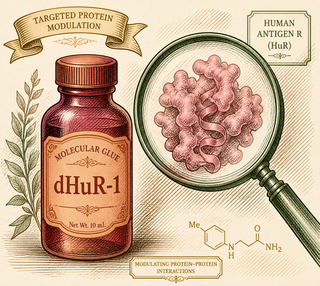
Lu and colleagues built and screened a large library of cereblon-binding compounds, looking for molecular glues. A molecular glue is a small molecule that forces two proteins into an awkward new relationship. In this case, the glue helps cereblon, part of a protein disposal system, recognize HuR and send it to the cellular trash compactor.
The team identified dHuR compounds, especially dHuR-1 and dHuR-2, that make cereblon recruit HuR as a “neosubstrate.” Cryo-electron microscopy then showed how the three-part complex fits together. This was not just “we added mystery sauce and the cells looked sad.” They actually mapped the handshake.
Once HuR got degraded, something unexpected happened: BRAF RNA splicing changed. Specifically, HuR loss promoted skipping of BRAF exon 18, which reduced oncogenic BRAF protein and lowered downstream ERK signaling. The tumor’s MAPK offense, usually a no-huddle attack, suddenly started missing assignments.
Why This Is More Than a Lab Trick
The researchers tested these degraders in BRAF-mutant colorectal cancer models, including cells made resistant to BRAF inhibitors. Those resistant cells still responded to HuR degradation. That matters because resistance is the recurring villain in this series, and frankly, it has had too much screen time.
The degraders also appeared to reduce EGFR and VEGFA-related biology, suggesting HuR degradation may hit more than one cancer-supporting system at once: BRAF signaling, EGFR feedback, and angiogenesis. That is not a single tackle. That is a defensive coordinator dialing up pressure from three angles.
Even better, the study found that combining HuR degradation with BRAF, EGFR, or MEK inhibition could produce stronger anti-tumor effects in models. If this holds up, HuR degraders may become combination players rather than solo heroes. Cancer therapy loves a good lineup.
The Reality Check Booth Review
Now for the replay review. These are preclinical results, not proof that patients will benefit. The resistant cell lines were created in the lab, which is useful but cleaner than the chaos of real human tumors. HuR also regulates many RNAs, and its effects can change depending on cellular stress and context. Biology, naturally, refuses to be normal for five minutes.
Still, the translational angle is already moving. DEG6498, a HuR-targeting molecular glue degrader, has entered a Phase 1 study in advanced solid tumors, with BRAF-mutant tumors included as an expansion cohort. That does not mean victory parade. It means the prospect has made the roster and now has to face actual major-league pitching: safety, dosing, biomarkers, resistance, and patient benefit.
The Final Score, For Now
This study is exciting because it changes the matchup. Instead of chasing BRAF only at the protein-activity level, it attacks the upstream RNA-processing support system that helps mutant BRAF stay dangerous. If reproducible and clinically expandable, HuR degradation could offer a new route for patients with BRAF-mutant colorectal cancer, especially those whose tumors have learned to dodge current BRAF-EGFR strategies.
Cancer cells are excellent at running trick plays. This paper suggests scientists may have found a way to remove one of the tumor’s play-callers from the sideline.
References
-
Lu X, Wang X, Yang Z, et al. Molecular glue degraders of HuR suppress BRAF-mutant colorectal cancer. Nature. 2026. https://doi.org/10.1038/s41586-026-10613-5
-
Kopetz S, Grothey A, Yaeger R, et al. Encorafenib plus cetuximab as a new standard of care for previously treated BRAF V600E-mutant metastatic colorectal cancer: updated survival results and subgroup analyses from the BEACON study. Journal of Clinical Oncology. 2021;39:273-284. https://doi.org/10.1200/JCO.20.02088 PMCID: PMC8078423
-
Kopetz S, Yoshino T, Van Cutsem E, et al. Encorafenib, cetuximab and chemotherapy in BRAF-mutant colorectal cancer: a randomized phase 3 trial. Nature Medicine. 2025;31:901-908. https://doi.org/10.1038/s41591-024-03443-3 PMCID: PMC11922750
-
Zhang J, et al. Molecular glue degrader for tumor treatment. Frontiers in Oncology. 2024. https://doi.org/10.3389/fonc.2024.1512666 PMCID: PMC11697593
-
Fletcher A, Clift D, de Vries E, et al. A TRIM21-based bioPROTAC highlights the therapeutic benefit of HuR degradation. Nature Communications. 2023;14:7093. https://doi.org/10.1038/s41467-023-42546-2 PMCID: PMC10625600
Disclaimer: The image accompanying this article is for illustrative purposes only and does not depict actual experimental results, data, or biological mechanisms.