"We were hoping they'd sample somewhere else," the prostate cancer cells confess, "because for a long time that was a pretty reasonable business plan." That, in one slightly impolite sentence, is the whole drama behind this paper. The article itself is a reply to a letter, not a brand-new trial, but the argument it joins is lively and very real: when an MRI shows a suspicious spot in the prostate, how much extra tissue should doctors sample around it - and how much can they stop doing?
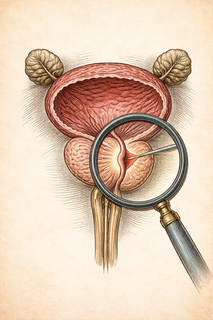
For years, prostate biopsy had a bit of the old treasure-map problem. You knew something might be buried in there, but the needle often had to poke around semi-blindly. Then multiparametric MRI showed up like the colleague who finally brought a flashlight to the basement. Now doctors can aim biopsies directly at suspicious lesions. Sensible. Elegant. Much less guesswork.
But cancer, being cancer, refuses to behave politely.
The Tumor Is Not a Dot
The central idea behind the debate is simple. An MRI lesion is not always the full footprint of the cancer. Think of it less like a pin on a map and more like a campfire at night - bright in the middle, but with sparks and heat spreading beyond the obvious glow. Researchers started calling that surrounding zone the "penumbra." In a 2022 European Urology study, most clinically significant prostate cancer cores found outside the visible lesion were still within about 10 mm of it, which gave real support to sampling the neighborhood, not just the front porch (Brisbane et al., 2022).
That brings us to the underlying paper discussed in this reply: Baboudjian and colleagues' MIRAGE study. Its message was that if you do targeted biopsies plus perilesional biopsies, then taking additional distant biopsies adds very little diagnostic value (Baboudjian et al., 2026). In other words, once you've sampled the suspicious spot and its immediate orbit, marching off to the far side of the gland with extra needles may be more ritual than revelation.
And yes, medicine has rituals too. They just come with billing codes.
Why the Reply Matters
The current paper is a response to a letter from respected prostate imaging and biopsy experts, including Hashim Ahmed. That alone tells you this is not some sleepy footnote. It is part of an active argument over what the next standard biopsy strategy should be.
The broader trend is clear. Recent reviews and guideline discussions have been moving away from the old "sample everywhere because who knows" mindset and toward a more risk-adapted, MRI-centered strategy. A 2025 systematic review in European Urology found that MRI-based biopsy pathways can improve the balance between detecting important cancers and avoiding unnecessary biopsies and overdiagnosis (Schoots et al., 2025). A 2025 commentary in Prostate Cancer and Prostatic Diseases argued that targeted plus perilesional biopsy is gaining serious traction, though standardization is still messy - because of course the prostate could not resist becoming a geometry problem (Windisch et al., 2025).
That last bit matters. Fewer biopsy cores sounds lovely, and it often is. Less overdiagnosis. Less detection of tiny low-risk cancers that may never cause harm. Potentially less morbidity. But nobody wants efficiency that comes with a side order of missed aggressive disease. The whole game is to cut down the unnecessary needles without letting the dangerous cells slip out the back door wearing sunglasses.
The Real-World Stakes
Why should anyone outside a urology conference coffee line care? Because biopsy strategy shapes what happens next.
If you oversample, you may find low-grade disease that leads to worry, repeat testing, and treatment that was never truly needed. If you undersample, you may miss disease that should change management. And if you sample smartly - targeted lesion, nearby penumbra, less random wandering - you may get closer to the sweet spot: better detection of meaningful cancer with less collateral nonsense.
That has implications for screening pathways, active surveillance, and treatment planning. It also fits with the larger MRI-first shift in prostate cancer care, which has been steadily reducing blind biopsy culture and replacing it with something more tailored and, frankly, less medieval (Fazekas et al., 2024; Windisch et al., 2025).
After half a century of cancer research, one learns to be suspicious of tidy revolutions. Interferon was once going to save the republic, and many of us were younger then. Still, this is the sort of incremental change that often sticks: not a miracle, not a moon landing, just a better map and fewer unnecessary stabs in the dark. Medicine advances more often by sharpening the question than by shouting the answer.
References
Uleri A, Diamand R, Ploussard G, Baboudjian M. Reply to A. Light, H. Ahmed H, T. Shah's Letter to the Editor re: M. Baboudjian, A. Uleri, J. Anract, et al. Targeted, Perilesional, and Distant Biopsies in Prostate Cancer. European Urology Oncology. 2026. DOI: 10.1016/j.euo.2026.04.004
Baboudjian M, Uleri A, Anract J, et al. Targeted, Perilesional, and Distant Biopsies in Prostate Cancer. European Urology Oncology. 2026. DOI: 10.1016/j.euo.2026.02.006
Brisbane WG, Priester AM, Ballon J, et al. Targeted Prostate Biopsy: Umbra, Penumbra, and Value of Perilesional Sampling. European Urology. 2022;82(3):303-310. DOI: 10.1016/j.eururo.2022.01.008
Schoots IG, Ahmed HU, Albers P, et al. Magnetic Resonance Imaging-based Biopsy Strategies in Prostate Cancer Screening: A Systematic Review. European Urology. 2025;88(3):247-260. DOI: 10.1016/j.eururo.2025.05.038
Windisch O, Valerio M, Yee CH, et al. Biopsy Strategies in the Era of mpMRI: A Comprehensive Review. Prostate Cancer and Prostatic Diseases. 2025;28:288-297. DOI: 10.1038/s41391-024-00884-2
Windisch O, Valerio M, de la Rosette J. Standardizing Targeted and Perilesional Biopsy: Considerations and Challenges. Prostate Cancer and Prostatic Diseases. 2025;28:526-527. DOI: 10.1038/s41391-025-00955-y
Fazekas T, Shim SR, Basile G, et al. Magnetic Resonance Imaging in Prostate Cancer Screening: A Systematic Review and Meta-Analysis. JAMA Oncology. 2024;10(6):745-754. DOI: 10.1001/jamaoncol.2024.0734
Disclaimer: The image accompanying this article is for illustrative purposes only and does not depict actual experimental results, data, or biological mechanisms.