Pancreatic cancer is one of those diseases that has spent decades humiliating tidy ideas. It hides deep in the body, builds a dense, unfriendly neighborhood around itself, and often becomes hypoxic, meaning low in oxygen. That is bad news for photodynamic therapy, or PDT, because PDT usually needs three things to cooperate: a photosensitizer, light, and oxygen. In solid tumors, that trio can behave like a jazz band in which the drummer never arrives.[2,3]
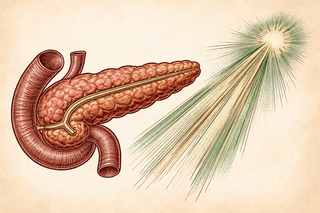
The new paper tackles that problem with asymmetric zinc phthalocyanines - compact light-activated molecules engineered to do two jobs. First, they generate a signal for optoacoustic imaging, which is the delightful trick of shining light into tissue and listening for the sound waves produced as molecules absorb that energy. Light in, sound out. Biology has become a gramophone.[4] Second, once illuminated, these molecules produce singlet oxygen and other reactive species that damage tumor cells, which is the business end of PDT.[1,5]
Why this molecule is not just another shiny chemical bauble
The authors did not simply toss a phthalocyanine at a tumor and hope for a miracle, which, to be fair, has been a recurring genre in oncology. They redesigned the scaffold.
They added glycerol groups to improve solubility, photostability, and cellular uptake. In plain English, the molecule behaves better in the bloodstream and gets into cells more effectively. They also included an iodine-containing heavy atom to boost singlet oxygen generation, making the PDT effect stronger. Just as important, these compounds were activated in the near-infrared range, where light penetrates tissue better than the shorter visible wavelengths that many older photosensitizers rely on.[1,5]
That matters in pancreatic cancer because the pancreas is not a skin lesion politely waiting by the window. It is tucked away, and the tumor microenvironment is notoriously hostile to treatment. In this study, the molecules circulated for a long time, accumulated at the tumor site without extra nanoparticle packaging, and showed activity in a hypoxic, gemcitabine-resistant mouse model. If you work in pancreatic cancer, that sentence alone is enough to make you sit up a little straighter.[1,3]
The part where diagnosis and therapy stop acting like distant cousins
This is what people mean by "theranostics" - a single platform that helps you see disease and treat it. The appeal is obvious. Instead of giving one agent to find the tumor and another to attack it, you try to combine the jobs. Fewer moving parts, better spatial precision, and the tempting possibility of real-time feedback: is the drug getting there, and is the tumor responding?[1,4]
That logic is showing up all over pancreatic cancer research. A 2023 Theranostics study used NIR-II fluorescent nanoparticles to guide endoscopic PDT in orthotopic pancreatic tumors and extended survival in mice, again leaning on deeper-penetrating light and image-guided treatment.[6] In late 2024, Nature Communications reported a data-driven imaging strategy for pancreatic cancer theranostics built around claudin-4, underlining the same broader theme: better targeting, better mapping, less guesswork.[7] Even on the clinical side, investigators described a phase 1 study of padeliporfin vascular-targeted photodynamic therapy for locally advanced unresectable pancreatic ductal adenocarcinoma in a 2024 ASCO abstract.[8]
I have lived long enough to remember when interferon was going to sort everything out. Oncology is full of splendidly dressed disappointments. So no, a preclinical mouse study is not a victory parade. But it is a respectable and interesting step.
What could this mean in the real world?
If findings like these hold up in larger preclinical studies and then in people, the payoff could be substantial.
A small-molecule agent that homes in on pancreatic tumors, reveals where it has accumulated, and then helps deliver a local photodynamic hit could improve treatment planning for locally advanced disease. It could help doctors identify which tumors are actually reachable and responsive. It might also pair well with chemotherapy or other local approaches, especially in tumors that resist standard drugs. Pancreatic cancer has a long history of teaching us humility, but it also rewards any method that chips away at the twin problems of poor drug delivery and poor local control.[2,3,8]
The broader field agrees on the obstacles. Reviews from the past few years keep coming back to the same villains: shallow light penetration, lousy tumor oxygenation, uneven delivery, and the pancreatic stroma acting like a bouncer who has confused the guest list.[2-5,9] This paper is intriguing because it addresses several of those at once, using a molecule that is smarter by design rather than merely more elaborate.
That, in science as in tailoring, is often the difference between decorative and useful.
References
-
Sharma A, Pradhan RK, Venkatraman AS, et al. Advanced Theranostics in a Pancreatic Cancer Model Integrating Dual Optoacoustic-Photodynamic Performance of Asymmetric Zinc Phthalocyanines. Small. 2026:e73557. DOI: 10.1002/smll.73557
-
Sarr S, Godard J, Valzer E, et al. Targeted photodynamic therapy for pancreatic cancer: recent innovations from fundamentals to in vivo and clinical applications (2020-2025). Chem Commun (Camb). 2026;62(12):3662-3701. DOI: 10.1039/d5cc05629b
-
Ho WJ, Jaffee EM, Zheng L. The tumour microenvironment in pancreatic cancer - clinical challenges and opportunities. Nat Rev Clin Oncol. 2020;17(9):527-540. DOI: 10.1038/s41571-020-0363-5
-
Zhao Z, Swartchick CB, Chan J. Targeted contrast agents and activatable probes for photoacoustic imaging of cancer. Chem Soc Rev. 2022;51:829-868. DOI: 10.1039/D0CS00771D
-
Wang X, Peng J, Meng C, Feng F. Recent advances for enhanced photodynamic therapy: from new mechanisms to innovative strategies. Chem Sci. 2024;15:12234-12257. DOI: 10.1039/D3SC07006A
-
Chen K, Yin B, Luo Q, et al. Endoscopically guided interventional photodynamic therapy for orthotopic pancreatic ductal adenocarcinoma based on NIR-II fluorescent nanoparticles. Theranostics. 2023;13(13):4469-4481. DOI: 10.7150/thno.84164 PMCID: PMC10465211
-
Wang J, Seo JW, Kare AJ, et al. Spatial transcriptomic analysis drives PET imaging of tight junction protein expression in pancreatic cancer theranostics. Nat Commun. 2024;15:10751. DOI: 10.1038/s41467-024-54761-6
-
Phase 1 study to evaluate safety and preliminary efficacy of padeliporfin vascular targeted photodynamic therapy in patients with locally advanced unresectable pancreatic ductal adenocarcinoma. J Clin Oncol. 2024 ASCO Annual Meeting abstract. DOI: 10.1200/JCO.2024.42.16_suppl.TPS4204
-
Hu JJ, Lei Q, Zhang XZ. Recent advances in photonanomedicines for enhanced cancer photodynamic therapy. Prog Mater Sci. 2020;114:100685. DOI: 10.1016/j.pmatsci.2020.100685
Disclaimer: The image accompanying this article is for illustrative purposes only and does not depict actual experimental results, data, or biological mechanisms.