Severance gave us a nice recent lesson in how much chaos can happen when communication gets weird inside a system. Cancer, naturally, looked at that premise and said, cute, but what if we also added molecular sabotage. That is more or less where circular RNAs - circRNAs, because oncology loves a nickname - enter the story.
This paper is a review, not a single experiment, but it covers a genuinely lively corner of cancer biology: tiny loops of RNA that do not behave like the straight-line scripts we learned about in Biology 101 and then promptly tried to forget. Instead of having loose ends, circRNAs are closed loops. No dangling bits. No easy entry point for the enzymes that normally chew RNA up. Basically, they are the smug Tupperware of the RNA world.
Wait - what even is a circular RNA?
Most people hear "RNA" and think of messenger RNA, the temporary copy of genetic instructions that cells use to build proteins. Fair enough. But cells make lots of other RNA molecules too, and some of them get stitched into circles through a process called back-splicing. That weird shape matters because it makes circRNAs unusually stable compared with standard linear RNA molecules [1].
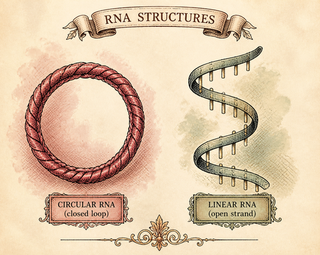
And stability is power. If a molecule hangs around longer, it has more time to meddle.
Researchers have learned that circRNAs can influence cancer cells directly by helping control proliferation, invasion, metastasis, resistance to treatment, and other behaviors oncologists would very much prefer tumors not to have [1,2]. They can act by binding microRNAs, interacting with proteins, regulating gene expression, and in some cases even getting translated into peptides. Because apparently cancer biology woke up one day and chose complexity.
Tumors are not lonely - they are terrible neighbors
The more interesting part of this review is not just what circRNAs do inside tumor cells, but what they do outside them.
Tumors live in a whole ecosystem called the tumor microenvironment - immune cells, fibroblasts, blood vessels, signaling molecules, assorted biochemical drama. If the immune system is the building's security team, the tumor microenvironment is the lobby where half the guards have been handed the wrong badge and one guy is definitely taking bribes.
CircRNAs can move between cells, often packaged in extracellular vesicles like exosomes, and help reshape that environment [1,3]. That means a tumor cell can potentially send out little looped messages that nudge nearby immune cells into becoming less effective. Not ideal. A circRNA might encourage macrophages to adopt more tumor-friendly behavior, affect T cell activity, or alter inflammatory signaling in ways that help the cancer keep the lights on [1,4].
This matters because immunotherapy, for all its genuine brilliance, still crashes into a brick wall in many patients: the immune system gets suppressed, excluded, exhausted, or otherwise outmaneuvered inside the tumor microenvironment [5]. If circRNAs are part of that sabotage network, they become interesting targets.
Why anyone in clinic should care
Two reasons. Maybe three, if you are feeling caffeinated.
First, biomarkers. Because circRNAs are stable and can be found in body fluids, they are appealing candidates for liquid biopsy tests - blood-based clues that might help detect cancer, estimate prognosis, or monitor treatment response [1,2]. In oncology, the dream is always the same: less invasive, more informative, fewer occasions where we say "we need another biopsy" and watch everyone's soul leave the room.
Second, therapy. The review discusses two broad possibilities. One is blocking harmful endogenous circRNAs that help tumors or suppress immunity. The other is engineering useful circRNAs as therapeutic tools - for example, to encode tumor antigens or immune-stimulating proteins [1]. That second idea is especially intriguing because the same structural stability that makes natural circRNAs persistent might make engineered versions useful drug platforms.
Third, and this is the subtle one, circRNAs may help explain why some patients respond to immunotherapy and others do not. If these RNA loops help tune the immune landscape of tumors, then they may become part of future combination strategies - not replacing checkpoint inhibitors, but helping them actually get through the door.
Before we all declare victory and go home
A little restraint. Very fashionable. Also necessary.
This paper is a review of a fast-moving field, and a lot of the evidence is still preclinical. Mechanisms are often context-dependent. A circRNA that looks villainous in one tumor type may behave differently in another. Detection methods are still being standardized. And if you want to turn circRNAs into reliable biomarkers or therapies, you have to solve some deeply unsexy but essential problems: reproducibility, delivery, off-target effects, manufacturing, and proving benefit in actual humans rather than in cells behaving suspiciously well in a dish [1,3,5].
There is also the classic omics-era problem: we can identify a mountain of interesting molecules, but turning "look at this cool signal" into "this changed patient care" is the part where science starts charging overtime.
The big takeaway
What makes circRNAs worth watching is not just that they are unusual. Biology is full of unusual things. It is that they sit at an annoying and important intersection: tumor behavior, immune control, and clinical detectability. That is a strong résumé.
So no, circRNAs are not magic. Oncology has had enough of magic. But they may be one more way tumors rig the game - and one more place we can potentially rig it back.
References
-
Jiang Z, Peng Y, Yang X. Circular RNAs in tumor biology and immunology: molecular mechanisms and therapeutic implications. Mol Cancer. 2026;25:41. doi:10.1186/s12943-026-02708-4
-
Chen LL. The expanding regulatory mechanisms and cellular functions of circular RNAs. Nat Rev Mol Cell Biol. 2020;21(8):475-490. doi:10.1038/s41580-020-0243-y
-
Zhang HD, Jiang LH, Sun DW, Li J, Tang JH. CircRNA: a novel type of biomarker for cancer. Breast Cancer. 2018;25(1):1-7. doi:10.1007/s12282-017-0793-9
-
Kristensen LS, Jakobsen T, Hager H, Kjems J. The emerging roles of circRNAs in cancer and oncology. Nat Rev Clin Oncol. 2022;19(3):188-206. doi:10.1038/s41571-021-00585-y
-
Binnewies M, Roberts EW, Kersten K, et al. Understanding the tumor immune microenvironment and strategies to improve immunotherapy. Nat Med. 2018;24(5):541-550. doi:10.1038/s41591-018-0014-x
Disclaimer: The image accompanying this article is for illustrative purposes only and does not depict actual experimental results, data, or biological mechanisms.