That is what makes this new paper in Cell Host & Microbe worth your time. Not because it promises a miracle. We have enough miracle headlines already. But because it asks a practical question with real teeth: if measles comes roaring back into a community - and yes, it still can - do we have human antibodies that can block it hard and fast?
Turns out, we might.
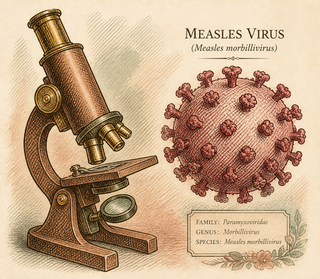
Measles: absurdly contagious, still not messing around
Measles is one of the most contagious viruses on the planet. Not "pretty contagious." More like "if this virus attended a party, everyone leaves with a plus-one they did not ask for." It spreads through the air, can cause pneumonia and encephalitis, and hits infants and under-vaccinated communities especially hard. Vaccination remains the main event, full stop. But outbreaks still happen, and some people are too young, too sick, or too immunocompromised to count on vaccine protection alone.
That is where antibody therapy starts looking less like a science fair fantasy and more like a useful backup plan.
The immune system's greatest hits album
In this study, Acciani and colleagues pulled memory B cells from a person who had received the MMR vaccine and used them to isolate fully human monoclonal antibodies against measles virus [1]. These antibodies targeted the virus's two key surface proteins:
- Hemagglutinin, or H - the part the virus uses to grab onto host cells
- Fusion protein, or F - the machinery that helps the virus merge with the cell membrane and break in
If H is the hand on the doorknob, F is the shoulder slam that gets the door open. Very civilized stuff.
The researchers mapped four major epitope clusters on H and five on F, meaning they identified several distinct spots where human antibodies like to latch on. Then they used cryo-EM - frozen molecular glamour photography - to see exactly how representative antibodies bind these targets.
And some of these antibodies were not merely decent. They were picomolar-potent, which in lab-speak means "ridiculously strong at tiny concentrations."
Why this is cooler than just "we found antibodies"
The important bit is not simply that the antibodies stuck to measles. Lots of antibodies stick to things. Human beings also stick motivational quotes on office walls, and that does not mean much.
The important bit is that antibodies against both H and F could broadly neutralize measles virus and lower viral loads in animals, whether given before exposure or after exposure [1]. That gives them two potential jobs:
- Prophylaxis - protecting someone after a known exposure
- Therapy - helping treat infection after it has already started
That matters because measles does not give you much time to admire the rash and make a plan. A post-exposure treatment that works quickly could be a big deal, especially in vulnerable patients.
The structural biology part, minus the headache
Cryo-EM let the team pinpoint where the best antibodies bind on H and F, and many of those binding sites were highly conserved [1]. Translation: the virus cannot easily change those regions without potentially messing up its own machinery.
That is exactly what you want in an antibody target. If you aim at a part of the virus that mutates every five minutes, congratulations, you have built a lock for a door that keeps changing shape. But conserved sites are more stable. Less flashy. More useful. The boring parts of biology are often the ones that pay rent.
This also opens the door to antibody cocktails that hit measles from multiple angles, reducing the chance of viral escape. Infectious diseases, much like clinic paperwork, get harder to defeat when you rely on only one strategy.
Why this matters outside the lab
If these findings hold up in further studies, fully human anti-measles monoclonal antibodies could become a meaningful tool for:
- Protecting infants after exposure
- Helping immunocompromised patients
- Containing outbreaks in under-vaccinated settings
- Providing a bridge when vaccination cannot act fast enough
To be very clear, this is not a replacement for vaccination. It is a seatbelt, not the brakes. Measles control still depends on high vaccine coverage, and no elegant antibody paper changes that basic public-health math.
Still, backup tools matter. Ask anyone who has ever watched a preventable outbreak unfold because herd immunity got treated like an optional group project.
The catch, because there is always a catch
This is early translational work. Promising, yes. Ready to hand out in every emergency department, no.
A few things still need sorting out:
- How well these antibodies perform in humans, not just animal models
- How long protection lasts
- Whether manufacturing and cost make broad use realistic
- Whether combining antibodies will be necessary to avoid escape
There is also the usual issue that biology enjoys humiliating our optimism. A molecule can look spectacular in a paper and then become expensive, awkward, or underwhelming in the real world. Science keeps us humble. Or tired. Usually both.
The bottom line
This paper gives a sharp, detailed look at how human antibodies can neutralize measles by targeting its H and F proteins, including several conserved sites that seem especially vulnerable [1]. It is a nice mix of immunology, structural biology, and actual practical relevance - always refreshing.
Measles is not ancient history. It is a virus that takes advantage of lapses, gaps, and wishful thinking. Studies like this help build the kind of layered defense we should have had all along: vaccines first, then smart biologic backup for the people who need it most.
Which, honestly, is a far better plan than acting surprised every time an airborne virus behaves like an airborne virus.
References
-
Acciani M, Zyla D, Niemeyer G, Harkins S, Parekh D, Pawlack E, et al. Human neutralizing antibodies targeting the measles virus hemagglutinin and fusion surface proteins. Cell Host Microbe. 2026; DOI: 10.1016/j.chom.2026.04.010. PubMed: 42102820
-
Moss WJ. Measles. Lancet. 2024;403(10436):1561-1574. DOI: 10.1016/S0140-6736(24)00374-7.
-
Mina MJ, Metcalf CJE, de Swart RL, Osterhaus ADME, Grenfell BT. Long-term measles-induced immunomodulation increases overall childhood infectious disease mortality. Science. 2015;348(6235):694-699. DOI: 10.1126/science.aaa3662. PMCID: PMC4823017
-
de Vries RD, Mesman AW, Geijtenbeek TBH, Duprex WP, de Swart RL. The pathogenesis of measles. Curr Opin Virol. 2024;64:101380. DOI: 10.1016/j.coviro.2023.101380.
-
World Health Organization. Measles outbreaks strategic response plan 2024. Available from: https://www.who.int
Disclaimer: The image accompanying this article is for illustrative purposes only and does not depict actual experimental results, data, or biological mechanisms.