If immune cells need training like gym regulars, prostate tumors have been the shady fitness center that keeps canceling the membership of the people supposed to do the spotting. This new paper asks a sneaky question: what if the problem is not that T cells are lazy, but that cancer has hidden the name tags they use to recognize trouble in the first place?
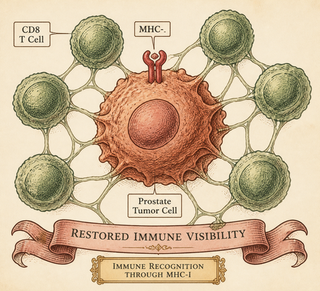
That name tag is MHC-I, a molecule cells use to display little protein fragments to the immune system. When MHC-I is present, killer T cells can say, "Ah, yes, this cell is up to nonsense." When it disappears, tumors can slip past immune surveillance like a guy leaving the party with your phone charger and a suspiciously innocent face.
A new study in Nature Biomedical Engineering reports a way to restore MHC-I in prostate cancer by reprogramming RNA - not by changing DNA permanently, but by editing how a message gets finished and read inside the cell.1 It is clever, a little wild, and worth paying attention to.
The problem: immune therapy works better when the tumor can actually be seen
Immune checkpoint therapy has transformed treatment for some cancers, but prostate cancer has mostly been the kid in the back of class refusing to participate. It is often considered an "immune-cold" tumor, meaning it tends to have fewer active T cells inside and around it.23
One big reason may be poor antigen presentation. In plain English, tumor cells stop showing enough evidence of who they are and what they are doing. Without MHC-I, even a well-armed T cell has trouble finding the right target. You cannot tackle the burglar if the security camera feed is just static.
Researchers have known that tumors often lose MHC-I, but selectively restoring it has been hard. Most approaches are blunt instruments. This paper goes after a more specific culprit.
A tiny tail with outsized consequences
The key player here is the 3' untranslated region, or 3'UTR, a stretch of mRNA that does not code for protein but helps control how that message behaves - how stable it is, where it goes, and how much protein gets made.4 Cancer cells often tinker with these regions through alternative polyadenylation, basically choosing a shorter or longer ending for the same RNA message.5
In this study, the authors found that prostate tumors can shorten the 3'UTR of a gene called SPSB1. That matters because SPSB1 helps tag MHC-I for destruction. So when the shortened SPSB1 message becomes more active, the tumor gets better at stripping away MHC-I. Same tumor, fewer name tags, more immune invisibility. It is both elegant and annoying - a classic cancer move.
The team built what they call the 3'UTR CRISPR/dCas13 Engineering System, or 3'UTRCES. Unlike the CRISPR you usually hear about, this system acts on RNA rather than cutting DNA. Delivered in lipid nanoparticles, it pushed the cell to use a longer SPSB1 3'UTR again, which reduced SPSB1's ability to drive MHC-I loss.1
Translation: they nudged the message, not the genome, and the tumor started becoming visible to immune cells again.
What happened in mice?
In syngeneic mouse models, restoring the longer SPSB1 3'UTR increased MHC-I on tumor cells, brought in more CD8 T cells, and improved antitumor immune activity.1 The treatment also made checkpoint therapy work better.
That is the part that should make oncologists lean forward slightly instead of scrolling past another "promising preclinical platform" headline. The value here is not just that the RNA engineering did something on its own. It appears to sensitize prostate tumors to immunotherapy by fixing a visibility problem upstream.
And importantly, the paper reports this effect without changing PD-L1, another common immune target. That suggests the mechanism is not just broad immune chaos. It is more targeted than that, which is exactly what you want when the body in question is, inconveniently, your body.
Why this matters beyond the lab bench
This work opens up two big ideas.
First, it suggests that alternative polyadenylation - a process that gets far less public attention than mutations - may be an underappreciated driver of immune escape in cancer.56 Tumors are not only changing genes. They are also changing how gene messages end, which is a sentence I realize sounds like a biology professor's horoscope, but here we are.
Second, it hints at a future where RNA engineering could make stubborn tumors more treatable without permanent genome editing. That is attractive scientifically and ethically. Reversible, programmable interventions may be easier to adapt, and perhaps safer to test, than permanent DNA changes - though "may" is doing a lot of responsible work in that sentence.
The reality check nobody should skip
This is still a preclinical study. Mice are useful, but they are not tiny men in sneakers. We do not yet know how well this strategy will work in people, how durable the effect will be, or whether tumors will simply find another escape route, because cancer treats obstacle courses like a hobby.
There is also the matter of access. Lipid nanoparticle delivery, custom RNA-targeting systems, and combination immunotherapy do not automatically translate into broadly available care. The distance between a Nature paper and a patient in a community clinic can be measured in years, cost, and who gets included in the first trials. Science can be dazzling. Health systems, less so.
Still, this study gives a smart answer to a frustrating problem. Instead of yelling louder at the immune system, it restores the tumor's missing ID badge and lets T cells do their job. Sometimes the breakthrough is not building a stronger security team. It is making sure the suspect cannot keep wiping their fingerprints off the scene.
References
Disclaimer: The image accompanying this article is for illustrative purposes only and does not depict actual experimental results, data, or biological mechanisms.
-
Huang F, Yuan F, Li K, et al. Programmable mRNA 3'UTR engineering restores MHC-I and overcomes immune evasion in prostate cancer. Nat Biomed Eng. 2026. doi:10.1038/s41551-026-01720-9 ↩↩↩
-
Hegde PS, Chen DS. Top 10 challenges in cancer immunotherapy. Immunity. 2020;52(1):17-35. doi:10.1016/j.immuni.2019.12.011 ↩
-
Fay EK, Graff JN. Immunotherapy in prostate cancer. Cancers (Basel). 2020;12(7):1752. doi:10.3390/cancers12071752 PMCID:PMC7408984 ↩
-
Mayr C. What are 3' UTRs doing? Cold Spring Harb Perspect Biol. 2019;11(10):a034728. doi:10.1101/cshperspect.a034728 PMCID:PMC6779124 ↩
-
Gruber AJ, Zavolan M. Alternative cleavage and polyadenylation in health and disease. Nat Rev Genet. 2019;20(10):599-614. doi:10.1038/s41576-019-0145-z ↩↩
-
Xia Z, Donehower LA, Cooper TA, et al. Dynamic analyses of alternative polyadenylation from RNA-seq reveal landscape of 3'UTR usage across human cancers. Nucleic Acids Res. 2014;42(22):13309-13320. doi:10.1093/nar/gku1166 PMCID:PMC4267669 ↩