The harvest from this study is surprisingly practical: the researchers found a possible new weak spot, PLOD2, then built an early proof-of-concept compound that degraded it and slowed pancreatic cancer growth in living models. Now let’s rewind through the garden path, because cancer biology never simply hands you a tomato - it gives you a thornbush, a maze, and three suspiciously confident weeds.
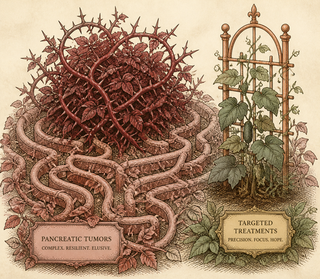
The Problem With Looking at the Whole Field
Pancreatic ductal adenocarcinoma, or PDAC, is the most common form of pancreatic cancer, and it has a reputation for being brutally hard to treat. Part of the trouble is that pancreatic tumors are not tidy little lumps of identical bad cells. They are tangled gardens: cancer cells, immune cells, fibroblasts, blood vessel cells, and structural material all growing together like someone gave the compost pile a strategic plan.
For years, scientists have used “bulk” transcriptomics to measure which genes are active in tumor tissue. That is useful, but it is also like blending the whole garden into soup and then asking whether the basil looked stressed. You get an average. You lose the individual plants.
Single-cell and single-nucleus RNA sequencing fix part of that by reading gene activity cell by cell. Instead of one muddy average, researchers can ask: what are the cancer cells saying, what are the immune cells muttering, what are the fibroblasts building, and who keeps ordering more collagen like the tumor is opening a rustic furniture store?
A Survival Map, Not Just a Cell Atlas
In this new Cancer Cell study, Tang and colleagues integrated single-nucleus RNA sequencing with long-term clinical follow-up from 152 patients with PDAC. They profiled about 1.2 million cells and built a map linking cell type-specific gene expression to overall survival Tang et al., 2026.
That matters because a gene may mean different things depending on where it is active. A sprinkler in the vegetable bed is helpful. A sprinkler in the attic is a homeowner’s insurance subplot. Likewise, gene expression in a tumor cell may carry a different message than the same gene in a fibroblast, immune cell, or endothelial cell.
The team also used a single-cell-resolved spatial transcriptomic platform to examine about 3.1 million cells and connect where cells sit in the tumor landscape with treatment response. This adds geography to the biology. In pancreatic cancer, location matters: immune cells parked far from cancer cells may be less useful than immune cells standing at the fence with pruning shears in hand.
Meet ctPANDA, the Garden Ledger
The researchers packaged these data into ctPANDA, an interactive platform meant to help scientists explore cell type-level prognostic signals. That is not a small thing. A lot of cancer datasets are like old seed catalogs in a damp shed: full of promise, hard to search, and faintly threatening. A usable platform can help researchers test whether a gene looks dangerous in one cell population, harmless in another, or suspiciously busy across the whole plot.
This fits a bigger movement in pancreatic cancer research. Recent reviews have argued that single-cell and spatial technologies are reshaping how scientists understand the pancreatic tumor microenvironment, especially the roles of immune cells, stromal cells, and treatment-resistant niches Bärthel et al., 2023; Fu et al., 2024. Other spatial and single-cell studies have also shown that pancreatic tumors contain distinct cellular neighborhoods associated with poor prognosis and therapy response Zhang et al., 2024.
PLOD2: A Weed With Deep Roots
One standout from the atlas was PLOD2. Higher PLOD2 expression predicted poorer outcomes across eight cell types. That is the sort of finding that makes researchers put down their coffee very carefully.
PLOD2 is involved in collagen modification, which matters because pancreatic tumors often grow inside a dense, fibrotic stroma. Think of it as a hedge maze built by cells that insist they are “just improving the property value.” Too much structural remodeling can help tumors stiffen their surroundings, evade therapy, and generally behave like invasive weeds with a zoning permit.
The exciting part is that the team did not stop at pointing to PLOD2 on the map. They developed a proof-of-concept degrader compound that reduced PLOD2 and inhibited PDAC progression in vivo Tang et al., 2026. That is early, preclinical work, not a treatment patients can receive now. But it turns a data signal into something testable, which is how translational medicine earns its muddy boots.
Why This Could Matter
If these findings hold up in larger cohorts and future experiments, this approach could help researchers identify targets that bulk sequencing misses. It may also help explain why two patients with “the same” pancreatic cancer can respond so differently to therapy. Their tumors may look similar from the road, but up close one garden is full of locked gates, another has immune cells stuck in the shrubbery, and a third is apparently running a collagen side business.
The real promise is precision oncology with better resolution. Not just “which genes are high in this tumor?” but “which genes are high in which cells, in which neighborhoods, and what does that mean for survival or treatment response?” That is a sharper question. Sharper questions usually make better tools.
Pancreatic cancer remains a hard field to cultivate. But this study gives researchers a more detailed map, a public platform, and a possible new target to prune. For a cancer that has spent decades hiding in the brambles, that is a meaningful start.
References
-
Tang R, Jin L, Chen C, et al. Mapping cell type-resolved transcriptomic profiles to patient survival in pancreatic cancer. Cancer Cell. 2026. DOI: 10.1016/j.ccell.2026.05.012
-
Bärthel S, Falcomatà C, Rad R, Theis FJ, Saur D. Single-cell profiling to explore pancreatic cancer heterogeneity, plasticity and response to therapy. Nature Cancer. 2023;4:454-467. DOI: 10.1038/s43018-023-00526-x
-
Fu Y, Tao J, Liu T, et al. Unbiasedly decoding the tumor microenvironment with single-cell multiomics analysis in pancreatic cancer. Molecular Cancer. 2024;23:140. DOI: 10.1186/s12943-024-02050-7
-
Zhang Z, Bai M, Barbosa GO, et al. Integrative analysis of spatial and single-cell transcriptome data from human pancreatic cancer reveals an intermediate cancer cell population associated with poor prognosis. Genome Medicine. 2024;16:20. DOI: 10.1186/s13073-024-01287-7
-
Zhang S, Yang S, Hou Y, et al. Single cell transcriptomic analyses implicate an immunosuppressive tumor microenvironment in pancreatic cancer liver metastasis. Nature Communications. 2023;14:5123. DOI: 10.1038/s41467-023-40727-7
Disclaimer: The image accompanying this article is for illustrative purposes only and does not depict actual experimental results, data, or biological mechanisms.