Pancreatic ductal adenocarcinoma, or PDAC, has spent decades acting like the worst kind of biotech founder: overconfident, under-regulated, and somehow still raising capital from your body’s blood supply.
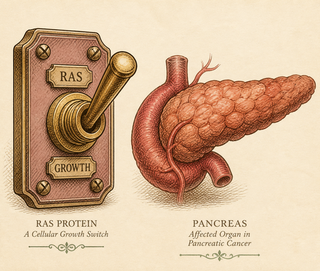
The new Nature Reviews Gastroenterology & Hepatology note by Katrina Ray highlights positive results for daraxonrasib in previously treated metastatic pancreatic cancer, and the reason people are paying attention is simple: this drug goes after RAS, the molecular switch that tells cells when to grow. In many pancreatic cancers, that switch gets stuck in the "on" position, like a smoke alarm with venture funding.
Daraxonrasib, also known as RMC-6236, is a RAS(ON) multiselective inhibitor. Translation: it targets active RAS proteins, including mutant KRAS, while they are in growth-signal mode. That matters because more than 90% of PDAC tumors carry activating RAS mutations, and KRAS has long been the protein everyone wanted to drug but could not. For years, KRAS had a reputation as "undruggable," which in cancer biology usually means "we tried everything except yelling at it in a conference room."
The Switch That Would Not Quit
RAS proteins behave like tiny cellular toggle switches. When bound to GTP, they say, "Grow." When they convert GTP to GDP, they shut down. Healthy cells use this system like sensible adults. Cancer cells, those overachieving little platform disruptors, mutate the system so the growth signal keeps firing.
That is especially brutal in pancreatic cancer. PDAC often hides until it has already spread, and once metastatic, it has historically left patients with limited options after first-line chemotherapy. Standard second-line chemotherapy can help some people, but the benefit is often modest and the side effects are not exactly a spa weekend.
So the idea of an oral targeted therapy that hits the central growth engine of most pancreatic cancers is a very big deal. Not magic. Not a cure. But potentially a new operating system in a disease that badly needs one.
The Data Have Entered the Chat
In a phase 1/2 study published in the New England Journal of Medicine, daraxonrasib showed antitumor activity in previously treated, RAS-mutated pancreatic cancer. Among patients receiving clinically relevant dosing, common treatment-related side effects included rash, diarrhea, nausea, mouth inflammation, vomiting, and fatigue. Grade 3 or higher treatment-related adverse events occurred in about one third of patients. So yes, the drug has baggage. Most startups do.
The bigger headline came from the phase 3 RASolute 302 trial, comparing daraxonrasib with standard chemotherapy in previously treated metastatic PDAC. Reported results showed median overall survival of 13.2 months with daraxonrasib versus about 6.6 to 6.7 months with chemotherapy, with improved progression-free survival as well. In pancreatic cancer, where timelines can be painfully short, doubling median survival is not a rounding error. It is the kind of signal that makes oncologists sit up straighter.
The trial also matters because daraxonrasib was tested against real-world chemotherapy choices, not a cardboard cutout labeled "control group." That makes the result more clinically meaningful, though we still need full peer-reviewed details, longer follow-up, real-world experience, and the usual unpleasant question: how long before resistance finds a workaround?
Because cancer always has a product roadmap. Resistance is technical debt with a nucleus.
Why This Could Change the Field
If these results hold up and daraxonrasib becomes widely available, it could give many patients with metastatic PDAC a targeted option after first-line therapy. That would be a shift from treating pancreatic cancer mainly by carpet-bombing fast-dividing cells to directly blocking one of its core growth circuits.
It may also validate a broader RAS strategy. KRAS mutations drive not only pancreatic cancer, but also subsets of lung and colorectal cancers. Earlier KRAS inhibitors were mostly mutation-specific, like KRAS G12C drugs. Daraxonrasib is different because it aims more broadly at active RAS signaling. That is less like building one custom charger for one weird phone and more like finally agreeing on USB-C.
Still, caution belongs in the room. Daraxonrasib is investigational and, as of this writing, not yet FDA approved, though the FDA has allowed expanded access for eligible patients and previously granted breakthrough and orphan designations. Patients should not delay standard treatment while waiting for a headline to become a prescription.
The Bottom Line
Daraxonrasib does not make pancreatic cancer easy. Nothing about PDAC is easy. But it suggests that one of cancer biology’s most stubborn growth switches can be targeted in a way that helps patients live longer than chemotherapy alone.
For a cancer that has spent years treating progress like an optional software update, that is a serious upgrade.
References
-
Ray K. Positive results for daraxonrasib for previously treated metastatic pancreatic cancer. Nature Reviews Gastroenterology & Hepatology. 2026. DOI: 10.1038/s41575-026-01222-8
-
Wolpin BM, Wainberg ZA, Hendifar AE, et al. Daraxonrasib, a RAS(ON) multi-selective inhibitor vs chemotherapy in previously treated metastatic pancreatic adenocarcinoma: primary and final analysis from RASolute 302. Journal of Clinical Oncology. 2026. DOI: 10.1200/JCO.2026.44.17_suppl.LBA4005
-
Wolpin BM, Park W, Garrido-Laguna I, et al. Daraxonrasib in previously treated advanced RAS-mutated pancreatic cancer. New England Journal of Medicine. 2026;394:1790-1802. DOI: 10.1056/NEJMoa2505783
-
Park W, Chawla A, O’Reilly EM. Pancreatic cancer: a review. JAMA. 2021;326:851-862. DOI: 10.1001/jama.2021.13027
-
Singhal A, Li BT, O’Reilly EM. Targeting KRAS in cancer. Nature Medicine. 2024;30:969-983. DOI: 10.1038/s41591-024-02903-0
Disclaimer: The image accompanying this article is for illustrative purposes only and does not depict actual experimental results, data, or biological mechanisms.