A circular RNA sets off like a traveler who has burned the map, tied the road into a loop, and somehow made itself harder for the cellular border patrol to deport. That, in a molecule-sized nutshell, is why scientists keep staring at these little RNA rings with the expression usually reserved for suspicious hotel buffets and unusually confident toddlers.
The new review by Jiang, Peng, and Yang in Molecular Cancer pulls together a fast-growing story: circular RNAs, or circRNAs, are not just odd scraps from the cell’s editing room floor. They may help tumors grow, dodge immune attack, reshape the tumor microenvironment, and perhaps even become tools for future cancer vaccines or liquid biopsies [1].
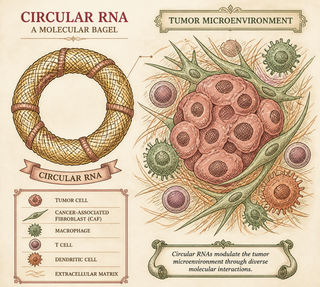
Which is a lot of responsibility for something shaped like a molecular bagel.
RNA, But Make It Existential
Most people learn the tidy version of biology: DNA stores instructions, RNA carries messages, proteins do the work. Very civilized. Very committee-approved.
CircRNAs mess with that neat little diagram. Instead of being linear strands with two ends, they form closed loops through a process called back-splicing. Because they have no loose ends, many enzymes that normally chew up RNA cannot easily grab them. They are stable, persistent, and frankly a little smug about it.
That stability matters. If a molecule hangs around longer, it has more time to influence the cell. Some circRNAs soak up microRNAs, which are tiny regulators that usually keep gene activity in check. Others bind proteins, affect transcription, or in some cases may even help produce proteins themselves. In cancer, where cooperation among cells has already collapsed into a tiny Hobbesian nightmare, this extra regulatory layer can become part of the problem.
A 2024 Nature Reviews Cancer article described circRNAs as deeply involved across cancer biology, from tumor initiation to metastasis and treatment resistance [2]. Translation: the circles were not decorative. They were in the group chat.
The Tumor Neighborhood Has Bad Zoning Laws
The tumor microenvironment, or TME, is the neighborhood around a tumor: immune cells, fibroblasts, blood vessels, signaling molecules, structural matrix, and other local characters who may or may not be helping. In a healthy setting, immune cells are the tiny bodyguards, roaming around and asking suspicious cells for ID. Near tumors, though, the neighborhood can become sketchy. The bodyguards get tired, bribed, locked outside, or handed confusing paperwork.
Jiang and colleagues focus on how circRNAs may help tumors influence this neighborhood. Some circRNAs appear to regulate immune checkpoints such as PD-1 and PD-L1, the molecular “do not attack me” badges tumors use to calm T cells down. Others may affect macrophages, natural killer cells, regulatory T cells, dendritic cells, and cancer-associated fibroblasts.
This is where the philosophy sneaks in wearing a lab coat. Cancer is not only a disease of bad cells multiplying. It is also a breakdown of civic order. Cells that should live within a cooperative tissue society start renegotiating the social contract, and circRNAs may be among the memos passed under the table.
A 2023 review in Cell Death & Disease summarized how cancer-derived circRNAs can reshape immune cells including T cells, natural killer cells, and macrophages [3]. A 2024 review in the same journal focused on circRNAs in immunotherapy resistance, especially through immune checkpoint pathways and cytokine signaling [4]. In other words, circRNAs may help explain why some tumors respond beautifully to immunotherapy while others react like they missed the meeting invite.
Liquid Biopsy: The Blood Test Dream With Homework
Because circRNAs are stable, researchers are interested in using them as biomarkers in blood and other body fluids. That is the liquid biopsy dream: instead of repeatedly cutting into tissue, clinicians might track cancer signals through a blood draw.
This sounds wonderfully civilized, like replacing a medieval siege with a text message. But the science still has homework. Researchers need to prove which circRNAs reliably indicate cancer type, stage, prognosis, or treatment response. They also need standardized detection methods, large patient cohorts, and careful validation across messy real-world biology, where no tumor has the decency to behave like the diagram.
Still, the appeal is obvious. If reproducible circRNA signatures can help detect cancer earlier or predict whether immunotherapy will work, clinicians could make sharper decisions with less guesswork.
Could We Turn the Circle Into a Weapon?
Here is the plot twist with actual therapeutic swagger: circRNAs might not only be targets. They might become tools.
Engineered circRNAs can be designed to encode tumor antigens or immune-modulating proteins. Since circRNAs are stable, they may keep producing an immune-stimulating signal longer than ordinary linear RNA. In a 2022 Theranostics study, researchers built circRNA lipid nanoparticle vaccines that produced durable antigen expression and triggered antitumor immune responses in mouse tumor models [5]. Mice are not humans, and oncology has a long history of “worked in mice” becoming “awkward silence in clinic,” but the concept is genuinely intriguing.
If future studies can solve delivery, safety, dosing, manufacturing, and tumor-specific targeting, circRNA-based therapies could join the broader RNA medicine toolbox. Not magic. Not a cure-all. More like a clever new courier with unusually durable shoes.
The Circle Closes, Naturally
Jiang, Peng, and Yang’s review does not claim that circRNAs explain everything in tumor immunology. Good. Biology punishes overconfidence with grant revisions.
What it does show is that these circular molecules sit at a crossroads between cancer cell behavior, immune escape, biomarker discovery, and future therapeutic engineering. They are small, stable, versatile, and annoyingly good at making us redraw our maps.
Nietzsche wrote of eternal recurrence. Cancer biologists, apparently, got circular RNA. One is a philosophical challenge. The other may someday help us catch tumors earlier, understand immune resistance better, and design treatments that make the tumor neighborhood less hospitable to cellular rebellion.
References
-
Jiang Z, Peng Y, Yang X. Circular RNAs in tumor biology and immunology: molecular mechanisms and therapeutic implications. Molecular Cancer. 2026. https://doi.org/10.1186/s12943-026-02708-4
-
Conn VM, Chinnaiyan AM, Conn SJ. Circular RNA in cancer. Nature Reviews Cancer. 2024;24(9):597-613. https://doi.org/10.1038/s41568-024-00721-7
-
Guan L, Hao Q, Shi F, et al. Regulation of the tumor immune microenvironment by cancer-derived circular RNAs. Cell Death & Disease. 2023;14:132. https://doi.org/10.1038/s41419-023-05647-w
-
Ma Y, Wang T, Zhang X, et al. The role of circular RNAs in regulating resistance to cancer immunotherapy: mechanisms and implications. Cell Death & Disease. 2024;15:312. PMCID: PMC11066075. https://doi.org/10.1038/s41419-024-06698-3
-
Li H, Peng K, Yang K, et al. Circular RNA cancer vaccines drive immunity in hard-to-treat malignancies. Theranostics. 2022;12(14):6422-6436. https://doi.org/10.7150/thno.77350
Disclaimer: The image accompanying this article is for illustrative purposes only and does not depict actual experimental results, data, or biological mechanisms.