When cancer builds itself a little clubhouse
Some cancer genes do not just switch on like a light. They gather a crowd.
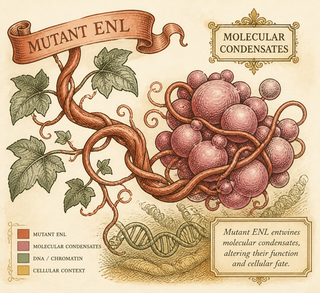
This paper looks at ENL, a chromatin-reading protein that helps control transcription - the process by which cells copy DNA instructions into RNA. In some cases of acute myeloid leukemia, mutant ENL behaves less like a tidy librarian and more like a vine that finds one weak fence post and then somehow claims the whole garden. It forms biomolecular condensates - little clustered hubs of molecules that are not wrapped in membranes but still manage to pull together the right ingredients in one spot.
And here is the twist that makes this study fun in a deeply nerdy way: the RNA being made at those genes is not just the product of transcription. It seems to help stabilize and reinforce the very condensates that drive more transcription. That is a feedback loop with strong "the weeds are composting themselves for extra power" energy.
Condensates: not blobs, but busy pop-up workstations
Condensates have become one of the liveliest corners of cell biology over the last few years. They are often described as droplets or clusters, but that can make them sound like passive goo. They are more like temporary workstations - busy patches where the right proteins and nucleic acids gather to get something done fast.
In cancer, that can turn ugly. If an oncogenic protein forms the wrong condensate in the wrong place, it can crank up gene expression programs that should have stayed quiet. Reviews over the past few years have highlighted how phase separation and transcriptional condensates may help explain certain forms of runaway gene control in tumors, including leukemia and solid cancers alike (Hnisz et al., 2023; Boija et al., 2024).
This study adds a particularly juicy detail: locally produced RNA helps mutant ENL nucleate and hold onto chromatin, especially at sites already permissive for condensate formation. In plain English, the gene starts making RNA, and that RNA helps the mutant machinery keep the gene revved up. Not ideal. Efficient, yes. Civilized, no.
The weird little handshake that matters
The authors found that mutant ENL binds RNA partly through a basic patch in its YEATS domain. If that phrase sounds like someone named a prog-rock album after a molecular surface, fair enough. What matters is this: ENL has a region that can physically interact with RNA, and that interaction boosts condensate formation.
They tested this several ways - in vitro, in cells, and in mouse models. They even used a clever system that let them displace condensates and watch whether they re-formed. When transcription was blocked, or when ENL-RNA interactions were disrupted, the condensates had trouble coming back at endogenous target genes. That is the sort of result that makes researchers sit up straighter and probably mutter, "Well, that is not nothing."
They also showed that RNA binding especially increased mutant ENL occupancy and transcriptional bursting at certain loci. Transcriptional bursting means genes often fire in pulses rather than in a smooth stream. Cancer, naturally, seems happy to exploit even that rhythm. Why settle for a faucet when you can rig the sprinkler system?
Why this matters outside the molecular hedgerow
Leukemia treatment has improved, but many aggressive forms still outmaneuver therapy. This study points to a new vulnerability: not just the oncogenic protein itself, but the interaction between that protein, chromatin, and newly made RNA.
That matters because cancer biology often rewards us for stopping thinking in straight lines. DNA makes RNA makes protein is the clean version you learn first. Real tumors behave more like an overgrown allotment in August - roots tangled under everything, one patch feeding the next, and something invasive thriving because the whole neighborhood got weird.
If these findings hold up and can be expanded, they suggest a future where drugs might interfere with condensate nucleation, RNA-protein binding, or the specific chromatin context that lets these feedback loops take hold. In acute myeloid leukemia, that could mean pruning an oncogenic circuit rather than merely shouting at it from across the yard.
A few thorns still attached
Before anyone starts engraving "cure" onto a watering can, a few realities matter.
First, condensates are everywhere in normal biology too. Cells use them for all sorts of healthy business, so targeting them without trampling normal functions is tricky. Second, the study focuses on a specific mutant ENL-driven system. We do not yet know how broadly this exact mechanism applies across other cancers or other condensate-forming oncogenes. Third, RNA-protein interactions are often slippery drug targets. Biology did not design them for our convenience, which was frankly rude.
Still, the conceptual advance is strong. The paper gives us a more detailed picture of how an oncogenic transcription program can become self-reinforcing - not just by recruiting proteins, but by using the RNA output itself as a kind of molecular trellis.
The take-home, minus the compost pile
This study says cancer can do something both elegant and annoying: it can use freshly made RNA to help mutant ENL build and rebuild condensates on chromatin, which then amplifies oncogenic transcription and promotes leukemia. That is a clever loop, and clever loops are exactly the sort of thing researchers love to break.
For the rest of us, it is a reminder that tumors are not just masses of fast-dividing cells. They are ecosystems with bad incentives, full of molecules helping one another make worse decisions. Science, fortunately, has started showing up with pruning shears.
References
Budinich KA, Yao X, Gong C, Song L, Wang X, Lee MC, Mathias KM, Li Q, Tang S, Liu Y, Nguyen SC, Joyce EF, Li Y, Li H, Wan L. RNA reinforces condensate nucleation on chromatin to amplify oncogenic transcription. Mol Cell. 2026. doi: 10.1016/j.molcel.2026.05.024
Hnisz D, Shrinivas K, Young RA, Chakraborty AK, Sharp PA. A phase separation model for transcriptional control. Nat Rev Mol Cell Biol. 2023. doi: 10.1038/s41580-023-00590-2
Boija A, Klein IA, Sabari BR. Biomolecular condensates in cancer biology and gene regulation. Nat Rev Cancer. 2024. doi: 10.1038/s41576-024-00715-1
Chong S, Dugast-Darzacq C, Liu Z, Dong P, Dailey GM, Cattoglio C, Heckert A, Banala S, Lavis L, Darzacq X, Tjian R. Imaging dynamic and selective low-complexity domain interactions that control gene transcription. Science. 2018. doi: 10.1126/science.aar2555
Sabari BR, Dall'Agnese A, Boija A, Klein IA, Coffey EL, Shrinivas K, Abraham BJ, Hannett NM, Zamudio AV, Manteiga JC, Li CH, Guo YE, Day DS, Schuijers J, Vasile E, Malik S, Hnisz D, Lee TI, Cisse II, Roeder RG, Sharp PA, Chakraborty AK, Young RA. Coactivator condensation at super-enhancers links phase separation and gene control. Science. 2018. doi: 10.1126/science.aar3958
Disclaimer: The image accompanying this article is for illustrative purposes only and does not depict actual experimental results, data, or biological mechanisms.