Breaking oncology bulletin: platelets, the tiny emergency sandbags of your bloodstream, may soon receive pharmaceutical backup during chemotherapy. The patients, meanwhile, would like to know whether this backup actually helps them live better, live longer, or simply win a prettier lab report.
That is the sharp little message behind a new commentary in Nature Reviews Clinical Oncology by Benitez-Fuentes, Teuwen, and Gyawali: the RECITE trial of romiplostim in chemotherapy-induced thrombocytopenia is encouraging, but oncology should not confuse “more platelets” with “better care” [1].
A mantra worth repeating, ideally before anyone orders confetti: treat patients, not platelets.
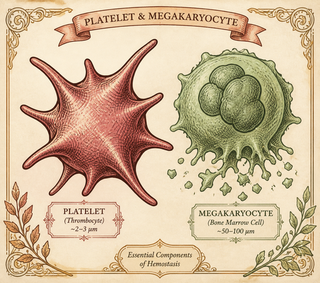
The Platelet Problem, Minus the Latin Fog
Chemotherapy is supposed to rough up cancer cells, those cellular rebels with terrible respect for zoning laws. The catch is that chemo also roughs up normal fast-growing tissues, including bone marrow, where platelet-producing megakaryocytes do their very niche factory work.
Platelets help your blood clot. When they drop too low, doctors call it thrombocytopenia. When chemotherapy causes it, we call it chemotherapy-induced thrombocytopenia, or CIT, because medicine loves turning four words into one small bureaucratic badge.
CIT matters because low platelets can mean bruising, bleeding, transfusions, treatment delays, or chemotherapy dose reductions. In evolutionary terms, that last bit is especially annoying. Cancer therapy is pressure on a tumor population. Reduce the pressure, and the surviving clones may get more room to adapt. Nature, as usual, is creative in the same way a locksmith at a bank heist is creative.
Enter Romiplostim, the Bone Marrow Pep Talk
Romiplostim is a thrombopoietin receptor agonist. Translation: it nudges the platelet-production pathway, encouraging megakaryocytes to make more platelets. Think of it as sending the bone marrow a strongly worded email with “urgent” in the subject line.
The RECITE trial tested romiplostim against placebo in patients with gastrointestinal cancers who had persistent CIT while receiving chemotherapy. The headline result was genuinely notable: 84% of patients receiving romiplostim avoided chemotherapy dose modifications, compared with 36% receiving placebo [2]. That is not a tiny difference. That is a “someone moved the furniture while I was out” difference.
Prior work had already hinted that thrombopoietin-pathway drugs could help. A 2021 multicenter study found romiplostim was associated with platelet responses in many solid tumor patients with CIT [3]. A 2022 phase 3 trial of avatrombopag, another thrombopoietin receptor agonist, explored a similar strategy in non-hematologic cancers [4]. Reviews of the field have also argued that CIT is common, disruptive, and awkwardly undertreated [5].
So yes, helping patients stay on schedule is a real achievement.
But here comes the evolutionary fine print.
Lab Wins Are Not the Same as Patient Wins
The Nature commentary asks the uncomfortable but necessary question: did RECITE show that patients lived longer, felt better, bled less in a meaningful way, or avoided serious harm? Not really. It showed fewer chemotherapy dose modifications due to thrombocytopenia [1,2].
That endpoint makes biological sense. It may even be a useful stepping stone. But a stepping stone is not the destination, unless you are a very confused frog.
Keeping chemotherapy dose intensity high can matter. A 2021 systematic review and meta-analysis linked higher relative dose intensity with better survival in some advanced solid tumor settings, including FOLFOX-, FOLFIRI-, FOLFIRINOX-, and carboplatin-based regimens [6]. Still, “more chemotherapy delivered” does not automatically equal “better outcome” for every patient, cancer type, regimen, and treatment goal.
Cancer treatment is not a video game where higher numbers always mean victory. Sometimes a dose reduction is a retreat. Sometimes it is wisdom wearing sensible shoes.
The Real Question: What Is Being Selected For?
This is where cancer starts looking less like a single enemy and more like a miniature Galapagos with worse lighting. Tumors evolve under pressure. Chemotherapy selects against sensitive cells and can leave resistant ones standing there like they just survived a corporate restructuring.
If romiplostim helps maintain effective chemotherapy intensity, it could improve tumor control in some settings. That would be a meaningful win. But if it mostly improves a blood count without improving survival, symptoms, bleeding risk, treatment experience, or quality of life, then we have polished the dashboard while the engine remains suspiciously smoky.
The authors of the commentary are not saying romiplostim is useless. They are saying the next question has to be patient-centered. Does this drug help people avoid dangerous bleeding? Does it help them receive cancer therapy that actually changes outcomes? Does it preserve quality of life, or does it simply make the CBC look more photogenic?
A Good Signal, Not the Final Sermon
RECITE gives oncology a promising signal: the platelet-production pathway can be manipulated during chemotherapy, and romiplostim can reduce CIT-related chemotherapy modifications. That is scientifically neat and clinically tempting.
But the mantra holds: treat patients, not platelets.
Platelets are useful little fragments. They deserve respect. They do not, however, get to be the main character. The main character is the person trying to get through cancer treatment with the best possible chance of living longer, feeling better, and not having their care dictated by a number on a lab sheet wearing a tiny crown.
References
-
Benitez-Fuentes JD, Teuwen LA, Gyawali B. RECITE this mantra in chemotherapy-induced thrombocytopenia: treat patients, not platelets. Nature Reviews Clinical Oncology. 2026. https://doi.org/10.1038/s41571-026-01170-x
-
Al-Samkari H, et al. Romiplostim versus placebo for chemotherapy-induced thrombocytopenia. New England Journal of Medicine. 2026;394:1061-1073. https://doi.org/10.1056/NEJMoa2511882
-
Al-Samkari H, Parnes AD, Goodarzi K, et al. A multicenter study of romiplostim for chemotherapy-induced thrombocytopenia in solid tumors and hematologic malignancies. Haematologica. 2021;106:1148-1157. https://doi.org/10.3324/haematol.2020.251900
-
Al-Samkari H, Kolb-Sielecki J, Safina SZ, et al. Avatrombopag for chemotherapy-induced thrombocytopenia in patients with non-haematological malignancies. The Lancet Haematology. 2022;9:e179-e189. https://doi.org/10.1016/S2352-3026(22)00001-1
-
Kuter DJ. Treatment of chemotherapy-induced thrombocytopenia in patients with non-hematologic malignancies. Haematologica. 2022;107:1243-1263. https://doi.org/10.3324/haematol.2021.279512
-
Nielson CM, Bylsma LC, Fryzek JP, Saad HA, Crawford J. Relative dose intensity of chemotherapy and survival in patients with advanced-stage solid tumour cancer: a systematic review and meta-analysis. The Oncologist. 2021;26:e1609-e1618. https://doi.org/10.1002/onco.13856
Disclaimer: The image accompanying this article is for illustrative purposes only and does not depict actual experimental results, data, or biological mechanisms.