The virus is already inside the brain tumor, unpacking its cargo like a field medic with very strange luggage.
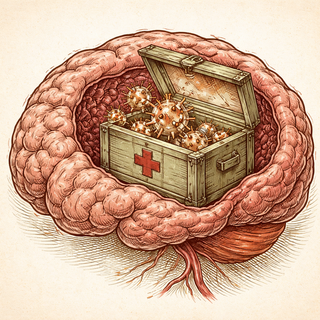
That is the scene behind a new Cancer Cell preview by Mo, Lu, and Zhang, discussing work from Koeber and colleagues in Nature: a therapy that tries to make glioblastoma cells flip their own kill switch. Not a metaphorical kill switch. A literal engineered DNA control panel that turns on only inside tumor-like cells, then orders the cell to make weapons against itself.
Cancer biology, never content to be normal, has given us a war zone where the enemy is made of your own cells, hiding behind your own biology, wearing your own molecular uniform. Glioblastoma is especially nasty. It grows fast, invades brain tissue, and has a long-running habit of returning after surgery, radiation, and chemotherapy like a villain who did not read the ending.
The Password Is Written in the Tumor
Cells do not use every gene all the time. They rely on DNA switches called enhancers to decide which genes get turned on. A super-enhancer is basically a crowded command center: lots of regulatory proteins gather there and shout, "Run this program!" Very official. Very tiny. Very much happening while you are trying to eat lunch.
Glioblastoma stem-like cells often rely on developmental transcription factors such as SOX2 and SOX9, proteins normally involved in brain development programs. Koeber and colleagues used that fact as the password. They stitched together enhancer fragments recognized by these tumor-associated programs and built synthetic super-enhancers, or SSEs, designed to work strongly in glioblastoma stem cells but stay quiet in normal brain cells.
That matters because gene therapy has a targeting problem. Viral vectors can deliver genes, but delivery is not the same as selectivity. If the virus is the delivery truck, the enhancer is the bouncer checking IDs at the door. Without a good bouncer, the payload can wander into the wrong neighborhood and start problems.
Two Payloads Walk Into a Tumor
The engineered system uses adeno-associated virus, or AAV, to carry two therapeutic instructions. The first is HSV-TK, a suicide-gene enzyme. Give the drug ganciclovir, and cells expressing HSV-TK convert it into a toxic DNA-disrupting compound. In plain English: the tumor cell gets tricked into helping load the gun pointed at itself. Dark? Yes. Cancer started it.
The second payload is IL-12, an immune-stimulating cytokine. IL-12 tells immune cells to wake up, stop staring at the fire alarm, and actually move. Glioblastoma tumors often create an immunosuppressive microenvironment, a sketchy neighborhood where T cells arrive, look around, and are quietly convinced to leave their weapons in the car. Local IL-12 aims to change that mood.
In the mouse models discussed by Mo and colleagues, the combination did more than shrink tumors. It produced durable immune memory. When researchers challenged successfully treated mice again with tumor cells, the immune system remembered the target. That is the dream: not just clearing visible disease, but teaching the body the enemy’s face before the next ambush.
Why This Is More Than a Fancy Switch
The clever part is not only the payload. HSV-TK and IL-12 have been explored before. The fresh move is putting them under tumor-specific control using synthetic regulatory logic.
That could address two old problems at once. First, suicide gene therapy can fail if it does not reach every cancer cell. Second, immune therapy in glioblastoma has struggled because the brain tumor microenvironment is very good at putting immune responses into airplane mode. Combining direct killing with immune training gives the system a chance to hit both the tumor mass and the leftover cells waiting to restart the campaign.
The caution flag is large and waving. These are preclinical results. Mouse glioblastoma is not human glioblastoma, and the history of cancer therapy is littered with treatments that looked heroic in mice and then entered human trials wearing clown shoes. Still, the authors also validated activity and selectivity in primary human glioblastoma tissue and normal cortex samples, which makes this more than a neat dish experiment.
If this approach holds up in people, it could point toward a broader strategy: design synthetic switches for disease cell states, then use them to control powerful therapies with more precision. Not "blast everything and apologize later." More like "enter the hostile building, identify the target, and call in the right unit."
For glioblastoma, that kind of precision is not decorative. It is the whole battle plan.
References
-
Mo W, Lu W, Zhang N. Engineered enhancers: Using tumor switches for precision therapy. Cancer Cell. 2026. doi:10.1016/j.ccell.2026.04.008
-
Koeber U, Matjusaitis M, Alfazema N, et al. Synthetic super-enhancers enable precision viral immunotherapy. Nature. 2026;653:232-241. doi:10.1038/s41586-026-10329-6
-
Zhuang HH, Qu Q, Teng XQ, et al. Superenhancers as master gene regulators and novel therapeutic targets in brain tumors. Experimental & Molecular Medicine. 2023;55:290-303. doi:10.1038/s12276-023-00934-0
-
Bacabac M, Xu W. Oncogenic super-enhancers in cancer: mechanisms and therapeutic targets. Cancer and Metastasis Reviews. 2023;42:471-480. doi:10.1007/s10555-023-10103-4
-
Agliardi G, Liuzzi AR, Hotblack A, et al. Intratumoral IL-12 delivery empowers CAR-T cell immunotherapy in a pre-clinical model of glioblastoma. Nature Communications. 2021;12:444. doi:10.1038/s41467-020-20599-x
Disclaimer: The image accompanying this article is for illustrative purposes only and does not depict actual experimental results, data, or biological mechanisms.